
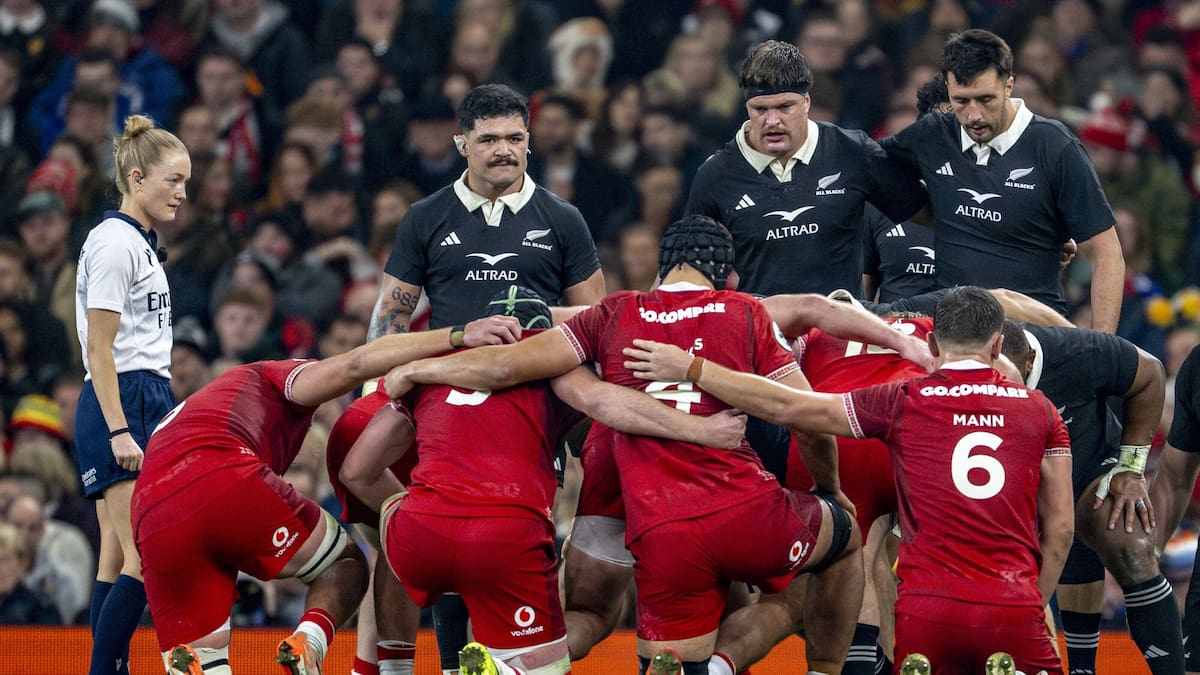
The low points of the 33-19 loss to England, and the nightmare in Wellington when South Africa won 43-10, won’t be erased by the win in Cardiff. But a real chance of redemption for the All Blacks will be offered next year.
The All Blacks’ 2026 programme, which includes a tour of South Africa and a rematch with England in London, will be brutally demanding. But it’s also – if the All Blacks can manage it – a perfect chance to prepare for the World Cup in 2027.
All Blacks coach Scott Robertson takes his side to South Africa next year. Photo / Photosport
Man of the match
The All Blacks forward coach, Jason Ryan, is unequivocal when you ask him about Wallace Sititi. The Chiefs man’s best position, Ryan will tell you without a moment of hesitation, is No 8 – and he predicted great things for Sititi on the northern tour.
Against Wales, Sititi had probably his best game of the year. Not all brilliant runners with the ball are that keen about getting involved in the dark and dirty work of winning the breakdown. Sititi is happy to do it all. It may still be early days in what is hopefully a long career, but Sititi – intelligent and able to express himself well – shapes as a future All Blacks captain.
Man of the season
World Rugby’s Breakthrough Player of the Year, Fabian Holland, was once again outstanding against Wales. His lineout work has reached the stage where the All Blacks threw almost exclusively to him in Cardiff. Not once did he fail to take the ball cleanly.
Looking to the future
Given a start, after what must have been starting to feel like an eternity in the wings, Ruben Love seized his opportunity. Once the game was in the bag for the All Blacks, it would have been fascinating to see Love have a shot, even if it was brief, at first five-eighths.
One of the intriguing questions in Super Rugby Pacific next year will be how often, and how well, Love manages to run the Hurricanes backline. He has a well-justified confidence in his own ability, a trait essential in international sport of every kind.
Cheers for the ref
One of the great bugbears for Kiwi rugby fans has often been the pin-pricking attitude taken by northern referees. So it was a real pleasure to see how Scottish woman Hollie Davidson ran the test in Cardiff. We all now know that if you want decisive officiating and a game that has fluidity, then if a Southern Hemisphere referee can’t be used, the answer is pretty simple. Give Johnson more big games.
Jonah was equally great off the field
The sadness of the 10th anniversary of Jonah Lomu’s death was a reminder of how lucky rugby was that the sport’s first global superstar was a good man off the field, too.
In the lobby of the All Blacks’ Johannesburg hotel, the luxurious Crowne Plaza, three days before the final of the 1995 World Cup, I saw a perfect example of his grace and class. Among the besuited businessmen was a group of excited girls from a nearby private school.
An All Blacks team meeting on the ground floor broke up. Players started to saunter out, and then a huge man, with an “11” shaved into his left eyebrow, emerged. One tiny girl, faster than her classmates, exploded across the foyer, launched herself into the air, and locked her legs around Lomu’s midriff. Like her friends, she was screaming.
Jonah Lomu on the charge against England. Photo / Mark Mitchell
Lomu hardly blinked, but, like a skilled hostage negotiator, quietly talked her down. With great dignity, he carefully prised her limbs away. A series of quick photographs followed and then, as much as is possible for a giant man among a throng of small girls, he gently slipped away to a lift.
Manu Samoa captain Peter Fatialofa, a teammate of Lomu for Counties, understood the man. “Jonah has never changed. People around him have acted differently, but he’s always stayed a good South Auckland boy.”
Phil Gifford is a Contributing Sports Writer for NZME. He is one of the most-respected voices in New Zealand sports journalism.