
Unlock the Editor’s Digest for free
Roula Khalaf, Editor of the FT, selects her favourite stories in this weekly newsletter.
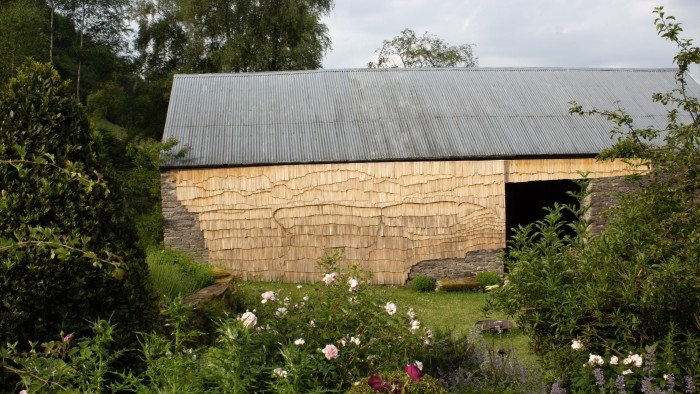
Artist Wycliffe Stutchbury’s installations of undulating oak shingles normally adorn the walls of a gallery, but for a 17th-century stone barn near the Black Mountains of Monmouthshire, Wales, they are less delicate artwork than a vast protective cloak. Oak panels wrap around its exterior, forming rippling fringes. They sensitively repair the structure, which had been crudely patched up with breeze blocks several decades before. “I’m a big believer that if something needs repairing or propping up, you should declare the changes you have made, not try to pretend they are part of the past,” he says.
It’s a chic outfit for something that stores lawnmowers and tools. But the owner saw it a canvas for the artist to experiment on an architectural scale. Stutchbury harvested the oak from fallen branches in the surrounding woodland, machining the timber on site before “stitching” the delicately hewn pieces into the masonry, working intuitively, without following a preset design.
“I see this kind of unplanned intervention as a way to connect a building to the landscape,” says Stutchbury, who has gone on to create a facade for a house in Quebec.
 Stutchbury’s work on the facade of a house in Quebec, Canada © Wycliffe Stutchbury
 ‘I see this kind of unplanned intervention as a way to connect a building to the landscape,’ he says
Visible mending has long been a trend in fashion. The ancient Japanese art of kintsugi — which repairs broken pottery with lacquer mixed with powdered gold, silver or platinum — has also experienced a surge in popularity. Cracks and imperfections in the built environment, however, often conjure a fear of poor workmanship or structural defects; remedial work is mostly intended to make something look as it was when it was new. But there’s a movement to change how we think about repair in architecture.
Its roots are also in street art. Since 2007, Franco-German Jan Vormann has been filling cracks in buildings around the world with Lego bricks — and encouraging others to do the same through his Dispatchwork website. Street artist Ememem — dubbed “The Pavement Surgeon” — transforms potholes in his home city of Lyon with mosaics. New York artist Rachel Sussman riffs on kintsugi by filling pavement and flooring fissures with tree sap resin, bronze and gold dust.
For Sussman, the act is a metaphor about care. “The idea that [kintsugi] renders something more beautiful for having been broken really struck a chord with me,” she says. “Bringing the specialness of gold into the mundane or overlooked can be a reminder to tend to our own cracks.” Museums and other public organisations have invited her to burnish their flaws.
 Jan Vormann’s Lego repairs on a building facade © Belish/Dreamstime.Colorful mosaic titled “Vocate Matrem Tuam” by Ememem embedded in cobblestones, with a person walking nearby casting a shadow.m
 ‘Vocate Matrem Tuam’, a mosaic by the French artist Ememem on the pavement of Paris © Giuseppe Anello /Dreamstime.com
In Japan, architecture firm Tank actively encouraged cracks when it was renovating an apartment in Kyoto, eschewing modern flooring plasters for a traditional recipe prone to fissures — something “usually deemed inferior work”, it says. It filled those cracks in the living room floor with gold coloured epoxy-resin to transform “what was considered imperfect into a subject of beauty”.
The idea that kintsugi renders something more beautiful for having been broken really struck a chord with me
Artist Rachel Sussman
When creative director and stylist Liz Gardner was renovating Maison Bodega — her 1920s Minneapolis home and creative studio designed by the architect Ernest Kennedy — she ignored advice to pull out the damaged original tiles in the main bathroom. Instead she commissioned artist Jonathan Janssen to work kintsugi magic on the walls. “We were committed to allowing time to be made visible,” she says. “Instead of hiding every crack or intersection of materials, we embraced them, even highlighted them, following the principle of the palimpsest.”
In 2018, Cornwall and St Austell councils began a £1.5mn National Lottery-funded initiative to regenerate historic shop fronts with contemporary ceramic installations, inspired by the region’s past as a centre for china clay production. Charlotte Moore designed two facades in 2023: “Edible Hinterlands”, created with Maria Saeki, clads a café and an apartment with hollowed glazed tiles planted with edible wild flowers, while “Cornubia Tropicus” fronts a gift shop and home, capturing the plants that have recolonised the post-industrial landscapes around the town.
 Creative director and stylist Liz Gardner commissioned artist Jonathan Janssen to work kintsugi magic on the walls of her home in Minneapolis © Dane Tashima
 ‘Edible Hinterlands’ by Charlotte Moore, a ceramic tiled facade in Cornwall, was inspired by the region’s heritage as a centre for china clay production
“Without these repairs, extensive demolition works would have had to be carried out,” says Moore. “They represent a slow, non-extractive method of repair and their longevity in part relies on the nature of the design and the material itself.” The tiles work equally well in residential projects.
But planning laws and building regulations can sometimes inhibit creative expression — particularly in conservation areas or when properties are heritage listed — as British interior designer Jonathan Reed and his artist husband Graeme Black found when reviving a derelict, Grade II-listed Regency house in the Yorkshire Dales. Almost all of its original features remained, which meant the conservation officer scrutinised every detail of their work.
“When you’re trapped in the conservation world working on an old house, it’s hard to create something of ‘now’, but all the great houses have had interventions at different times and that’s what makes them interesting — joyful even,” Reed says. He points to Lindisfarne Castle in Berwick-upon-Tweed, a 16th-century fort heavily modernised by Edwin Lutyens at the turn of the 20th century.
 Artist Ruth Wilkinson’s mosaic adder, made from broken pottery, slithers across the Yorkstone flag floor of Jonathan Reed’s Regency house in the Yorkshire Dales
Reed found small chinks in which to add a contemporary spirit, however. When he relaid the Yorkstone flag flooring over underfloor heating, crevices remained where the previous tenant had installed a heating pipe. These were “begging for some kind of intervention”, so he commissioned Yorkshire-based artist Ruth Wilkinson to fill them with mosaics made from broken pottery dug up during the renovation. A series of adders now slither across the floor. “The mosaics are a bit of a folly but they’re the thing that makes everybody stop and say, ‘Isn’t that fantastic?’ They’re so unexpected,” says Reed, pointing to one snake that is coiled up in a crack at the foot of the dining table.
Recommended

“As a culture, we seem to have decided that it’s better to return everything to how we imagine it was when it was first built,” says Reed. “But is it not better to create something new than to reproduce something that you believe might have been there in the first place, but you don’t really know exactly?”
Find out about our latest stories first — follow @ft_houseandhome on Instagram