
A Now is the time. The scheme starts on January 1, but next Monday, the Department of Social Protection is opening a portal where all companies have to register.
Q But not all employees are covered by auto-enrolment, right?
A True. Only employees aged between 23 and 60 who are earning at least €20,000 a year and are not contributing via payroll to a pension scheme will be automatically enrolled into My Future Fund, as the State-sponsored scheme is called.
The self-employed are not included, but about 750,000 people meet the criteria, because about two-thirds of private sector workers are not actively paying into a pension. People under 23 and over 60 can opt in to My Future Fund, as can those earning less than €20,000 a year and their employer has to facilitate that.

Some in-house pension schemes may be less favourable than My Future Fund. Photo: Getty
Q How much will workers be paying in and does their employer have to match it?
A Employees will pay 1.5pc of their gross income into a personal retirement savings fund and employers do have to match it. The State will add another 0.5pc.
That’s for the first three years. From Year 4 to Year 6, the employee’s contribution goes up to 3pc and their employer matches that, with the State adding 1pc.
There are further progressive increases until Year 10, when worker and employer will put in 6pc apiece and the State 2pc.
It’s mandatory for the first six months and then an employee can leave
Q So is this mandatory, or can employees opt out whenever they want?
A It’s mandatory for the first six months and then an employee can choose to leave, but only over the following two months. They will get their own contributions back, but there will be no refund for their employer or the State. Those contributions stay in the worker’s pension pot until they reach the age of 66.
Workers can also opt out six months after the contribution rate changes. At that stage they will only be refunded the difference between the new rate and the old rate.
Q Did I hear a new quango with an unpronounceable name is in charge of all this?
A That’ll be the National Automatic Enrolment Retirement Savings Authority, or Naersa , based in Letterkenny. It will collect all the contributions – from workers, companies and the State – and invest them.
The department is promising the admin burden on companies will be light, as Naersa will do the heavy lifting. So for example when a worker opts out, it will be Naersa that returns their personal contributions; the employer doesn’t need to get involved.
Q But surely companies will have to change their payroll to facilitate all this?
A The department says no, since My Future Fund is going to be fully integrated into payroll systems, with contributions deducted automatically. It’ll be similar to how Revenue send payroll notifications for tax collection.
“There is no need [for employers] to set up a scheme on their own account, to engage pension advisors, appoint trustees, enrol their employees or pay any employer administration fee,” the department said last month.
Q Happy days. As an employer, do I have to do anything at all then?
A You have to set up a profile on the My Future Fund portal. This opens on December 1 and you have until the end of the month.
The details you’ll be asked for include the company’s trading name, what sector it operates in, its number of employees and you register a contact name.
That really should only take a few minutes and then you set up a payment method, which will mostly be direct debit, but you could pay by visa card too.
Q Do employers have to work out what staff members are eligible?
A No, Naersa will do that, using payroll data from Revenue. If there’s no record of earnings, it will do a 13-week lookback.
If it finds €5,000 or more has been earned in that period, then it assumes the employee’s annual pay is over €20,000 and enrols them. An employee who only has a private pension, with contributions paid outside payroll, will be enrolled too.
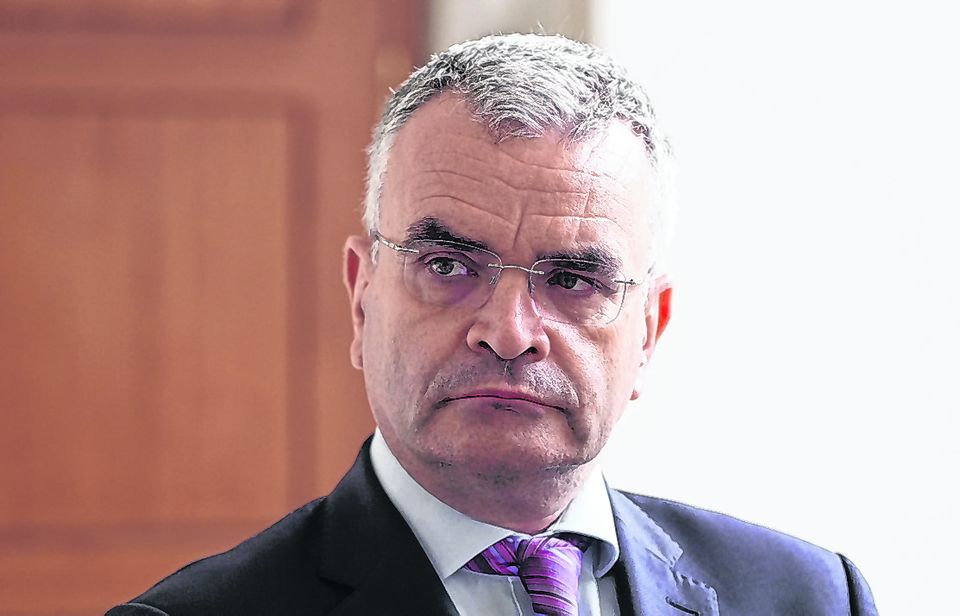
Social Protection Minister Dara Calleary. Photo: PA
Q Wasn’t there a row about this last week, with Social Protection Minister, Dara Calleary, saying some employers were forcing staff to join company pension schemes, to which they made tiny contributions, as a way around auto-enrolment?
A Were it to happen, it’s because of a clause in the new scheme that says for the first two years, if a worker is making any pension contribution above zero, they will be exempt from auto-enrolment.
Employer representatives, however, say they had seen no evidence of firms setting up schemes to bypass auto-enrolment. “This has not come up as an issue for us. We are not getting calls from members asking for more information on ‘how do I get around this’, ” Anna Marie Walshe, a HR adviser with ISME, said.
It’s definitely a concern, because this is yet another cost for a small business
Q But how much will it cost firms?
A For one that already has a pension scheme, nothing. For the rest, it depends on how many of your workers are eligible. You will need to budget for putting 1.5pc of their salaries into the scheme for the next three years and more after that.
“It’s definitely a concern, because this is yet another cost for a small business,” says Ms Walshe. “The minimum wage is also going up on January 1 [by 65c to €14.15 per hour].”
The Government has earmarked €154m for its contribution to My Future Fund in the first year. If that’s accurate, it means workers and employers will each chip in €462m.
Q But maybe thousands of workers will opt out after six months and that will reduce the cost for employers anyway?
A Workers can suspend contributions at any time, so our guess is very few will opt out entirely. If employees don’t pay in for a period, then of course their employer doesn’t either. But after two years, workers who have opted out will be re-enrolled if they are still eligible. Realistically, everyone will be staying on board here.
Q What pitfalls do employers have to watch out for?
A They are obliged to inform employees when they are enrolled and on what date. Crucially, they shouldn’t do anything to hinder staff from joining, or bully them into leaving it, because they could be prosecuted and fined. Naersa is going to publish a list of ‘bad employers’ who are convicted for not complying with the rules.
Q What sort of queries have companies been raising about auto-enrolment?
A common one is whether a company that already has an occupational scheme will now be forced to run two. The answer is ‘no’, as Naersa runs the auto-enrolment scheme.
Another is what happens in the case of a worker who is earning over €20,000 but from several different jobs, none of which have pensions.
Let’s say Company A pays €10,000 a year and Company B pays €13,000. The answer is both employers pay 1.5pc of the salary into My Future Fund, the employee also pays in 1.5pc of each salary and the State does a top-up based on the aggregate salary.
Finally, employers should note they are never getting their contributions back. It’s part of their employee’s pay and becomes their property.
Q From a worker’s point of view, what are the important aspects to be aware of?
A First, you stay enrolled even if your salary falls below €20,000. Like the Hotel California, you can check out of My Future Fund (at least for a while), but you can never leave.
You can’t pay Additional Voluntary Contributions (AVCs), nor can you be in both My Future Fund and an occupational pension. If you haven’t been in your employer’s pension scheme and you join down the line, you will no longer pay into My Future Fund, but the money you have already paid in stays invested.
If an employee is on unpaid leave, their gross pay is zero and therefore no contributions are deducted. And if a worker is on a short-term visa, they may still be included.
Q Pensions are boring. Is there any fun aspect to all this?
A Maybe. Employees can choose how to invest the money that goes into their My Future Fund account – a pot that remains with them until the end of their working life.
There’s a default investment strategy but there’s also a low-risk, a moderate-risk and a high-risk investment strategy to choose from.