
Enabling & Support
27/11/2025
6 views
0 likes
Extending the Internet beyond Earth has moved from science fiction to serious scientific endeavour, with the ESA at the forefront of developing technologies that could revolutionise space communications. A comprehensive study completed earlier this year laid the groundwork for ESA’s contribution to what could become humanity’s first solar-system wide network.
In May 2024, the Agency commissioned a specialised study through its Preparation element to define the concept of a Solar System Internet (SSI) – a strategic investigation into creating ‘an operations-ready Solar System Internet to serve as a backbone for future missions’. The work was undertaken by a German-led consortium comprising GMV (project management and systems engineering), Novaspace (strategic analysis and roadmapping), and D3TN (protocol evaluation and governance).
Felix Flentge from ESA’s Directorate of Operations, who has been leading ESA’s SSI efforts, explains the ambitious vision: “ESA is committed towards establishing the Solar System Internet (SSI), an advanced network for deep space radio frequency and optical communication, as well as Positioning, Navigation, and Timing (PNT) services.”
Technical Foundations
The Solar System Internet faces unique challenges. Terrestrial Internet protocols rely on bidirectional paths, low latency, minimal error rates, and steady network topologies. However, the Solar System Internet must be designed for dynamic topologies, high latency, increased error rates, and energy and bandwidth constraints.
To address these challenges, the consortium identified three key technology pillars:
Disruption Tolerant Networking (DTN) forms the backbone of the SSI concept. It enables reliable data transfer across disrupted and delay-prone environments using a store-and-forward mechanism. ESA has already demonstrated DTN capabilities through successful international collaborations, including the Lunar IceCube DTN demonstration involving ESA’s Kourou ground station, NASA JPL, and various partners.
Optical Communications are essential for high-data-rate communications in deep space missions. Recent demonstrations have shown remarkable potential – NASA’s Psyche mission successfully transmitted data at 25 Mbps from 226 million kilometres, while the earlier LADEE mission achieved 622 Mbps data communication from the Moon.
Positioning, Navigation and Timing (PNT) services for deep space will require highly autonomous space-based Orbit Determination and Time Synchronisation (ODTS) technologies and long-range optical and radiofrequency ranging capabilities.
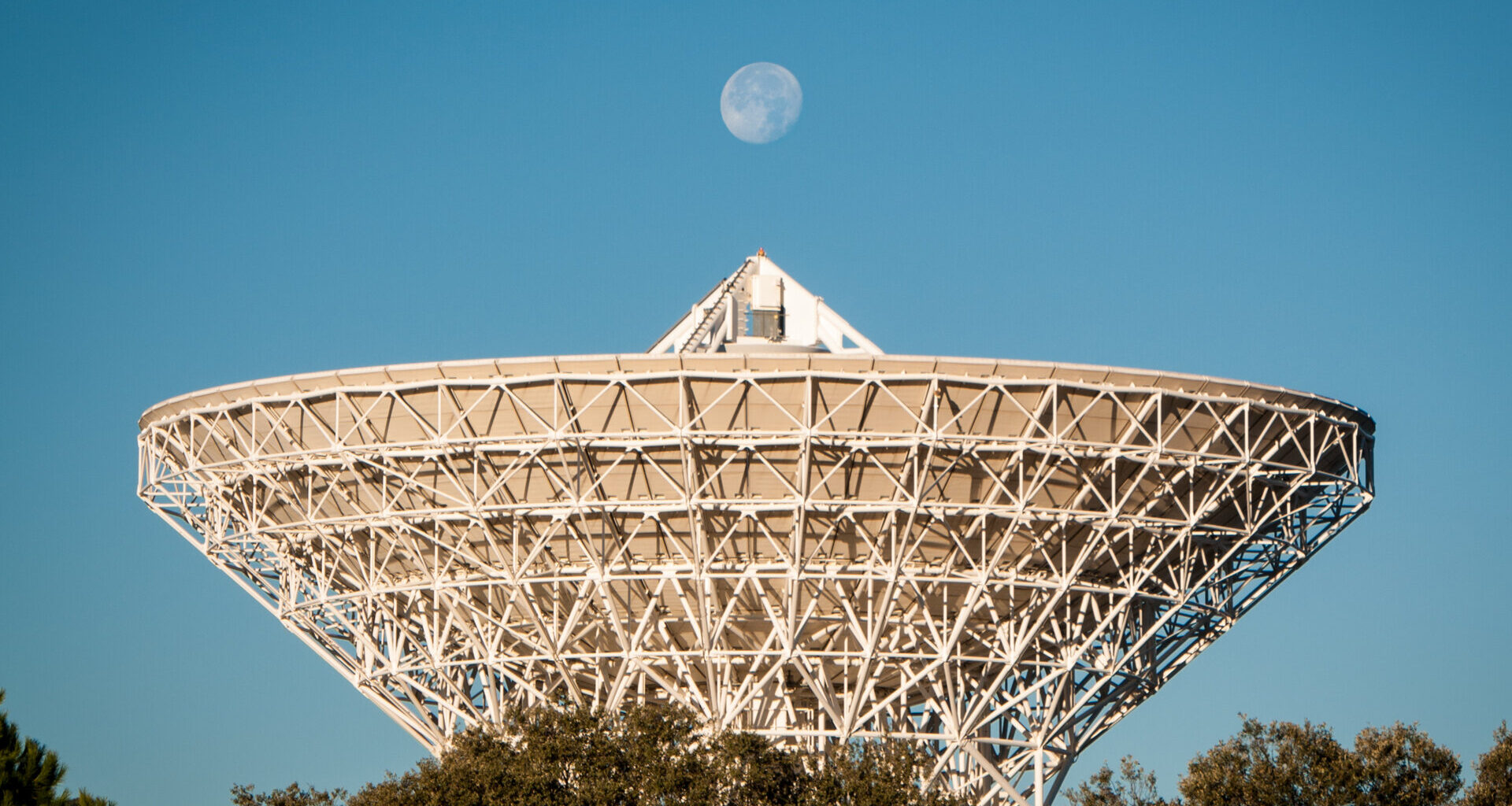
The SSI builds upon ESA’s existing capabilities. The ESTRACK Core Network with four 35-metre Deep Space Stations provides communication services across the entire Solar System. The Mars Relay Network, coordinated through the European Relay Coordination Centre (ERCO), is already the first operational interplanetary network.
The concept of the SSI will allow to connect infrastructures developed by different ESA programmes in a similar way the terrestrial Internet connects a huge number of autonomous networks today.
Moonlight will become Europe’s first off-planet telecommunications and navigation provider, offering lunar communications and navigation services through a constellation of five satellites in Elliptical Lunar Frozen Orbits.
HydRON is developing a high-throughput optical space network with terabit-per-second capacity, orders of magnitude greater than today’s systems.
MARCONI (the Mars Communication and Navigation Infrastructure) will provide a communication and PNT service for Mars, gradually built using the LightShip propulsion tug, with an intended six-node constellation by the 2040s.
The Path Forward: ASSIGN
ASSIGN (Advancing Solar System Internet and GrouNd)
ASSIGN (Advancing Solar System Internet and GrouNd) is a multi-directorate programme safeguarding Europe’s role and interests in the global vision of Solar System Internet.
The preparatory phase, planned for 2026-2028, will include Phase 0/A SSI System Architecture Studies covering user requirements, network architecture trade-offs, and operations concepts. Technology de-risking will address critical technologies in optical communication, DTN, and PNT. An SSI Enabler component will support industrial operational capabilities and establish an SSI Reference Facility.
A key component of ASSIGN will be further definition of the SSI Node-1 Pathfinder mission, already studied in ESA’s Concurrent Design Facility. This ambitious SmallSat mission aims to be the first to demonstrate reliable routine operations of a cis-lunar optical trunk link and the first ESA mission to use Disruption Tolerant Networking operationally.
As humanity expands its presence beyond Earth, reliable communication networks and autonomous navigation capabilities will be essential. ESA’s systematic approach to developing the Solar System Internet based on interoperable standards ensures that European capabilities will be integral to humanity’s interplanetary future with European companies playing a leading role.
Like