
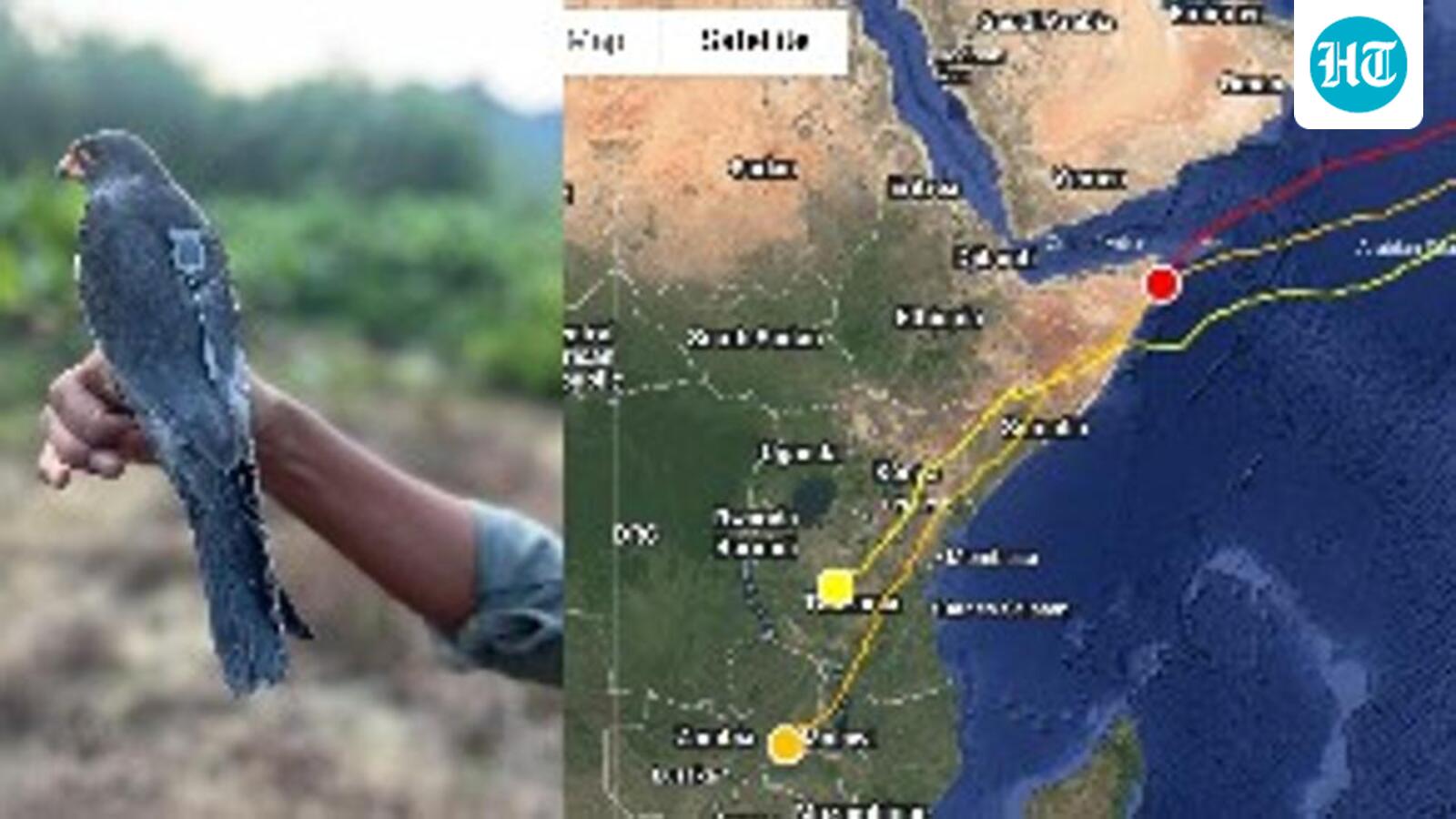
IMPHAL: Three radio-tagged Amur Falcons (Falco amurensis) have made a non-stop flight of 6,100 km from Manipur’s Tamenglong district to Africa, crossing the Arabian sea, in less than a week’s time, officials said.
 As per the latest satellite data of their migratory journey, Amur Falcon named Apapang has reached Zambia in Africa. (Sourced)
“The speed of radio-tagged Amur falcons this year could be increased because of the favourable oceanic winds,” said Kh Hitler, divisional forest officer (DFO) of the state’s Tamenglong forest division.
Dr Suresh Kumar of the Wildlife Institute of India (WII) Dehradun has been monitoring the bird’s migratory route.
Three satellite-tagged Amur Falcons,world’s longest flying migratory birds called ‘Apapang’, ‘Ahu’ and ‘Alang’ named after a roosting site and two rivers- Barak and Irang in Manipur’s Tamenglong district- started their migratory journey soon after being radio-tagged with satellite transmitters from Chiuluan village in Tamenglong district on November 11, 2025.
Apapang is an adult male falcon while Alu and Alang are females.
“Apapang is the fastest among these birds,” the forest official added.
This remarkable migratory journey showcases the endurance of these tiny migratory birds and is one of the longest nonstop flights recorded for raptors of this size.
Now Apapang has reached Zambia while Alang is in Tanzania, as per the latest satellite data of their migratory journey.
But Ahu is still at the horn of Africa. It is not making much movement. Let us pray for its safety, the official further added.
The radio-tagging programme of Amur Falcon was taken up for the first time in Tamenglong district in November 2018, in a move to conserve wildlife.
The Amur falcons, locally known as Akhuaipuina (Taomuanpui), protected under the Wildlife Protection Act 1972 and included under Schedule I, spend their summers at their breeding grounds in southeast Russia and northeast China.
They migrate to their wintering grounds in South Africa, from where they start their return journey in April-May through Afghanistan and East Asia, undertaking a yearly journey of about 20,000 km.
In their journey, this pigeon-sized world’s longest travelling raptors, arrive in large numbers during October in Nagaland and Manipur besides a few places in northeast India. They leave the region in November after having enough food for their non-stop flight to Africa, where they spend their winters.