
Hope everyone enjoyed the sun this week. Here’s some stories on urbanism that caught our eye!
This Week in Greater Auckland
This roundup, like all our work, is brought to you by the Greater Auckland crew and made possible by generous donations from our readers and fans. If you’d like to support our work, you can join our circle of supporters here, or support us on Substack.
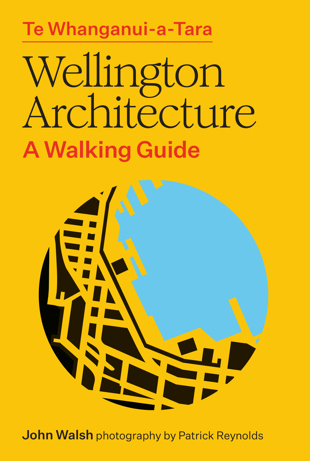
Book review of Te Whanganui-a-Tara Wellington Architecture: A Walking Guide
The new Wellington architecture walking guide book by John Walsh, with photos by our very own Patrick Reynolds, has a sweet review on NZ Book Lovers.
This guide is a must-have for anyone interested in walking the streets of Wellington and better understanding the architecture and history of 126 of Wellington’s most iconic buildings. The walks stretch from Oriental Bay to Thorndon.
This is a colourful, compact guide, and a very handy size to have with you when you walk the streets. There are maps, and each featured building includes a one-page colour photo and a one-page text summary, which gives you all you need to know about its history and significance. The book is divided into five routes: Harbourside, Te Aro Flat, Central spine, CBD and West Side.
The Spinoff takes a look at why it’s so hard to build stuff in NZ
Hayden Donnell examined a lot of the reasons why, in recent history, big projects keep not happening in Aotearoa, including a few comments from our own Matt Lowrie:
Brown and AT’s chief executive Dean Kimpton have had their disagreements, mainly over the aforementioned cones, but on this, they’re perfectly aligned. Kimpton says we’ve fallen into a habit of “ubering projects up and up and up” to include everything, when we’d be better starting small and expanding from there. He thinks light rail “fell over under its own weight” and believes we might not be stuck with nothing if the government had got on with laying some surface-level track on Queen St back when AT suggested it in 2015. “I think a lot of infrastructure investment is about momentum, not just about designing the ultimate solution,” he says. “So if there was one lesson learned, it’s ‘don’t think you have to have the ultimate solution’. You can have direction, but build it out and use momentum to help you get there, and it will deliver every time.”
In other words, wanting to “future-proof” projects may be understandable, but it’s often counterproductive. Greater Auckland’s Matt Lowrie says we end up spending billions of dollars today to “stop someone standing on a platform in 2070” when we could be getting lower cost projects underway and leaving the business of expanding them for later. He points out the projects that have been built in recent decades, including Auckland’s rail and motorway networks, have been constructed in stages. “But all the stuff that we’re seeing now is building 30 kilometres of State Highway in one go or a whole rail line in one go,” he says. “We’ve got to plan it for 100 years, and so now it’s got to include stuff that we might not need for 99 of those years.”
One mega project that failed to come to fruition
Also from The Spinoff this week: why are New Zealand drivers so aggro?
Have you ever experienced road rage? Or been stressed yourself when getting around? Well, it might be the case that New Zealand is worse than other places. Hayden Donnell takes a look:
Why are New Zealand drivers so aggro? Auckland University senior research fellow Kirsty Wild lists potential causes. Driving is just stressful, filled with dangers you can’t control. It’s easy to dehumanise other road users when you’re cut off from them by a windscreen and a few tonnes of metal. Our increasingly oversized cars may encourage risky driving and bullying behaviour, and when people do hurt someone on the roads, they tend to get away with it. Only 19% of serious crashes involving a bike are even investigated by police.
None of those factors are unique to this country. But there’s reason to believe things might be worse here. We have the highest rate of car ownership in the world, with our 869 vehicles per 1,000 people eclipsing even the US. That’s no accident. People drive because we’ve essentially made it the only way of getting around in a lot of places. The resulting congestion makes for a stressful road environment, and that can amp up the anger when someone slows a driver down.
All that is exacerbated by transport design. Wild says motorists could be forgiven for thinking they’re kings of the road, because that’s the way a lot of roads are laid out. Protected bike paths are still sparse and lanes are designed to get cars from A to B as quickly as possible. All that leads to more “baked in” conflicts between cars and people travelling on foot or by bike. “Poor design encourages aggressive driving,” says Wild. “I know that there is a culture war element, on some level, around hatred of cyclists. But honestly, the research suggests that it’s primarily environmental. It’s quite stressful for drivers to interact with cyclists on poorly designed roads.”
Who’s Stealing Bus Stop Seats?
If you think your usual bus stop is a little different recently, this might be why.
Benches in bus stops in Auckland have started disappearing, with Auckland Transport saying they believe they’re being stolen.
Around 65 benches have been taken from bus stops in Auckland according to AT. There are around 3000 stops in total across the city.
“It’s possible these benches are being sold as scrap metal. We are in the process of sourcing benches constructed from different materials making them difficult to graffiti and a less desirable scrap product,” Rebecca Temple, public transport real time and response manager told Stuff.
“We do use anti-theft bolting on seats but unfortunately these bolts have not been enough to stop the theft,” Temple said.
Photo from Puketāpapa Local Board Member Jon Turner
They paved over paradise the outer oval and put up a parking lot
Eden Park is hoping to make space for thousands of car parks on its outer oval as part of its plan to convert the stadium into a multi-purpose destination.
The park’s chief executive, Nick Sautner, told Herald NOW this morning that without more major events in its pipeline, the venue won’t be viable.
…..
Now, as they advance plans for their staged “Eden Park 2.1″ redevelopment, assets such as dedicated parking could help boost profit and would guarantee space for patrons with mobility and accessibility needs.
“I think when we do our redevelopment, the outer oval should have a two-level carpark, park and ride,“ Sautner said.
“When you look at the upzoning of the area, there’s a shortage of car parking. The number one complaint we get from residents is around traffic management and car parking.
“So there’s infrastructure needed to enhance our operations.”
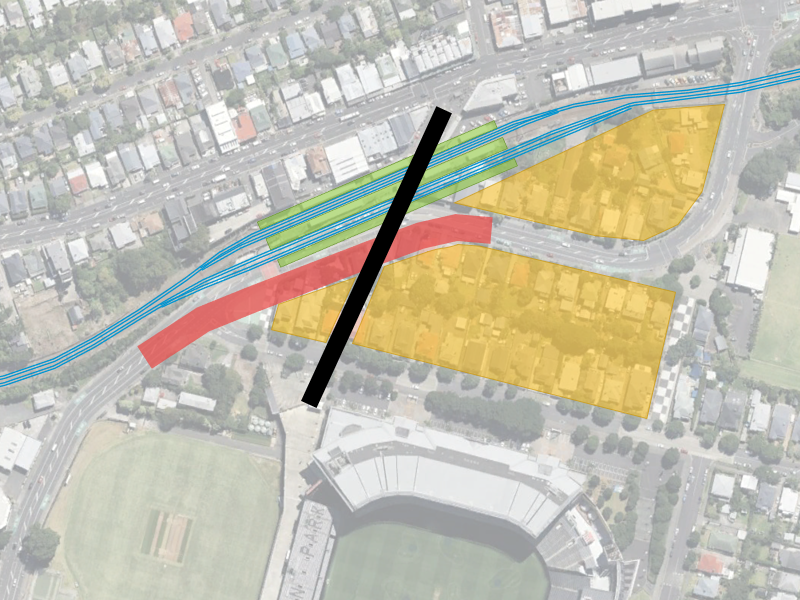
Sautner said with those plans, they could “easily get 1500 car parks on the outer oval”, which would then allow a footbridge to extend over Sandringham Rd into Kingsland.
Funny how talk of paving over the oval was never part of conversation before the stadium decision was made. And why does it require a carpark to build a pedestrian bridge?
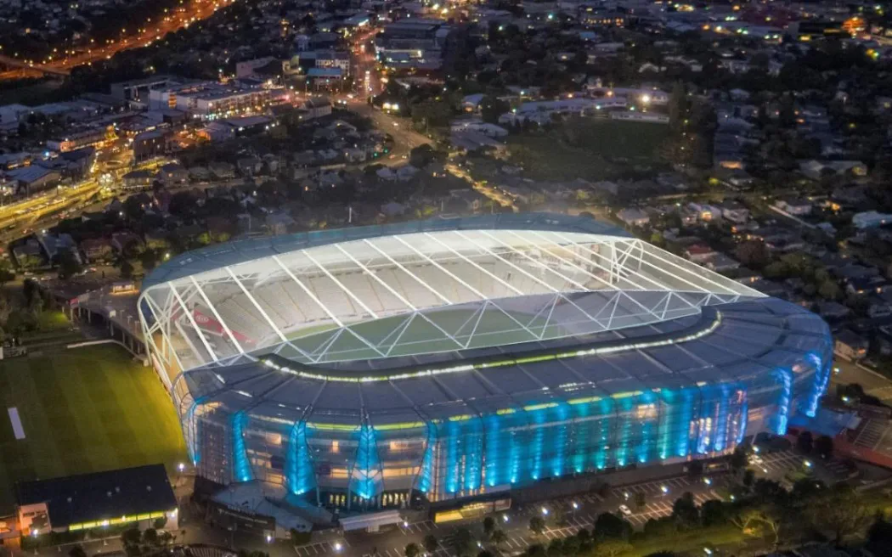 As we’ve suggested before, we think that Kingsland needs to be developed into a proper event station with additional platforms, as well as potentially an upgrade of Morningside to support it too.
Port Thoughts
The Ports of Auckland CEO Roger Gray has made a few comments, and there’s a lot that is simply wrong with them.
“I’m very critical of New Zealanders being so sour on the economy,” Gray told the audience, saying there was plenty of business to be done – if only the public would stop protesting it.
For example, last month was the best in terms of container volumes that the port had seen in nine years, Gray said. What’s driving growth? “It’s coal,” he claimed, telling the crowd: “All of you driving electric cars, you’re driving on coal, so keep doing so.”
So just say yes to everything, even if it is harmful to our environment? And no, people aren’t driving on coal.

Gray has some thoughts on the City Rail Link too.
Its value to the city in economic output would be much more apparent than the City Rail Link, claimed Gray, which he declared was “going to be a disaster”.
“It [CRL] is not going to be the game-changer, but when you’ve sunk as much money as politicians and council have, they have to say it’s amazing,” he said.
Such a disaster it’s already resulted in billions of private sector investment along its route, with much more to come in the likes of Downtown West
Albert Street Reopens to Buses
Speaking of CRL: as we highlighted earlier this week, tomorrow Albert St will reopen to buses.
Frequent buses are set to roll back onto one of Auckland city centre’s key transport routes, just in time for the busy Christmas shopping season.
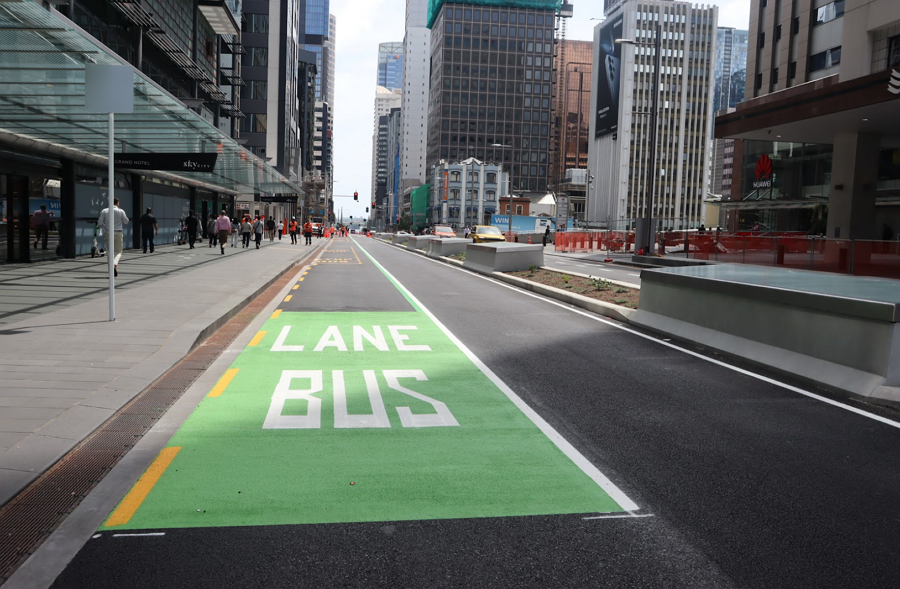
With City Rail Link (CRL) construction and streetscape upgrades nearing completion, Albert Street will reopen as a new purpose-built traffic corridor from Saturday 29 November, restoring two-way access between Customs St West and Mayoral Drive.
Having just completed road line marking including fresh green paint for dedicated bus lanes, a group of CRL workers were the first “passengers” on a trial drive along Albert St this morning.
The return of buses to Albert Street means a more direct route in and out of the city centre. Mainly western and northwestern services will switch, including the Western Express (WX1). The change means fewer buses on Queen St which will make it a more friendly place to shop and socialise and help with plans to improve air quality in the area.

How long till those mid-street skylights get damaged by an errant vehicle? And wouldn’t it have been nicer to have some trees along this hard-edged streetscape? (Not to mention bike lanes).
Passenger trains in Christchurch?
Could some of Auckland’s old trains help revive rail services in another city? As reported in The Press:
The case for privately-run passenger rail in Greater Christchurch for major events appears to be stacking up, with private investors, the city council and KiwiRail keenly involved.
What is understood to be across the board support for Mainland Rail’s ‘Events Express’ train may finally be made public in an early December presentation to the Christchurch City Council.
The company’s case for a private rail service from Rangiora, Rolleston and potentially Ashburton was first revealed by The Press in August. Director Paul Jackson wants the service to begin in time for the opening of One New Zealand Stadium at Te Kaha in April, but the “key ingredient” was a central city platform.
The company has bought eight old Auckland DMUs, among other rolling stock
Mt Messenger Blowout Just Keeps Growing
Another blowout for the Mt Messenger bypass project:
The budget for a major Taranaki road has climbed up in costs from $365 million to nearly $600m.
The Mt Messenger Bypass will be a new six-kilometre route that avoids the existing steep, narrow and winding road over Mt Messenger on State Highway 3 in north Taranaki.
It had been subject to multiple legal challenges, which in combination with associated delays on construction NZTA estimated would cost $350m.
The transport agency’s board confirmed up to $590m to complete the southern and central sections of the project.
In March it was reported the road had a budget of $365.1m.
The $365 million reported in March was already an increase on the original $280 million, and it sounds like the total (note: for the southern and central sections alone) will be even more than $600 million, especially once the northern section is resolved. Will this become a $1 billion project?
Road-Marking Robots
A neat story about using robots to set out road markings.
One little machine stole the spotlight during recent road works on State Highway 1 over the Brynderwyn Hills.
Among the big rollers and paving machines Fulton Hogan staff used to resurface SH1, they also deployed a nifty little gadget called the Tiny Surveyor.
The GPS-guided robot pre-marks lines for line marking and is operated remotely by tablet. The surveyor drives itself along the route, spray-painting markings as it goes.
A New Zealand Land Transport Agency (NZTA) Waka Kotahi spokesperson said Tiny Surveyor saves time as it is about five times faster than laying out lines in the traditional way.
The gadget also keeps staff safer on work sites as it negates the need to go near heavy machinery.

Tyres are the biggest single source of microplastics in our ocean
Marine researchers from the University of Auckland have found that significant amounts of microplastics are coming from cars. Half the rubber shed on roads, along with microplastics, ends up in our local marine environment. As RNZ reports:
Ladewig said there were very few stormwater treatment devices that were able to capture such tiny particles which would go directly from our roads through a stormwater pipe and into the coast.
“Over time you may realise your tyre tread reduces in size and that material goes onto the roadways and half of it ends up staying there and the other half goes into our environment.”
Ladewig said this amounted to about 5000 tonnes going into the environment every year.
She said the study looked at a few bays in Auckland including Coxs and Saint Marys Bay.
“We tried to sample areas that were right next to the road or by a motorway, and I can confirm we saw them [tyre particles], in every single spot in both the roadside sediment and the coastal sediment.”
Join Patrick and The Urban Room on December 9th for a City Vibes chat
Patrick is giving a bit of a presentation for The Urban Room’s ‘City Vibe’ meetings.
We’re already a quarter of the way into the 21st century—so where does Tāmaki Makaurau stand, and where are we heading next? As the year draws to a close, join us for Imagine, a City. Patrick Reynolds will takes us on a journey through Auckland’s progress, its possibilities, and the city it is ready to become.
Date: Tuesday, 9th December, 2025
Time: 8:00 AM – 8:45 AM
Arrive from 7:45am for a strict 8:00am start and wrap up by 8:45
Location: Spectra Cafe, Sky Lobby PwC Tower – 15 Customs Street West or Level 3 Commercial Bay, Auckland Central
City Vibes are monthly gatherings with the aim of:
Focusing on topical issues
Highlight emerging initiatives
Share knowledge
Engaging conversations
Check it out and RSVP if you’re interested.
Videos to enjoy
Interesting to compare this Melbourne project to our CRL:
When will tech bros stop (re)inventing silly Gadgetbahn?
From the socials
How to do the North Western Busway at a fraction of the cost:
And that’s it from us this week, we hope everyone enjoys their weekend! See in you (checks calendar) December!!
Share this