
John Ford, Taradale.
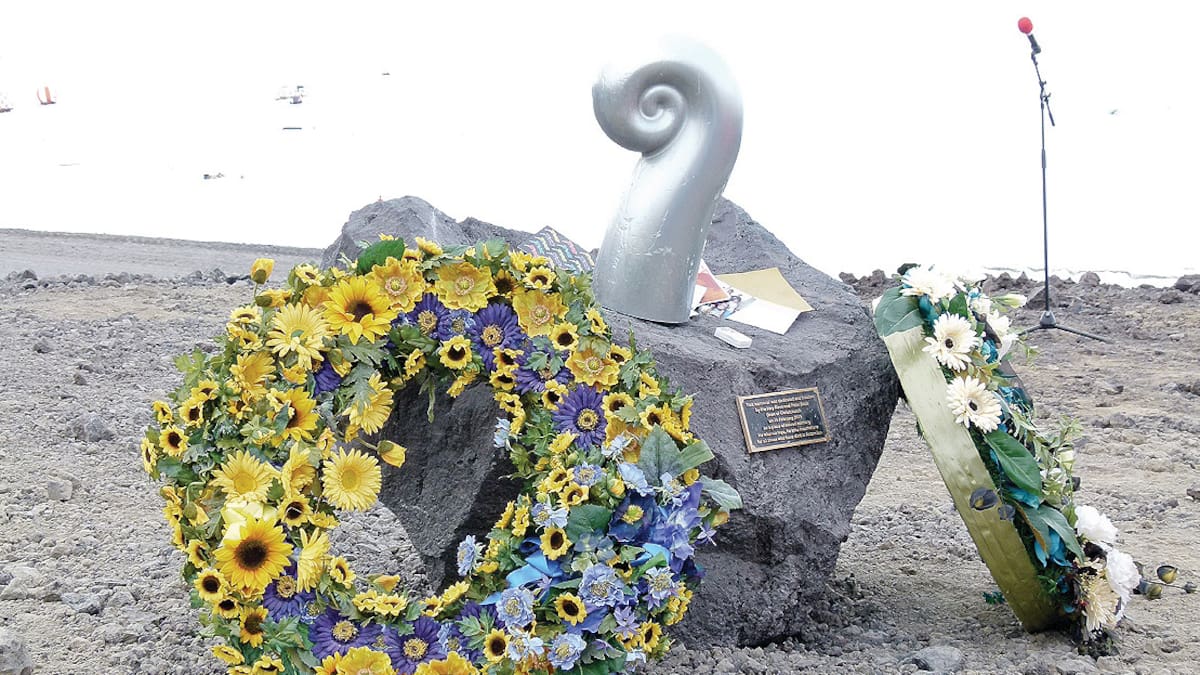
Erebus Memorial
The good people of Parnell should be deeply ashamed of themselves. Not all, but certainly those who opposed the Erebus Memorial being located alongside the beautiful Parnell Rose Gardens in the Dove-Myer Robinson Park.
There were 237 passengers and 20 crew were killed on Flight 901 to Antarctica. Personally, I thought this to be a perfect place for a memorial. Somewhere peaceful and tranquil where loved ones could come and pay their respects. Hats off to Christchurch for now finding a home for this in their city.
The sad thing is that the majority of those killed lived in Auckland, so, instead of a few minutes’ drive to Parnell, relatives will have to fly to Christchurch, which will be inconvenient and expensive.
So, the question needs to be asked: Why did authorities put the rich residents of Parnell’s views ahead of the families of those killed in this tragic disaster?
Glen Stanton, Mairangi Bay.
Russia-Ukraine war
Why is Russia dictating the ceasefire terms? Isn’t Russia the aggressor?
Hasn’t the Russian army shown it is no real threat? After four years with far superior weaponry, it can’t beat Ukraine, so it would be no real threat to the combined forces of the Western allies.
Putin says he feels threatened by the West. Seriously, what has Russia got that the West would go to war over? Is the proposed peace treaty just an economic deal between Russia and America, a carve-up of Ukraine’s massive assets?
Does anybody want the war to stop, as it would cause a massive downturn for the world’s armaments industry? I feel sorry for the people of Ukraine, who are just pawns in the contest.
Jock Mac Vicar, Hauraki.
Democracy’s challenges
Jonathan Ayling’s latest opinion articles (November 20 and 27) are timely as we face changes in local government and a national election next year. Liberal democracy faces significant challenges, and public confidence in elected officials and institutions is at risk.
The extensive public consultations on numerous reforms and legislative matters often seem to serve as public relations efforts, especially when major decisions have largely been predetermined. Furthermore, frequent policy and legislative changes due to shifts between political parties further undermine this trust. Greater collaboration, compromise and statesmanship are needed among all elected officials. Most importantly, new ways are needed to engage and involve citizens.
Kit Howden, Mt Eden.
KiwiSaver changes
Proposed policies of NZ First and National to increase KiwiSaver contributions by both employers and employees have garnered some support commentary by Aaron Gilbert (November 27) and Simon Power, of Fisher Funds.
I agree with all the points the above parties and commentators make, but they ignore what also should be a corresponding mandated lowering of KiwiSaver providers’ fees, as they would otherwise benefit handsomely from the increasing mountain of money that they will manage through no business-scale increase of their own doing.
That necessary fee relief would also benefit retirees’ balances.
Paul Minogue, Silverdale.
Helping low-income earners
A successful KiwiSaver programme would provide the opportunity for more people to enjoy a financially independent retirement, and also reduce Government superannuation payments in the long term.
National proposes that a KiwiSaver rate of 12% by 2032 would mean a 21-year-old earning $65,000 a year today would retire with a balance of around $1.4m. The first problem here is that, using IRD data for 2024, only 12% of 20–24-year-olds have a taxable income of $65,000 or more. About half of 20–24-year-olds and 28% of 25–49-year-olds have a taxable income of $30,000 or less.
Using a simple business term, many NZ families are trading at or below breakeven, which makes saving harder if not impossible, and they pay taxes on their first and every income dollar. In Australia and the UK, the first A$18,200 and £12,570 are tax-free.
Improving our tax scale to make the first $20,000 tax-free for all New Zealanders, funded by changing the effective marginal tax rates for the much better off, would make compulsory KiwiSaver more viable for low-income Kiwis, could be designed to protect middle-income earners, and would be better for the whole economy.
Greg McKeown, Mt Eden.
Devonport naval base
If the Defence Force chiefs are serious about protecting us in the event of war, it seems rather daft to spend $4 billion on redeveloping that prime target, the Devonport naval base, which is slap bang alongside downtown Auckland.
Surely, it’s time to dust down the old plans to rehouse our sailors at Marsden Point instead. Who knows, if we asked nicely, President Donald Trump might share his Gaza holiday park redevelopment blueprints as a guide for a Devonport rebuild, and the navy chiefs might end up with spare cash for a new frigate or two.
Brian Rudman, Ponsonby.
Leaky buildings
When a major property insurance company says the Government is “going down a very dark road” with its proposed loosening of liability in the Building Act, you’d better believe it.
The plan to end all parties in a defective build being jointly liable will leave apartment owners very exposed in future. Instead, liability will be apportioned. This protects councils from being solely responsible for defective construction when all else fails.
Unscrupulous developers and builders will simply fold up companies and walk away, irrespective of any warranty insurance, when weathertightness fails.
Rather than imposing tougher building standards and inspections to stop the endless leaky-building failures, the Government is instead seeking to water down liability for substandard construction.
As someone who has experienced this, it is simply going to mean more costly building failures in future.
Cutting regulatory standards and reducing liability is only going to set up a whole new wave of leaky-apartment disasters, the cost of which will be devastating to those caught up in them.
Jeff Hayward, Auckland Central.
Council amalgamation
We appear to be witnessing a power grab by central government.
Removing regional councillors and amalgamating small councils will further undermine citizens’ rights. Local government is not the problem; central government is.
We constantly have ministers interfering in local democracy, such as Simeon Brown’s raising of local speed limits and abolishing the Auckland fuel tax, both of which were opposed by the council. At a national level, we have Erica Stanford imposing her ill-informed ideas on the education system, and David Seymour deciding on what children should eat for lunch. This is ludicrous, as well as undemocratic.
We need localism more than ever. The coalition’s latest plan is to abolish regional councils because developers are “scared of them”!
I wonder why? Maybe our local representatives are trying to protect our environment from exploitation and profiteering by private business? Public assets are ripe for the taking, and investors will be queueing up to buy them.
As Anne Salmond pointed out this week, successful small democracies have more localism, not less. The Government is taking us in the opposite direction and must be stopped.
If we want a better system of local government, we should convene some citizens’ assemblies and have a proper debate. We don’t want Trump-style government by decree in our country.
Vivien Fergusson, Mt Eden.
A quick word
Not being much of a beer drinker myself, could we consider changing Wayne Brown’s comment to free beer and wine?
Kate Dixon, St Heliers.
I just watched Jack Tame’s doco on TV1, You, Me and The Economy, and I have to say that was the most positive programme I have ever seen on our state broadcaster. Has the editorial board finally got the message? Good news, well presented, is just as interesting as the doom and gloom they usually serve up.
John Denton, Eskdale.
I’m looking forward to the next Chasing the Fox challenge, but hope it is not spoiled, as in the past, by inappropriate innuendo from the commentators. Not only are they often sexist, but usually inappropriate at best. Worst of all, a large majority of viewers, especially non-golfers, wouldn’t understand them.
It can be a fun presentation, and that’s great. But please keep it clean.
Dennis Trotter, Morrinsville.
It’s not every day that a request to AT ends up with a positive result, so a shout-out to Abishek Sharma, who persevered with getting new live bus and train signage in the Henderson Walk bridge. Much appreciated, and it improves our ability to use public transport efficiently.
Fiona Edgar, Henderson.