
“Working with Ralph Roberts and Warren and Mahoney was a real once-in-a-lifetime opportunity.”
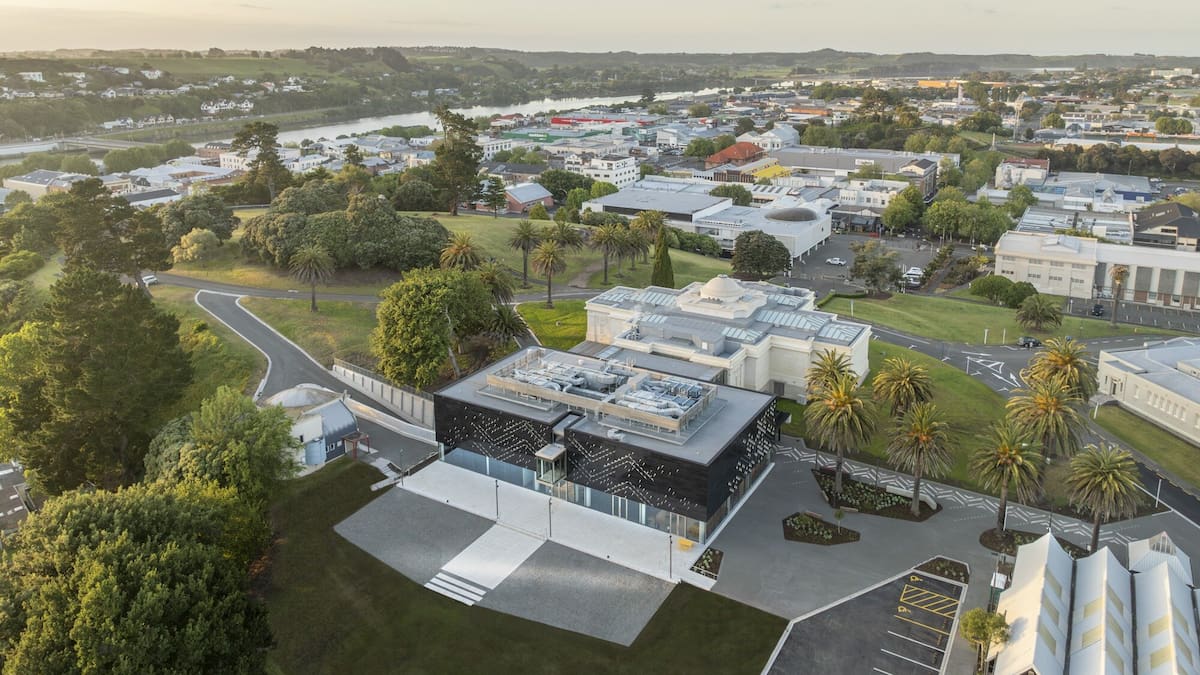
The $79.4 million gallery reopened to the public last November.
Sarjeant curator Greg Donson said it was a piece of civil architecture that would serve the community well into the future.
“The heritage building was beautiful in its own right, but to now see people being able to access the shop, cafe, classroom, library and event spaces as well as our wonderful galleries, gives people a great experience.
“I think we’re really lucky to have some of the most beautifully scaled gallery spaces in the country.”
Parties involved with the redevelopment project have been recognised at several events this year, including the Concrete Construction Awards, the NZ Property Industry Awards, the Designers Institute of New Zealand Best Design Awards, and the Interior Awards.
Craig Dalgleish says the pātaka is being used as a storge space and classroom. Photo / Simon Devitt
Sarjeant director Andrew Clifford said the redevelopment’s success across all major award programmes was a huge validation for the team and community.
“A lot of people have contributed to this project over a long period of time and not only have we completed this long-held vision, but we can also now confirm that it is a huge success.
“From industry acclaim to huge visitation numbers, we are off to a flying start as one of the most significant cultural projects in the country.”
Both projects were winners at this year’s Western Architecture Awards, putting them in the running for the national awards.
The pātaka is being used at Pūtiki by the Ngāti Ruaka hapū as a teaching space for Te Morehu Whenua, a youth-led environmental group.
Dalgleish Architects director Craig Dalgleish said Ngāti Ruaka had a similar building at Rānana that collapsed many years ago.
Te Atawhai o Te Ao director and Rānana Marae Reservation Trust chairman Dr Rāwiri Tinirau invited him to visit it, Dalgleish said.
“We tracked into the bush and found the remnants, which were well covered,” he said.
“It was a great day, measuring and understanding what we could.
“The remnants were an influence. It’s not a copy. This is its grandchild, as it were.”
He said there were community gardens alongside the pātaka, where children grew vegetables to supply to hapū members.
“Within the pātaka, there is storage, of course, but there is certainly room for lessons as well. It’s partly a classroom.”
He said the award was “recognition at the highest level”.
“There is nothing above it, at least not in this country, so we’re very pleased.
“It [pātaka] has captured the imagination of a lot of people.”
Kumeroa said awards went towards measuring success, but the true achievement was when people were in the gallery enjoying exhibitions, “or just having a coffee and kai”.
“This is what puts the ‘mauri’ into our space, especially when we hear laughter, children, singing and music.
“It is also a validation of why it is important to keep strong relationships between tangata whenua and government, both local and national.”
Mike Tweed is a multimedia journalist at the Whanganui Chronicle. Since starting in March 2020, he has dabbled in everything from sport to music. At present his focus is local government, primarily Whanganui District Council.