
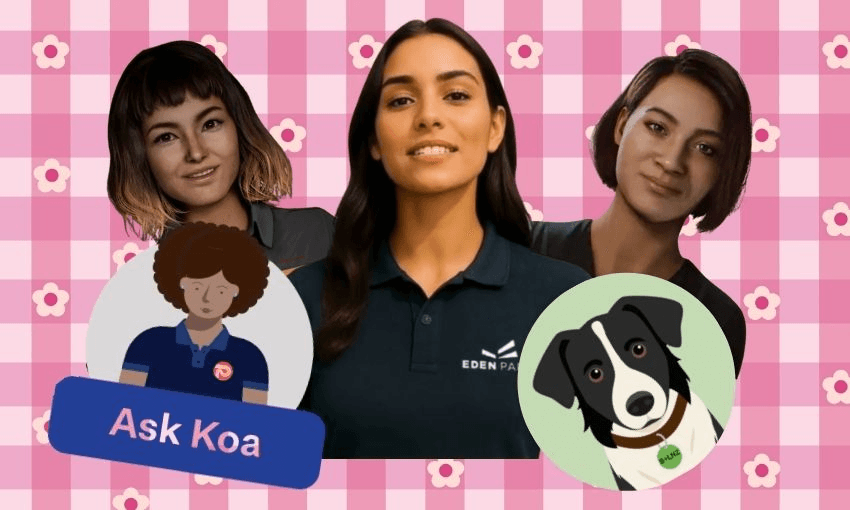
A veritable coven of female AI assistants, team members and spokespeople has been launched by New Zealand brands in recent years. Why?
A couple of weeks ago, Eden Park posted its “newest recruit” to social media. “Hi, I’m Eden, Eden Park’s first AI team member,” said the young, attractive, oddly Australian-sounding synthetic woman. “You’ll see me on socials creating digital artwork, sharing helpful updates for event days, and hopefully adding a bit of fun to your feed.” Alas, in the comments section, people did not seem to be having fun in their feed. “Controversial take: This could’ve been an email,” someone wrote. “Some things should be kept to a real person,” said another.
Eden joins a veritable coven of female AI assistants, team members and spokespeople launched by New Zealand brands in recent years. In 2018, ASB announced “human-like” AI interface Josie. “In a nod to our human teams, she is named after our first-ever full-time ASB Bank employee Joseph Coombe,” the release reads. A year later, Noel Leeming launched “digital human” Nola, who bleakly purported to “live” in the Westfield Newmarket store. “She helps countless people throughout the day, and she does so with consistency and a big smile.”
 Nola from Noel Leeming launched in 2019
Keep searching, and it becomes clear that the AI girls are well and truly on. NZ Post has “digital employee” Koa, represented as a cartoon woman with pierced ears, curly hair and an approachable smile. Skinny has Liz, its AI ambassador modelled off a real-life Skinny superfan. Beef and Lamb even has Bella the AI farm dog to help farmers access online resources (although Dan Brier, general manager Farming Excellence, explains her gender was unintentional – the name Bella is a nickname for Beef and Lamb Assistant).
Still, the feminisation of digital assistants extends as far as AI farm dogs, and there aren’t many male helpers to be found outside of Air New Zealand’s Oscar. “Why are you a woman?” I asked Josie through the ASB app. “Sorry, I’m still learning, and I didn’t understand that request,” she replied. Classic imposter syndrome – lean in, ladies! “Why are you a woman?” I asked Bella the AI sheepdog. “Sorry, I don’t have the knowledge to answer that question as it falls outside my area of expertise in beef, sheep and dairy-beef farming,” she replied.
Josie was launched by ASB in 2018.
Begrudgingly forced to interact with a real woman, I contacted Cassandra Mudgway, senior lecturer in law at the University of Canterbury, who has been researching the intersection of AI and gender this year. Mudgway wasn’t particularly surprised to hear that more and more brands in Aotearoa are embracing the lovely AI spokeslady to help local consumers with their queries. “Typically, in all kinds of communication-based tech in the last 10 years, it’s going to default into female,” she says. “You can draw a straight line from Siri to here.”
The first reason for this is a potent combination of marketing and mummy issues. “Companies who create this kind of AI assistance tech will point to behavioral psychological research that says women’s voices are attributed with greater likability,” says Mudgway. “There is some legitimacy to this – some research suggests that even from infancy you attribute more likeability to women, because mothers are more likely to traditionally be the caregivers at home than the fathers, in a Western context at least.”
Indeed, much of the way these AI women are described emphasises these likeable traits, from Nola’s “cheeky side” to Eden’s playfulness. “Her design is warm, approachable, and confident, helping new technology feel familiar and enjoyable for our audience,” a spokesperson from Eden Park explains when asked about her gendering. “Eden’s female persona simply reflects the tone and personality that best aligns with how we communicate as a brand – welcoming, friendly and proudly here for everyone who comes to Eden Park.”
Eden from Eden Park.
Another factor influencing this trend is that the tech industry remains dominated by men, which means biases seep in at the creation level. “You’ve got designers who, because we have a lack of women in the tech space, are designing tech from their own experience,” says Mudgway. “And if your experience is limited by your gender, you’re more likely to default to stereotypical coding.” So, when briefed to create an avatar who is passive, caring and helpful, where are most people going to turn? Women. “It’s basically ‘Mum, help me out’,” says Mudgway.
And while there is something mildly amusing about this current gaggle of glassy-eyed girlies, Mudgway adds that there are serious issues lurking just beneath the surface. “It is harmful in the sense that it reinforces the idea that women are a group of people that are there to serve, which is more likely to normalise other ideas about women being inferior,” she says. “The more integrated that this technology becomes in our everyday lives, the higher the stakes in terms of normalising or further entrenching those harmful stereotypes.”
The good news is that some brands have been reflecting on their role in the AI lady-verse. Noel Leeming CEO Jason Bell says that after six years, the lifelike in-store version of Nola was decommissioned earlier this year. It continues to be the name of their chatbot – although they are now reviewing that too. “Looking back at when Nola was created six years ago, we don’t think that the AI gender bias was part of our team’s conversations,” he says. “If we were to do something similar again we would approach it differently.”
Mudgway emphasises that it is important to stay aware of these biases in AI while it continues to encroach into our lives. “It’s not neutral and it is not harmless. You might think it’s silly, but it all fits into how we think about women,” she says. The greatest irony of all is that AI promised us expansive horizons, and yet here we are just seeing more of the same. “It’s really interesting, because you don’t even need to personify any of this at all. It’s all synthetic and can be as androgynous and weird as you want,” Mudgway adds.
“Whatever happened to Clippy, you know?”