
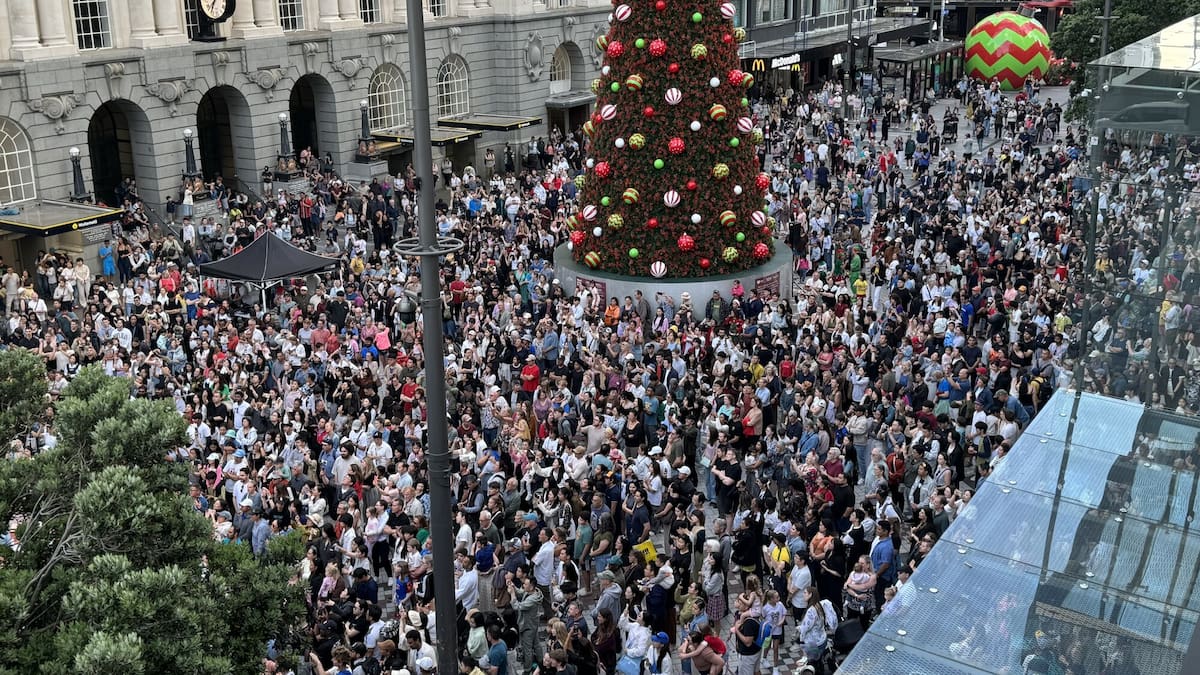
“Who says people don’t come into the city,” said Wayne Brown, when he sent
me this photo of the launch of the Christmas tree last Saturday in Te Komititanga Square.
Heart of the City’s Viv Beck also sent me a photo of the event, calling it a “wonderful crowd”.
Christmas is happening, y’all, in the city centre and all over. The famous and much-loved Farmers Santa Parade is this Sunday at 1pm.
Buses, trains and ferries are the best way to get in. Auckland Transport is expecting up to 150,000 people and is laying on extra ferries, extra double decker buses for the Northern Express routes and six-carriage trains. They’ll also have extra trains on standby at Waitematā Station (Britomart) to help people get home afterwards.
Here’s my Christmas wish: that people do their Christmas shopping in shops. If we want them, we have to use them.
Golly Roger, why don’t you tell us what you really think?
Ports of Auckland chief executive officer Roger Gray. Photo / Supplied
Port of Auckland (POA) boss Roger Gray was guest speaker at a business event this month. He complained that the cruise industry calls us “No Zealand”, and that’s why there won’t be as many cruise visits this summer as he would like.
What was he actually upset about? Ships being prevented from entering Milford Sound because they had not had their hulls cleaned and inspected.
Milford Sound is probably the most carefully preserved natural environment in the country that’s reasonably accessible to tourists. That’s a big part of why they go there.
It beggars belief that anyone thinks we should relax the “biofouling” restrictions for the sake of – tourists?
Gray also complained about rising cruise ship fees. But that’s a worldwide phenomenon.
And he had a go at the previous Government’s handling of cruise ships in the early days of the Covid pandemic. “Jacinda called them petri dishes,” he said.
It’s not clear that Jacinda Ardern used the phrase, but plenty of other people did. Is it really so easy to forget those first months, when the virus was killing thousands and very little was known about it? By June 2020, 40 cruise ships, including some with New Zealanders on board, were carrying infected passengers and crew, and the virus spread rapidly in those closed environments. On the Ruby Princess, which docked in Sydney, 28 people died.
Gray also told his audience it’s great the Government is importing coal, because that’s been good for the port. He called for more. The things beneficiaries of the fossil-fuel industry say when their guard is down, eh.
And he predicted the City Rail Link (CRL) will be a disaster.
Gray is not an impartial observer. Vehicle imports are usually one of the most profitable parts of the POA business. But in the last financial year they dropped 17% on the year before, the lowest they’ve been since 2013.
Gray’s entitled to his views. But his bottom line depends on us buying more cars. He doesn’t want us thinking we might start catching the train.
Faded beauty: The Pink Pathway turns 10
Te Ara I Whiti, the Lighpath, the Pink Pathway, is 10 years old. Photo / Supplied
Last year, 241,265 cycling trips were recorded on Te Ara I Whiti, aka the Lightpath, aka the Pink Pathway. And as every cyclist who uses it will tell you, there are always others there too: families from the nearby apartments with kids on their trainer wheels, TikTok and Instagram sessions, runners, people walking to work.
It’s a kind of urban park, as well as a commuter route. And now it’s 10 years old.
The pink has faded, and with the council’s current cost constraints, it’s hard to think anything will be done about that. But the LED strip lights that change colour as you pass are still doing the business and to commemorate the birthday, there’s a soundscape called Symphony in Space playing there until December 7.
Meanwhile, the central city’s cycling network progresses. The Victoria St stretch is mostly open, providing an essential cross-town connection. Albert St is mostly open and Mayoral Drive as it passes the CRL’s Te Waihorotiu Station isn’t far away.
The new bike lanes on and near Canada St are nearly ready too: that’s another essential piece of cycling infrastructure connecting several bike lanes to the CRL’s Karanga-a-Hape Station and K Rd.
And if you’re still wondering if it’s worth it, all this work to make streets more appealing for pedestrians and cyclists, check out Quay St and Queen St. The planting is luxurious now. Quay St especially is looking splendid – and it’s highly functional for all its users.
Don’t believe it? Here’s a tip. Vehicle insurers have ranked the Netherlands as the best country in the world to … drive a car. Sweden and Norway aren’t far behind.
Why? Because countries with excellent cycling infrastructure and great public transport take cars off the road and foster a general sense of care and politeness.
As Bike Auckland’s Donna Wynd says, “we’d love to remind everyone that people on bikes aren’t rivals to drivers – they’re allies. Every bike you pass represents one less car in front of you at the lights.”
Still, there is always more to be done. Top of my wish list: safe ways for people from all directions to cycle to Cornwall Park. Imagine it.
Bike Auckland will be celebrating 10 years of the pinkness on Wednesday, December 3, with an 8am ride on the pathway, plus entertainment and goodies.
Showtime at Eden Park?
Cupcakes by Bluebells, presented to the council this week by Eden Park chief executive Nick Sautner. Photo / Simon Wilson
This week’s debate about whether Eden Park should have more concerts threw up some basic issues the council and the Government have been avoiding. But they can’t keep doing that.
First, the park’s calendar is very light for 2026. This cannot be because of the existing restrictions: the concerts of Coldplay and Luke Combs, among others, seemed to prove the value of the park to promoters and everyone else.
We haven’t heard enough yet about why promoters aren’t building on that in 2026, bringing more big acts to Eden Park next year.
Next, the trust board that owns and runs the venue seems to have a new strategy to make money, sort-of-unofficially revealed this week by chief executive Nick Sautner. It involves the possibility of apartment blocks on the perimeter, a 1500-vehicle car park (real money spinners, those big car parks) and buildings on the outer field.
If they keep going down this track, they’ll end up with a plan for a big complex that seems rather familiar. Oh, wait, isn’t that what the Quay Park stadium option proposed? The same Quay Park option the council rejected out of hand?
Sautner gave the councillors a big box of cupcakes during his presentation this week and it was met with bribery jokes.
He and all the councillors passed it off as a nice gesture, a harmless bit of fun.
Still, the message was clear enough. He was saying to them, we’re all in this together and we’re going to look after each other. Most of the councillors think that too: they rejected waterfront stadium proposals and voted for Eden Park earlier this year.
But that leads us to the money. There’s a $50 million debt that isn’t being repaid, and more costs for council every time the park stages a big event.
And while the council supports Eden Park’s bold plan to add a roof and give itself a full makeover, they have made it clear they won’t pay for it. The Government isn’t interested either. So who is going to pay?
To my mind, there’s an even bigger problem. This isn’t one of those issues where the complaints will drop away once people see how well it works. The more Eden Park succeeds as a concert venue, the more residents will complain.
In early 2024, the council approved a new plan to increase the number of concerts to 12. At the time, that was called “the edge of acceptability”. Now they’ve agreed it wasn’t anywhere near the edge: the new limit will be 32.
What’s next? Personally, I think the city’s major events venue should be able to stage as many events as it possibly can. Why would we want there to be any barriers at all to its success?
A summer packed with concerts and festivals and big summer sports; and a winter with more shows under the roof and all the winter sports: that’s the ideal.
But not if it’s in the suburbs. Residents were fine with 12 and might be fine with 32, but could you blame them for complaining if it’s 50? What if it’s 100?
The point is, success will breed divisiveness. As the park gets more successful, by staging ever more events, the division will get worse.
In my view, the council hasn’t thought this through at all.
Fortnightly rubbish trial rubbished
Rubbish collection in Auckland. Photo / Michael Craig
The council’s plan to trial fortnightly rubbish collection in Te Atatū Peninsula, Panmure-Tāmaki and Clendon Park-Weymouth has been strongly rejected in public feedback. In all three areas, around 80% of submitters said no, with less than 20% saying yes.
A decision on whether to ditch the whole thing, or go ahead anyway, will be made in December by the council’s Policy, Planning and Development Committee.
But the result from the in-person component of the consultation was much more balanced. Of the people who turned up to “have your say” events, 35% were in favour of a trial, 24% were unsure and 41% were opposed.
There are a few lessons in this. The obvious one is that people want weekly rubbish collections. The second is that when there’s a chance for in-person discussion and explanation – about a trial, remember – many people will change their minds.
And the third is that this issue came up during the council election campaign. A lot. While the good citizens of Mt Eden were angsting about high-rise housing and in Warkworth their main concern was rates, in the trial areas, rubbish collection was the No 1 hot topic.
Most candidates were committed to opposing the trial and very few of those who weren’t managed to get themselves elected.
Eighteen other councils run fortnightly kerbside rubbish collections. In Hamilton and Tauranga, doing this has led to households reducing their waste going to landfill by around 50%. Doesn’t wash in Auckland. Maybe it’s the humidity.
Mike Lee starts with a roar
Waitematā councillor Mike Lee, who is likely to join the board of Auckland Transport. Photo / Alex Burton
Veteran councillor Mike Lee was comfortably re-elected last month in the Waitematā and Gulf ward, and he’s celebrating with his trademark curmudgeonly disruption.
At council meetings, the usual format is for councillors to hear presentations from the public, local boards and officials, and ask questions. Speeches and substantial debate are supposed to wait till later.
But at this week’s council meeting, Lee used question time on one issue to launch a loud and lengthy attack on the Government, the council and, it seemed, anyone who had the temerity to give either of them the time of day.
It wasn’t the first time. His colleague Richard Hills was in the chair and tried to shut him down, but Lee was having none of it, complaining that every chair of every meeting always tries to shut him down.
This is basically true, because they want him to use question time for questions and keep his speeches for later. Lee’s response to Hills was that he was just going to keep on talking, and that is what he did, very loudly.
The other councillors took the chance to catch up on TikTok or Facebook, or whatever.
They have a new electronic voting system, which requires councillors to vote on their computers, with the results flashed up on screens. When it came time for the next vote, Lee busied himself talking with an official, and then turned away. The “voted” window next to his name on the big screen remained empty.
Deputy Mayor Desley Simpson and others called out to him to vote and he ignored them all. They waited and waited. Eventually, Lee turned on his mic and launched another attack, complaining about the “ridiculous delay”.
Ready, set, go for speedway
Onehunga’s Waikaraka Park, with the new track shown here nearing completion. Photo / Supplied
Racing begins this Saturday at Auckland’s new home of speedway open: Waikaraka Park, in Onehunga.
The $11m upgrade includes a new purpose-built track, designed by an architect who is also a former speedway driver, with a new safety wall, catch fence and pit area for 130 drivers at one time. For the spectators there’s new seating for 3000, with capacity for another 1500 on the embankment, new lighting and new toilet facilities.
The council says the new track “has been designed to promote a faster, closer racing spectacle and allow local drivers to hone their skills in a similar environment to international drivers”. Speedway NZ, the governing body of the sport, has certified its safety.
Local councillor Josephine Bartley calls the upgrade “an investment to support the long-term sustainability of the sport in Auckland”. She expects the speedway will be enjoyed “by Aucklanders and racing enthusiasts from across the country for generations to come”.
The work was done by Tātaki Auckland Unlimited. Chief executive Nick Hill says, “Aucklanders and visitors can now enjoy a modern, international-standard speedway facility, with faster racing and an improved fan experience. With a long-term deal secured that guarantees the presence of four-wheel speedway classes at Waikaraka Park, it is great to have a facility that preserves the viability of speedway in Auckland for years to come”.
The lease on Waikaraka Park is held by the Auckland Stock & Saloon Car Club and is secure until 2051. The council says it “secures the long-term presence of all four-wheel speedway classes, including the open wheel classes that previously raced at Western Springs”.
The closure of the Western Springs track is still hotly debated, although Mayor Brown dismisses the idea it could be changed. It shouldn’t take long to discover if the teams, drivers and fans embrace the new experience.
Stock and saloon car racing begins this Saturday, with open-wheel classes to start two weeks later. In total, 24 race nights are scheduled for this season, including a minimum of 11 race nights for open-wheel classes.
To sign up for Simon Wilson’s weekly newsletter, click here, select Love this City and save your preferences. For a step-by-step guide, click here.