
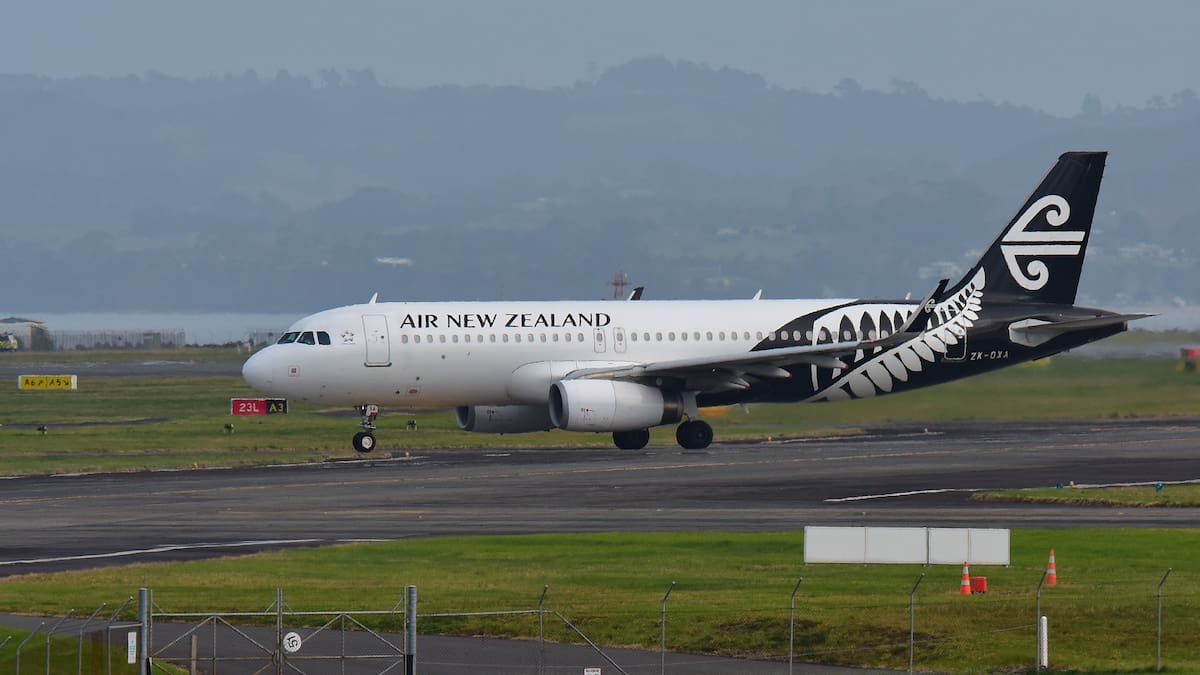
Air New Zealand chief safety and risk officer Nathan McGraw said they’ve received confirmation they can resume flying the A320s.
“To allow aircraft to get to their destination and minimise disruption, a new update from the European Union Aviation Safety Authority [EASA] has advised that aircraft with this software can continue operating until 12.59pm on November 30, New Zealand time.
“This means that, where possible, we are able to operate A320 services today before commencing the required updates,” said McGraw.
The software fix may cause future delays.
An Air New Zealand Airbus A320.
“Air New Zealand will begin rolling through the updates to its A320 fleet as quickly as possible to minimise ongoing disruptions. It is important for customers to know that this is a precautionary software update and does not present an immediate safety risk to our flights,” said McGraw.
Travellers across New Zealand and Australia have been impacted so far.
“We have cancelled 12 services today and are expecting some further disruption today. Customers travelling today should continue to check the Air NZ app or website for the latest information on their flight,” said McGraw.
He says Air New Zealand will provide updates on any disruption to its schedule as soon as it has more information.
“We know unexpected changes are frustrating, and we are working hard to keep customers moving wherever possible,” McGraw said.
Passengers at departure gates at Auckland Airport await their delayed flights. Photo / NZ Herald
Jetstar has also been caught in the chaos, saying safety is its “number one priority”.
“To respond to a precautionary action from Airbus, we have cancelled some Jetstar Airways flights. Our teams are working on options to get customers on their way as quickly as possible and are contacting affected customers directly.
“We thank customers for their understanding and patience. We will continue to provide updates.”
An NZ Herald journalist who was scheduled to fly with Jetstar this morning described a “stampede” at Auckland Airport as cancelled flights were rebooked.
“We were waiting for flights that had already been delayed because of this global issue. There were no seats available [in the terminal lounge], and people were scattered across the floor.
Large queues at Auckland Airport after delayed flights and cancellations caused by a global Airbus A320 warning. Photo / NZ Herald
“We were hopeful that maybe we’d start boarding soon and then this packed waiting room with two flights, one to Queenstown and one to Christchurch, we just heard over the intercom that both the flights had been cancelled and that everyone had to go downstairs and rebook,” said the traveller.
They’d managed to get on another flight later this afternoon – but others hadn’t.
“There’s hundreds of people waiting now. A lot of people seem quite frustrated.”
They said communication between the airline and passengers over the cause of the cancellations had been poor.
Large queues at Auckland Airport after delayed flights and cancellations caused by a global Airbus A320 warning. Photo / NZ Herald
Airbus warned of impending disruption
Airbus on Friday warned of potential travel disruption as it upgrades some 6000 operational A320 aircraft, after an incident on a JetBlue flight last month.
The European plane-maker on Friday instructed its clients to take “immediate precautionary action” after evaluating the incident.
“Intense solar radiation may corrupt data critical to the functioning of flight controls,” Airbus stated, adding that “a significant number of A320 Family aircraft currently in-service” may be affected.
Replacing the software will take “a few hours” on most planes but for some 1000 aircraft, the process “will take weeks”, a source close to the issue told AFP.
The faulty software, the Elevator and Aileron Computer (ELAC), is made by aerospace and defence giant Thales.
“Airbus acknowledges these recommendations will lead to operational disruptions to passengers and customers,” it said, apologising for the inconvenience.
On October 30, a JetBlue-operated A320 aircraft encountered an in-flight control issue due to a computer malfunction.
The plane suddenly nosedived as it travelled between Cancun in Mexico and Newark in the United States, and pilots had to land the plane in Tampa, Florida.
US media quoted local firefighters saying some passengers were injured.
Produced since 1988, the A320 is the best-selling airplane globally, with Airbus selling 12,257 of the aircraft by the end of September compared with the sale of 12,254 Boeing 737s.
– Additional reporting Agence France-Presse