
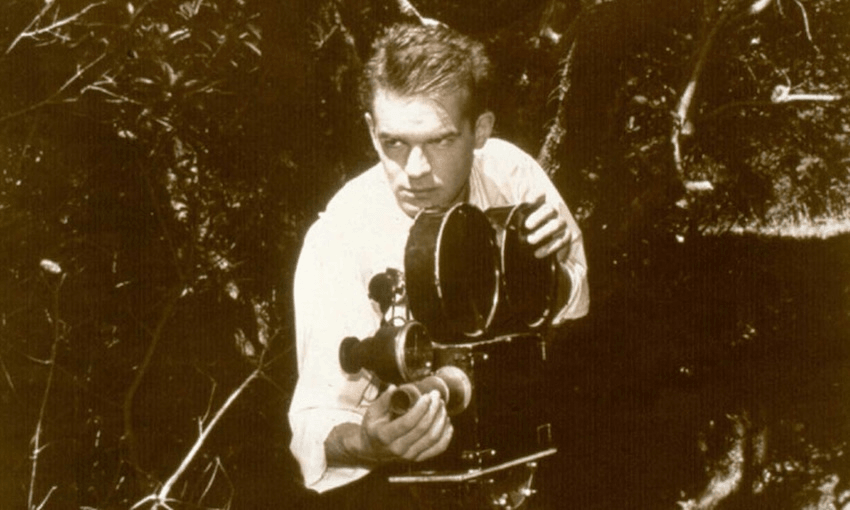
Filmmaker Costa Botes has died, but his mockumentary Forgotten Silver lives on. Ian Pryor reflects on what makes the film so unforgettable.
On the set of TV show Worzel Gummidge Down Under, Costa Botes met a filmmaker who was even more unknown than he was. That filmmaker was Peter Jackson; Botes would later write that he had an ugly cardigan and a bad stammer. Jackson invited Botes to play one of the victims in his first feature, Bad Taste. Botes got to choose between death by chainsaw or being torn in two by a car.
Botes and Jackson were both in love with cinema, though from different angles. Botes read the movie magazine Sight and Sound, watched arty old French films, and was best known as a film reviewer (he got the job after critiquing a piece by the previous reviewer). Jackson read horror movie magazine Fangoria and the niche publication Famous Monsters of Filmland, and threw out memorable quotes about how outlandish violence can be harmless fun. If these two softly-spoken film obsessives had never met, the glorious creation that is 1995 mockumentary Forgotten Silver would never have happened.
Sadly, many people think that Forgotten Silver only had one parent; fame can work that way. On a number of occasions, Jackson has been given all the credit for the film, even though this fictional tale – about a New Zealander, Colin McKenzie, who invented colour films and made a biblical epic – was Botes’ idea.
 Costa Botes, playing himself, holds a Colin McKenzie film reel in Forgotten Silver, 1995.
Botes, whose death was announced this week following almost a decade after being diagnosed with cancer, must have known that Forgotten Silver would dominate his epitaph, however mangled the credits. With 11 feature-length documentaries behind him, he published his first and only book, Remembering Forgotten Silver, earlier this year.
For my money, Forgotten Silver is the best thing Botes ever did. And that is saying something – only documentary maker Shirley Horrocks has had more films screened at the NZ International Film Festival. Forgotten Silver is like a five-course meal hidden inside a muesli bar. It’s a nostalgic rollercoaster, pretending to be a documentary; a comedy and a drama, sometimes in the same sentence. It’s a loving tribute to the days when film was actually shot on film.
Forgotten Silver feels like a love letter to the creative life – the narrow line between courage and failure, between heroism and absurdity. It’s also about a land that fails to fully support its artists. In Botes’ book, Peter Jackson notes that the character Colin McKenzie never wins the acclaim he deserves at home. McKenzie has to go to some crazy places overseas to fund his biggest dreams. New Zealanders, argues Jackson, have a habit of “not backing ourselves”.
Botes’ book is likely to be the most complete account of Forgotten Silver we’ll ever get. It reveals that sometime in the early ‘90s, caught between the dramas he wanted to make and the documentaries he suspected were easier to sell, Botes got hung up on the idea of making a pseudo-documentary. UFOs – no, forget the UFOs. How about Richard Pearse, flying an aeroplane before anyone else? What if someone filmed Pearse taking off, and the footage disappeared? And what if this Colin guy had also been behind key filmmaking inventions like colour and sound?
Co-directors Peter Jackson and Costa Botes in Forgotten Silver, 1995
Jackson’s name surely helped get the ball rolling. He was clearly the supernova of the pair. By the start of 1995 he’d already made four attention-grabbing features, while Botes’ biggest projects were a Sam Hunt documentary and episodes of the American TV anthology show, Ray Bradbury Theater.
When Forgotten Silver hit television in October 1995, some of the most annoyed reactions were from those who had fallen for the lie. Botes details vociferous letters to the editor – and cheering crowds at the Venice Film Festival.
Following 1997’s Saving Grace, Botes’ sole attempt at a feature drama, he focused on documentaries. The irony is that the lies of Forgotten Silver had set Botes on the path to becoming an accomplished documentary maker. Co-creating that film helped him appreciate the challenges of ‘past tense’ storytelling – where the subject is dead or the key events happened years ago. Botes would deal with such challenges again on documentaries as rich as Angie, about a survivor of Centrepoint, and Act of Kindness, about a New Zealander in Rwanda. His work, much of it self-funded, ranged from the unexpectedly lyrical (When the Cows Come Home) to a chronicle of manic depression in full flight (Daytime Tiger). With few exceptions, each of his documentaries was built around a single, passionate person.
When newbie filmmaker Zoe McIntosh pitched Botes the idea for her award-winning doco Lost in Wonderland, her career was launched by his response: “Let’s just go make it.” Botes also taught his share of film students. Perhaps channeling the frustrations of his chosen career, Botes advised one group of film students not to waste their time becoming filmmakers.
He failed to follow his own advice. In his final weeks, he was editing another film and playing guitar from his hospice bed. He’d finally managed to secure some return cinema screenings for Forgotten Silver. It was still his favourite project – “because it was the hardest to get right, and because it made everyone else who worked on it happy,” he writes in his book.
My mind jumps to Forgotten Silver’s final shot. Colin McKenzie, long dead but in this moment still beautifully alive, smiles at the audience, while filming himself in a mirror. Farewell Costa … and Colin, well I know I’ll catch you again.