
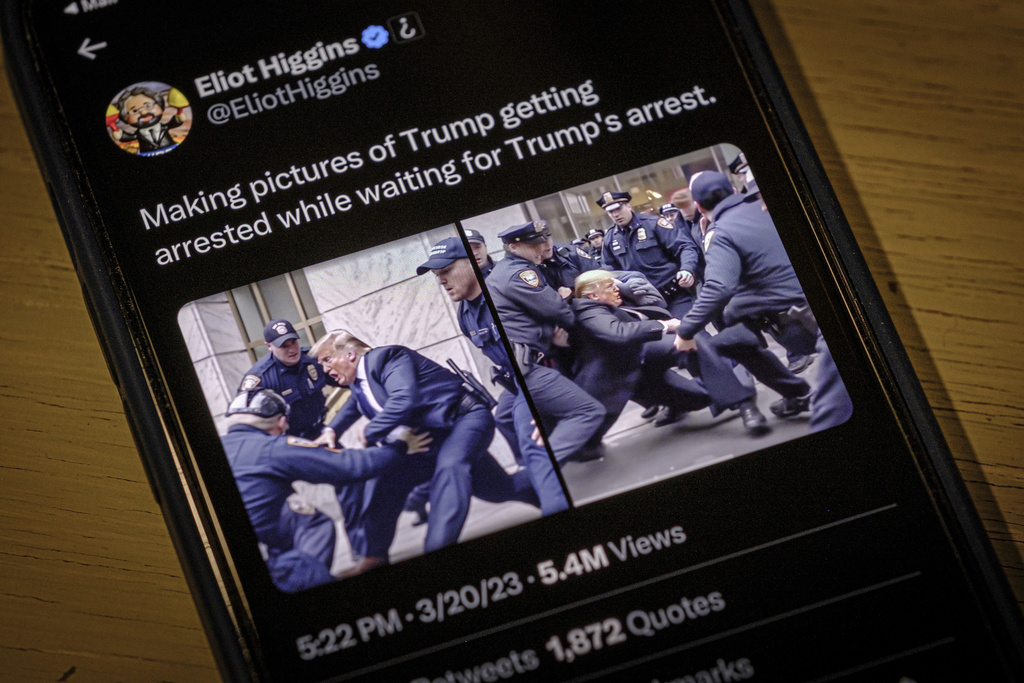
A recent campaign ad in Georgia that used an AI generated video of Sen. Jon Ossoff (D-Ga.) saying things he never said is appropriately getting attention because of the ethical questions it raises. The answer to the ethical question is that it’s wrong, campaigns shouldn’t make things up about their opponents. But it’s not wrong because the ad uses artificial intelligence. The ad is wrong because it makes stuff up. AI isn’t the problem, lying is the problem.
The Republican attack ad is not the first, and will certainly not be the last, to get headlines for using AI to generate nonsense. In early 2024, an unpopular sheriff in Philadelphia got in trouble for using AI to generate what looked like real and glowing coverage in local media outlets. The media outlets were real, but the stories were fake. As with the most recent ad, AI got the headlines, but the lying was the problem.
Concerns about politicians making up news, faking images, and otherwise lying to get what they want are as old as politics. The Ancient Greek philosopher Plato criticized the sophists for emphasizing what sounded good over what was true. In about 94 C.E., the Roman orator Quintilian warned about “hack advocates” (his words, not mine). One of the most famous political lies of all time was told in the 12th Century B.C.E. when the Greek army pretended to leave Troy and left behind what appeared to be the gift of a large wooden horse. The horse, of course, was full of soldiers who took the city and won the war. No AI needed, just a bit of cunning and a lot of wood.
The U.S. has our own history of lying for political gain. In 1782 Ben Franklin fabricated stories about the British to help sway European public opinion toward the colonies. One hundred years later, the Hudson River School painter Albert Bierstadt “freely altered details” in his paintings of the American West that helped shape federal policy. In 1895, newspaper magnate William Randolph Hearst sent a reporter to cover an insurrection in Cuba. The reporter said there was no war to cover, to which Hearst reportedly replied, “you furnish the pictures, I’ll furnish the war.”
Closer to our time, President Trump has been fooled by impersonators calling his office twice. In 2018 a comedian pretending to be Sen. Bob Menendez (D-N.J) talked to the president about the Supreme Court and immigration. In 2021 Trump was fooled by someone pretending to be Piers Morgan. Rep. Gerry Connolly (D-Va.) called the 2018 call “chilling” in its implications, a word many apply to AI generated deepfakes. As with fake images and fake news the problem isn’t AI, it’s the faking.
By focusing on AI generated lies, we miss the point that lying is bad and should be condemned. We also risk not paying attention to the real gray areas.
For example, during the most recent federal government shutdown, the National Republican Senatorial Committee used AI to generate what appeared to be a video of Senate Minority Leader Chuck Schumer (D-N.Y.) saying something that was never recorded. The words were the senator’s, he really said them, but there was no recording or video of him saying them. AI generated the visuals and audio.
Whether or not that is ethical is something worth debating. For example, what if the ad showed an image of Schumer’s words and had someone impersonating the senator read them? Would that be different from the AI generated voice, and if so why? As with the anti-Ossoff ad, the debate isn’t about AI, it’s about how the information is presented.

A further risk is that increased coverage of AI may lead some voters to distrust everything they see or hear. If everything, good or bad, can be falsely dismissed as merely AI generated, then why trust anything? Democracies rely on trust balanced with a healthy dose of skepticism. Without a basic trust in our institutions and leaders, skepticism quickly becomes cynicism. A democracy without trust and grounded in the quicksand of cynicism cannot long survive.
AI may be in the headlines, but it may not be what we should be most worried about.
Peter Loge is the director of Project on Ethics in Political Communication at The George Washington University.
Copyright 2025 Nexstar Media Inc. All rights reserved. This material may not be published, broadcast, rewritten, or redistributed.