
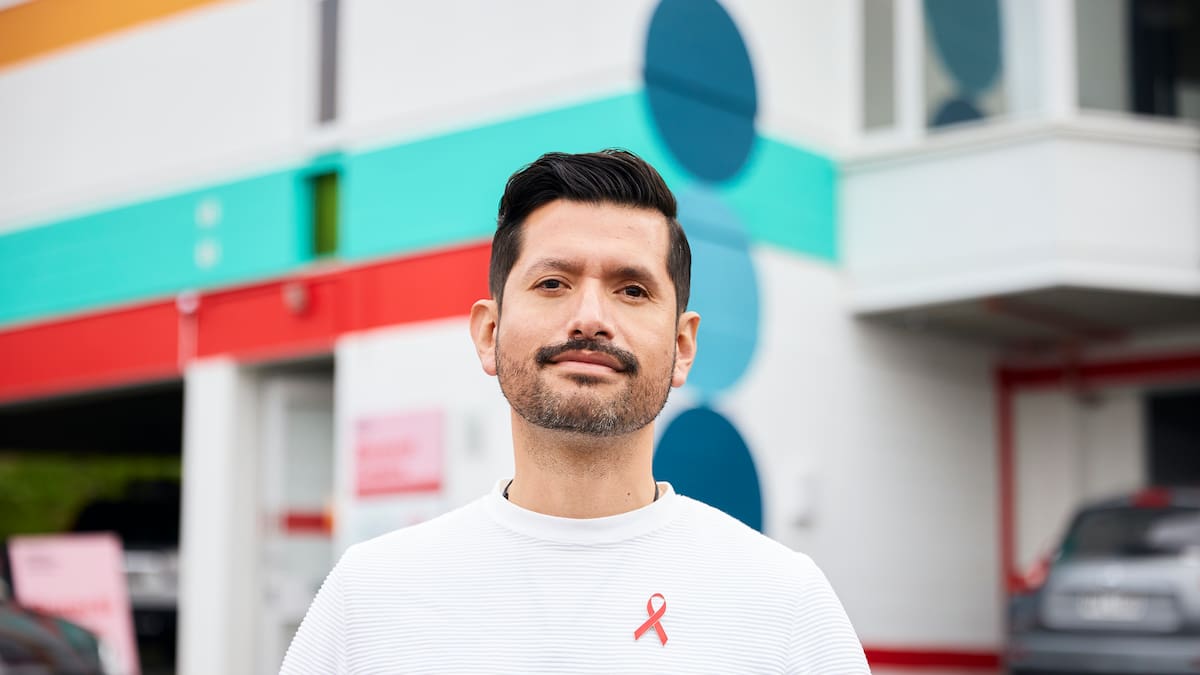
Rodrigo Olin-German has lived with HIV for 22 years. Photo / Supplied
Rodrigo Olin-German is an HIV advocate who has lived with the virus since 2003. He is board chair of the Global Network of People living with HIV and head of services and outreach at the Burnett Foundation Aotearoa. Here, on World Aids Day, he talks to Paulette Crowley
about what’s it like living with HIV.
Have you ever seen the movie Philadelphia? It’s about a gay man with a very successful career as a lawyer. He had human immunodeficiency virus (HIV), which destroys your immune system. Like many people with HIV back when that movie was made in the 1990s, he got really sick and died.
I watched that movie back in my homeland of Mexico when I was 20, while I was waiting for the results of an HIV test. I had symptoms of a sexually transmitted infection but doctors also tested me for HIV. Watching that movie was really, really powerful. I couldn’t help thinking, “Is this what my life is going to become?”
Mexico is a very conservative Catholic country where religion has permeated the culture. One of the things that’s been ingrained in the minds of many Catholics is that being homosexual is wrong and that gay people will go to hell. That stigma pushes people into living hidden lives and not talking about who they love. So, I was very aware of that as I identified myself as a gay man when I was growing up. My mother didn’t take it very well when I came out to her as gay in my late teens. She was frightened I would get the disease that “gays get” and die.
When my results finally came back from the doctor, they showed I was HIV positive. I was aware of how HIV was contracted and knew that using condoms was a way to avoid it, but I was young and having a good time in Mexico City where I had moved from my small hometown. Deep down, I knew the test would come back positive because of all the times that I really didn’t use a condom.
The way the news was delivered to me by medical staff was pretty brutal. They basically just said my test was positive and that I was most likely going to die from acquired immunodeficiency syndrome (Aids). Aids is caused directly by untreated HIV and means that even usually mild viruses and illnesses can make you very sick, or even kill you, because your immune system doesn’t work any more. I was advised to look after myself, avoid crowded places and stop having sex. Of course, this really crushed my world. I felt destroyed.
That was back in 2003 and the medical approach to HIV was to let the immune system weaken to the point where you started to develop Aids before giving you medication. I was very privileged and lucky that I never got any Aids-related illnesses but my blood markers had reached the level where I needed treatment when I was 24, which is when I started medication.
By then I’d involved myself in learning everything I could about living with HIV. I learnt about the treatments, how to look after myself and about disclosing the condition to others. I got used to the idea that I would have this condition for the rest of my life.
I was at university then and wondered if there was any point in my studying if I was just going to die. I ended up getting a lot of support from people at an HIV organisation, who helped me develop a different outlook on my life. I started volunteering with them, which led to me dedicating my career to working in HIV prevention.
The first anti-retroviral drugs to control HIV were a game-changer in the late 1990s, and treatments have continued to improve, so now therapies have fewer side effects.
My work took me to the Netherlands, where I met my then-partner, who lived in Australia. We tried to live together in Australia, but I had trouble getting a visa because of my HIV status, so, in 2011, we ended up in Dunedin on a working holiday visa while we dealt with immigration in Australia.
I established myself here by working in the public health space. Because I wasn’t a resident, I couldn’t access funded medical HIV treatment, so I approached HIV organisations for advice and support. Dr Jill Wolfgang, an infectious disease specialist, was sympathetic to my case and applied to a drug company to get treatment under compassionate circumstances.
I was granted residency to New Zealand in 2013 and from then was able to access publicly funded HIV treatment. Modern HIV treatment allows people to stay healthy without developing Aids. While HIV is mainly transmitted through sexual contact and prevention remains key, research shows those on effective treatment with an undetectable viral load cannot transmit HIV to sexual partners.
I have had partners who were HIV negative, who were obviously understanding of the virus because they decided to be in a relationship with me. I’ve also had partners who were HIV positive, including my current partner. We have a deeper understanding of what it’s like to live with HIV. We totally get each other.
I’m 42 now and take really good care of myself these days. I mostly don’t have any negative side effects from the medication. As I get older and eventually develop other age-related conditions, things may change but we’ll see what happens.
I have met so many wonderful people and get to do the work I love but I sometimes sit and reflect on what my life would be like if I didn’t have HIV. My life in New Zealand is so good and I’m really grateful to be here but still, I wish I didn’t have it because the HIV stigma remains.
SaveShare this article
Reminder, this is a Premium article and requires a subscription to read.
Copy LinkEmailFacebookTwitter/XLinkedInReddit