
The QEII National Trust oversees more than 5000 hallowed, irreplaceable, remnants of ecosystems that New Zealand once had in spades.
The covenants have robust statutory protections but many now lack enough physical armour to prevent growing numbers of feral deer moving in and making their own arrangements for these precious plots.
In the third of Newsroom’s series on pest issues in the southern region, we continue to look at the impact deer are having on biodiversity.
Across the country about a quarter of the trust’s sites are being impacted by feral deer, but in Southland the invasion is much more widespread.
There, very few of the region’s 430 covenants don’t have deer issues and damage ranges from subtle to severe.
QEII Trust representative, Jesse Bythell, who oversees about half of Southland’s sites, says the situation is a “slow-moving train wreck” with the animals decimating native species.
“Numbers are significantly increasing even in urban areas like on Stewart Island, in Oban, to the point where people deer fence their veggie gardens to protect them from deer because that’s the only way. And at $25 bucks a metre deer fencing is not cheap.”
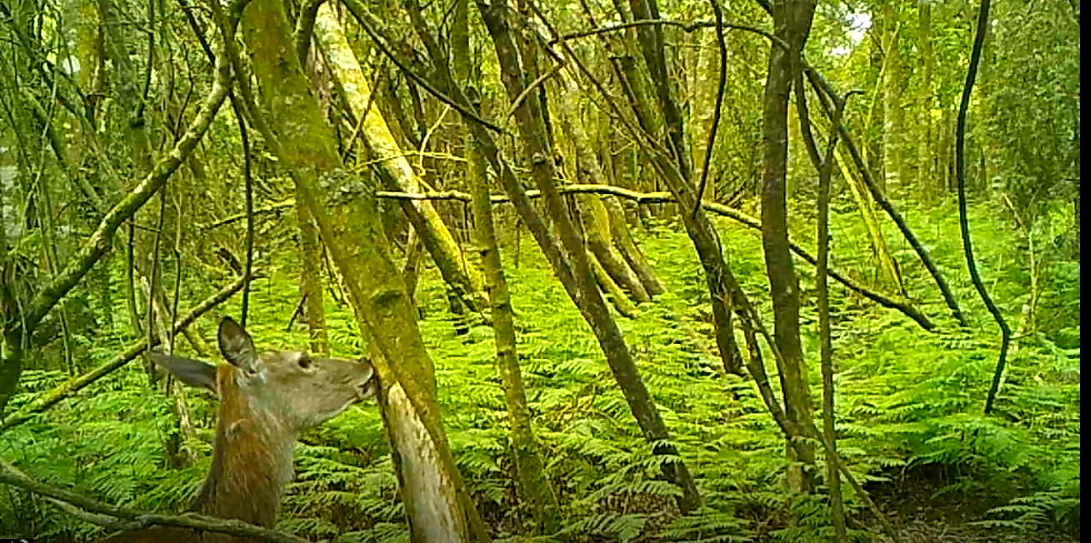
Red deer – “big units with a big range” – have been recorded eating tree bark after consuming most of a forest’s lower-growing plants. The bark chewing, combined with damage from stags rubbing antlers on trunks, caused canopies to break apart and trees to fall. The browsers also killed rare plants and caused pugging of the ground and sediment run-off.
School children were amongst those facing the dismay of finding damaged plants inside covenants. Bythell says the 24ha Sherwood Forest, located 20 minutes from Invercargill, had been regenerating well following a severe frost event in 1996.
“It’s a rare remnant flood plain forest that contains threatened plant species, some nationally significant. Sadly, very recently deer have moved in. There is a lovely local school group that does work there. They trap possums and they have been growing some of the threatened plants from seed and planting them back in there. They were absolutely gutted to find their plantings are being chewed by deer.”
The children, from Hedgehope Primary School, erected trail cameras that recorded fallow deer – who are territorial – doing the damage.
‘The deer were having a party in there; it was stripped out and completely debarked. What you were seeing was rapid collapse of mature forest, it was very eye-opening for me and probably the worst I’ve seen.’
Kamahi forest owner
“In 10 years we’d never seen fallow in that area. Once fallow get established somewhere they like to stick around. And it’s in a flood plain so deer fencing wouldn’t work; it would get wrecked immediately.”
She says deer fencing sometimes only acted as “a bit of a band aid” as the animals could scramble over it at a push. Trees fell on it and on the coast, corrosion cut its lifespan down to about 15 years. It was expensive to install as well as maintain and only four covenant owners in her patch had elected to use it to defend their plots.
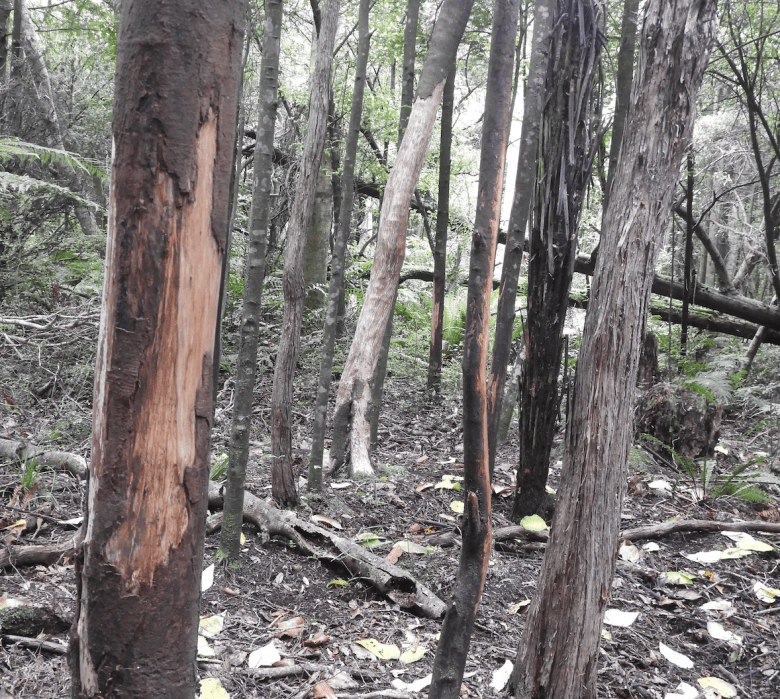 Young rimu trees that have been badly damaged by stags rubbing their antlers on the bark in Southland. Photo: Jesse Bythell
Owners were using all manner of methods to try and rid themselves of the animals, including building exit ramps so lone deer could get out without wrecking fences and side pens leading off covenants to act as trap areas.
Recreational hunters were being encouraged to shoot hinds as well as stags but could not lower populations enough to achieve good conservation gains, Bythell believes.
“Not when the numbers are this high.”
The issue was tough on owners’ moral and challenging to work on at “landscape scale”.
One owner whose kamahi forest was invaded by red deer and severely damaged, faced a massive task dealing with the animals. The 5.5ha plot was surrounded by high-intensity farming and the well-fed animals were grazing on both farm and forest.
“It was very frustrating and he was gutted to find that everything had been chewed to bits on the inside [of the forest]. The deer were having a party in there; it was stripped out and completely debarked. What you were seeing was rapid collapse of mature forest, it was very eye-opening for me and probably the worst I’ve seen.”
The trust helped organise the erection of deer fencing around the site.
Who’s in charge
On public conservation land, the Department of Conservation (DoC) manages feral ungulates under the Wild Animal Control Act. It also undertakes some work on private land.
Only on Stewart Island and a few small sites near Dunedin are they legally classified as pests and controlled through the Biosecurity Act by Environment Southland and the Otago Regional Council.
Elsewhere in Southland, Environment Southland classifies deer as ‘Organisms of Interest’ – a species they are keeping a wary eye on.
Holders of Crown leases such as on high country farms, are obligated through both their lease agreements with central government – via Land Information New Zealand – and through the Wild Animal Control Act, to control species causing damage. The reality is that while most do, some don’t.
Cost is an issue and it can be a waste of time and resources if the neighbour isn’t doing the same.
Then there is the NZ Game Animal Council which advocates for hunting and the management of the animals under the Game Animals Act introduced in 2013.
CEO Corina Jordan favours “adaptive management” where healthy, low-density deer herds are maintained as well as “healthy, resilient ecosystems”.
Hunters actively managing the number of female deer would be key to this approach.
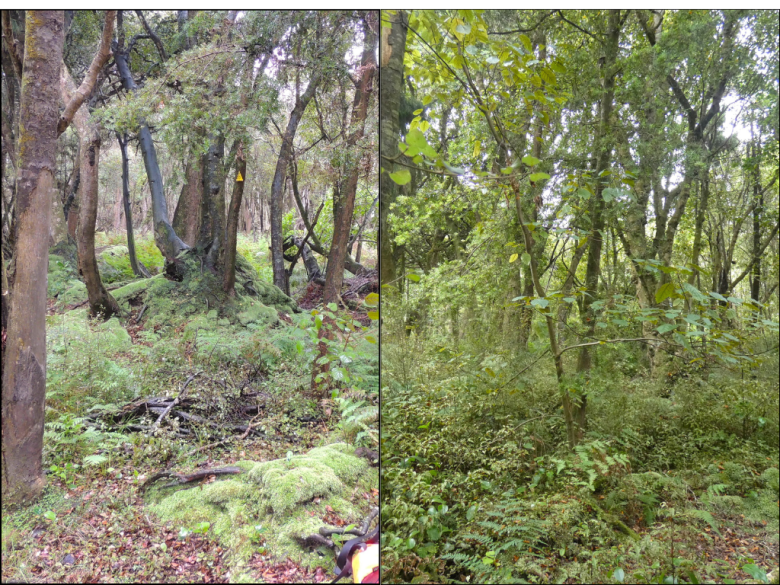 Before and after deer had been excluded from the same patch of native bush on a Southland farm. Photos: Jesse Bythell.
Production and permanent (‘carbon’) forestry is subject to pest management rules under the National Environmental Standards for Commercial Forestry. Land Information New Zealand confirms that regional councils are responsible for implementing, consenting, and monitoring compliance with these standards.
(However, that may well change following a government announcement last week that proposed to entirely overhaul regional councils, carving up their assets, liabilities and responsibilities between central government, local councils, multi-council-owned companies, and likely the private sector. This could well affect pest management plans and strategies.)
The Overseas Investment Office told Newsroom it had approved conversion of farmland to production forest on 58,660ha nationwide since 2022.
Pine forests are known to be favoured by ungulates, partly because of proximity to working farms – for pigs and deer it’s a bit like living next door to a supermarket. The industry, however, is getting sick of copping the blame, Dr Elizabeth Heeg, NZ Forestry Owners Association chief executive says.
Most operators, Heeg says, exceeded their legal pest control requirements, with tens of thousands of animals being removed since numbers began to grow post-Covid. Some operators were now facing costs of $132 per hectare for pest control.
In response to Newsroom’s questions regarding control work slacking off at later stages of forest growth, she says owners were being urged to record pest management activity and provide data on work being done at all stages to give a clear picture.
The majority of the irritation to foresters is caused during the planting and establishment phase, when pines are nipped off while still tender. In the Catlins, the Otago Daily Times reported last month a company having to replant several times on a farm-to-forestry conversion after deer repeatedly wrecked young trees.
“There needs to be a collaborative effort, Heeg says. These animals are using the landscape very broadly so we have to take a landscape approach to control.”
It is a sentiment being repeated by most parties including the QEII Trust.
“Most QEII covenant holders do their best to reduce the impact of deer in covenanted areas. However, the problem is landscape-wide and cannot be solved by a single landowner or covenant holder – it can only be solved on a landscape scale in an integrated manner,” QEII spokesperson Laura Dalby says.
Meanwhile, the Ministry for Primary Industries says it has begun a programme to improve the management and coordination of feral browsing animals with an initial focus on reducing the impact of wild deer on farmers, growers and production land.
“The programme is actively reviewing regulatory processes to make control operations easier. It is supporting the development of a joint wild animal data management information system that should improve understanding about feral deer populations and act as a vehicle to improve operational coordination, including for control operations,” says John Saunders, Director of Forestry Operations, at Te Uru Rākau – New Zealand Forest Service.
MPI was also looking at options for individual owners and catchment-level work.
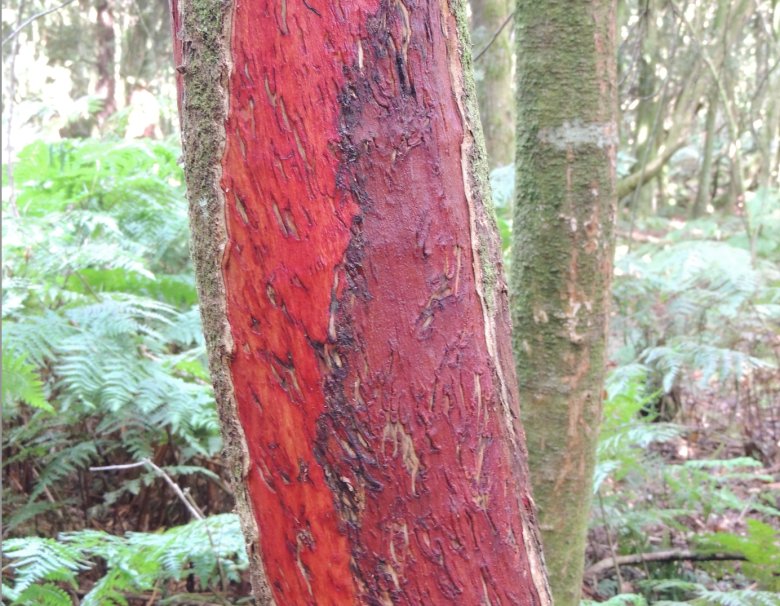 Pokaka tree with bark missing after it was eaten by deer in native forest in Southland. Photo: Jesse Bythell
He says the programme was “getting off the ground now” and involved DoC, Federated Farmers, Beef + Lamb New Zealand, Forest & Bird and others.
Saunders says regional councils had a significant role to play in managing these browsing pests and had a large body of work underway.
This could all change, of course, in light of the Government’s regional councils proposal.
Environment Southland, however, says that as ungulates are regulated under the Wild Animal Control Act, it was limited to offering advice following queries and information as part of other projects.
The regional authority had only “low-scale involvement” in recent discussions with the primary industries ministry, DoC and Federated Farmers about the development of a national strategy for feral deer management, through workshops and meetings the council attended, Environment Southland acting operations delivery manager, David Adamson, said.
Otago Regional Council has just kicked off a review of its regional pest management plan with the new plan initially due out in mid-2028. The authority has no funding for feral ungulate control but viewed the animals as a “biodiversity concern”, manager of environmental implementation, Libby Caldwell says. Staff had some involvement with DoC programmes and were aware of growing uneasiness in the community over the animals’ impact.
Federated Farmers Meat and Wool Industry chair Richard Dawkins believed there was merit in the idea of regional councils being more involved, but extra funding would be required. A proposal aiming to make this more possible through an amendment to the Biosercurity Act was made last month by Biosecurity Minister Andrew Hoggard.
Dawkins says a Wild Animals Management National Coordination Group was bringing lots of agencies and groups together to support a coordinated national response but the longer-term answers ultimately had to come from landowners.
“The enduring solution must come from those on the land – it will be impractical and expensive for government departments to manage pests in the long term.”