
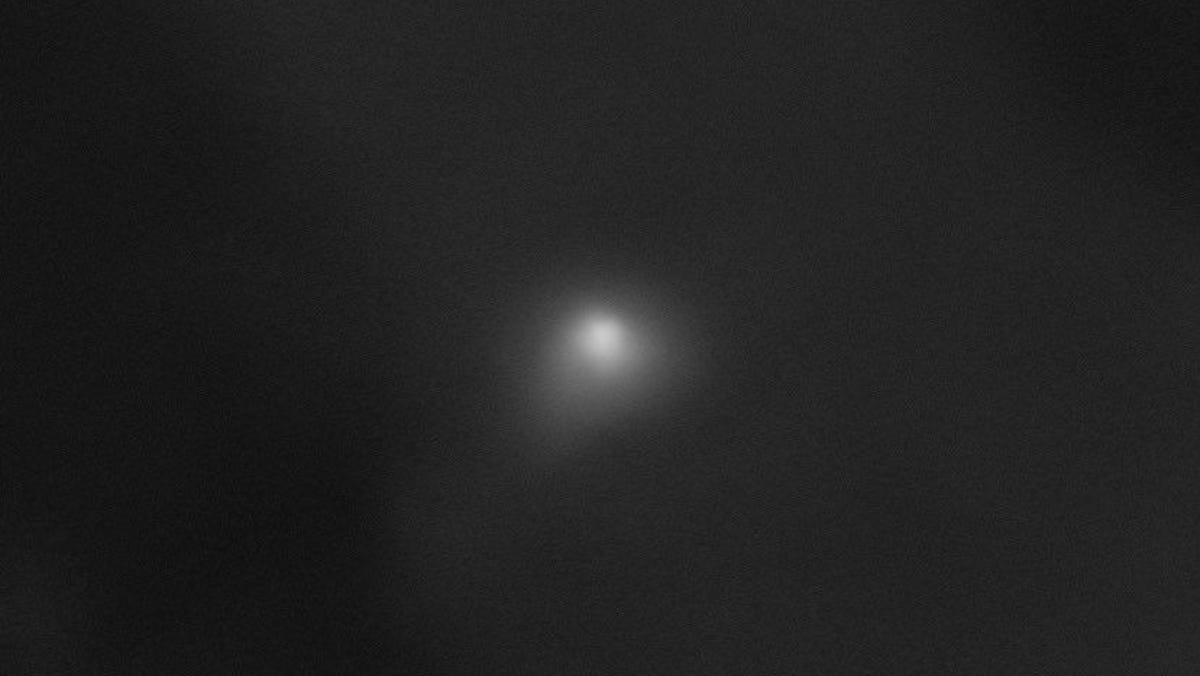
Here’s everything to know about 3I/ATLAS’s impending rendezvous with Earth and how you might be able to witness it.
December is the month that fans of the 3I/ATLAS interstellar comet have been waiting for.
In a matter of days, the strange space object that has become a cultural phenomenon is due to get as close to Earth as it ever will.
If you’re a professional or amateur astronomer, that means it’ll be among your best opportunities to catch a glimpse of an ancient object composed of planetary material that formed from another star. And if you’re among those buying into the conspiracy theory that 3I/ATLAS could be extraterrestrial technology, that may be the day of the alien invasion – or something?
No, 3I/ATLAS is not an incoming spaceship – at least, according to the consensus of astronomers and the world’s space agencies. But it still isn’t very often that an object from outside Earth’s solar system finds its way into our cosmic neighborhood.
Here’s everything to know about 3I/ATLAS‘ impending rendezvous with Earth and how you might be able to witness it.
What is 3I/ATLAS?
An object known as 3I/ATLAS made news in July 2025 when it was confirmed to be the third-ever object discovered originating outside Earth’s solar system. When it was spotted, 3I/ATLAS was whizzing at about 137,000 miles per hour, according to NASA.
Observations of 3I/ATLAS’ speed and trajectory confirmed to astronomers that it formed in another star system and was ejected into interstellar space – the region between the stars, according to NASA. For potentially billions of years, the comet has drifted on a journey from the general direction of the constellation Sagittarius in the center of the Milky Way that recently brought it into our solar system.
Unlike comets bound to the sun’s gravity, 3I/ATLAS is traveling on a hyperbolic orbit that will eventually carry it out of the solar system and back into interstellar space.
How big is 3I/ATLAS?
Astronomers don’t yet know exactly how big 3I/ATLAS could be, but estimates range from a few hundred feet to a few miles across, according to the European Space Agency. Data returned from the Hubble Space Telescope allowed astronomers to estimate the size of the comet’s solid, icy nucleus as anywhere from about 1,400 feet to 3.5 miles wide.
Where is 3I/ATLAS now? Interstellar comet approaches Earth
The comet 3I/ATLAS, which is not a threat to Earth, is projected to pass within about 170 million miles of our planet on Dec. 19 – or about twice the distance between Earth and the sun.
The object also came within 130 million miles of the sun on Oct. 30, just inside the orbit of Mars. For reference, the sun is about 93 million miles away from Earth.
Can I see 3I/ATLAS from the ground? Where can I track its position?
Though 3I/ATLAS is not visible to the naked eye, those with even a small telescope can observe the comet in the pre-dawn sky until spring 2026, according to NASA. The agency’s “Eyes on the Solar System” online simulation shows the current location and path of 3I/ATLAS as it moves through our solar system.
NASA releases photos of 3I/ATLAS comet
NASA on Nov. 19 released a trove of never-before-seen images of 3I/ATLAS unveiling new characteristics of the object. The imagery came courtesy of the space agency’s fleet of space telescopes and other spacecraft that have spent months observing the comet.
A look at all of the photos NASA has released of 3I/ATLAS since its July discovery, including detailed explanations of each, are available below:
Is 3I/ATLAS an alien spaceship? NASA leaders reject conspiracy theory
The strange outsider’s jaunt through Earth’s cosmic neighborhood has sparked plenty of outlandish conspiracy theories regarding its nature.
One particularly infamous idea – put forth by a Harvard astrophysicist named Avi Loeb – is that 3I/ATLAS could be an alien spaceship. Though Loeb has conceded on publishing platform Medium that the object is “most likely a comet of natural origin,” he has not ruled out the possibility that it could be extraterrestrial technology.
NASA officials, though, have attempted to put that notion to rest.
In a social media exchange with reality TV star Kim Kardashian in October, NASA Acting Administrator Sean Duffy affirmed: “No aliens. No threat to life here on Earth.”
Nicola Fox, associate administrator of NASA’s Science Mission Directorate, also rejected the alien conspiracy theory during the agency’s November news conference, saying “we certainly haven’t seen any technosignatures or anything from it that would lead us to believe it was anything other than a comet.”
Eric Lagatta is the Space Connect reporter for the USA TODAY Network. Reach him at elagatta@gannett.com