
According to the DJI website, the FlyCart 30 weighs 65kg with two batteries and has a max horizontal speed of 20 metres per second.
Drone operator Dan Thompson from Aeroinspect next to his DJI FlyCart 30, which was used to tow Jack Jensen on his surfboard. Photo / Jack Riddell
Recently, Thompson had been using the FlyCart 30 drone to take deer carcasses out of dense bush, but he said innovation has always been a big part of his life and that’s what helped him come up with the plan for drone surfing.
“It began having a couple of beers over the table.
“It was an idea and a vision and one day it all aligned and we just gave it a crack,” Thompson said.
“The future’s now, and it’s real cool to showcase what is going on and proudly here in Hawke’s Bay as well,” Jensen said.
“So stoked to be on the front edge of it.”
On Saturday, November 22, Jensen, the MSFT Productions team and Thompson with his drone met on the banks of Te Awa o Mokotūāraro (formerly known as the Clive River).
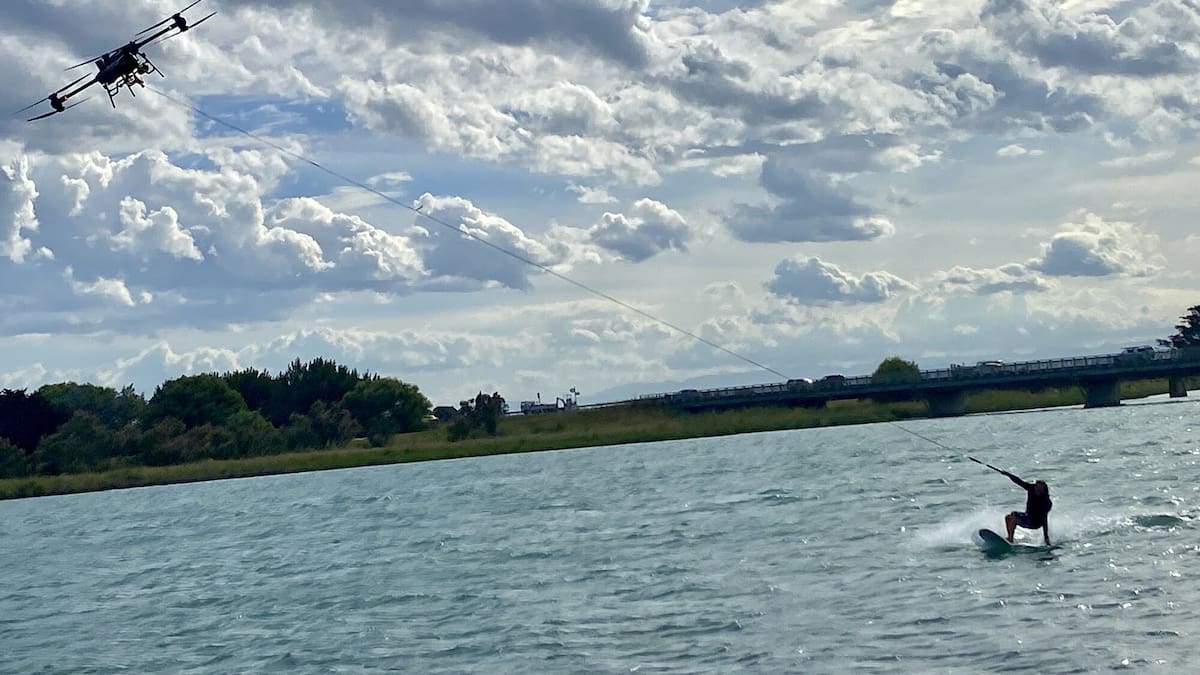
Thompson tied a wakeboarding tow rope with a handle to the bottom of the drone and Jensen grabbed his surfboard, crafted by Ben Knight from Hawke’s Bay board makers and shapers Lightwave Surfboards, and hit the water.
Soon, Jensen was being towed by the massive drone on the surfboard.
Two weeks later, Jensen had another try at drone surfing on the Ngaruroro River, this time in front of local media.
He said he was still “absolutely fizzing” after completing his first one.
He said the sensation of being towed through the water was the most striking part of the experience.
Jack Jensen “frothing” after drone surfing on the Ngaruroro River. Photo / Jack Riddell
“Psychologically it’s wild.
“But in terms of feel, it feels really similar to a cable, but better.
“That’s just because it’s a line, you don’t have a wake or anything like that, and probably the speed.”
However, Jensen has a warning for anyone thinking of giving drone surfing a go after watching him.
“We’re all for inspiring people to get out there and go get amongst, but just do it safely.”
Jensen said Thompson was one of only a few people in the country who was legally allowed to fly a drone of such size and had completed two years of courses just to do so.
“For all the gas, all the froth of people wanting to get out there, but just do it safely – make sure you dot all the i’s and t’s man.”
Jack Riddell is a multimedia journalist with Hawke’s Bay Today and has worked in radio and media in the UK, Germany, and New Zealand.