
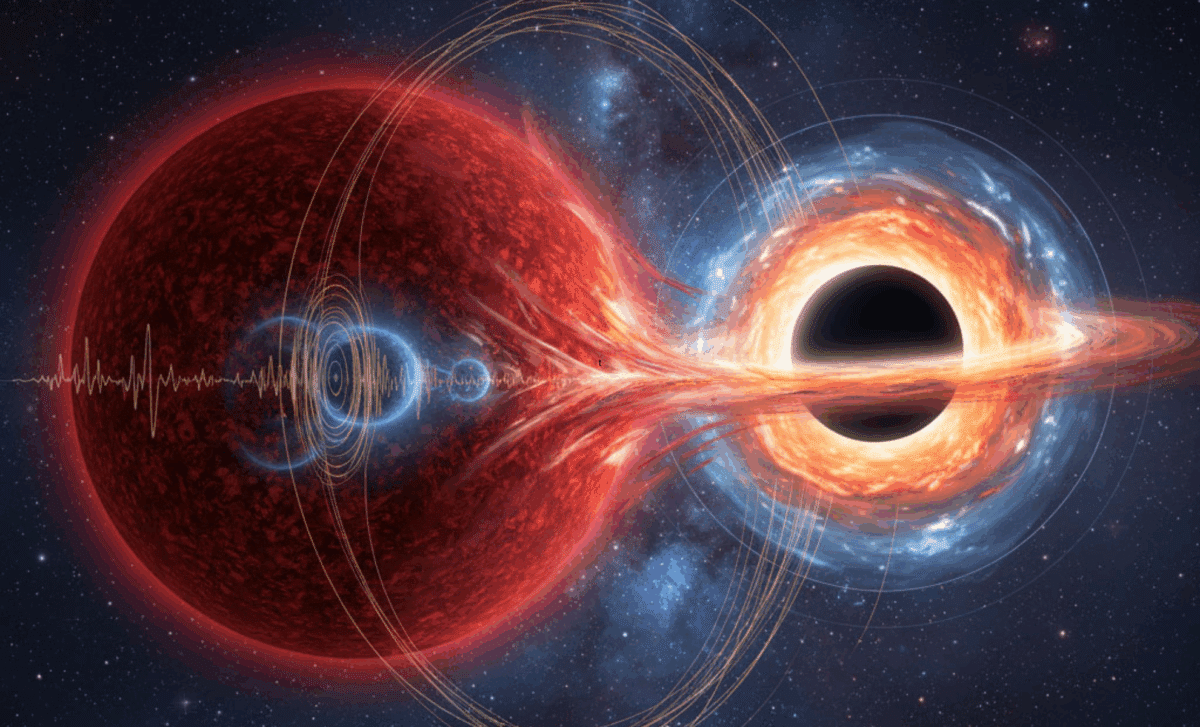
In a groundbreaking discovery, scientists using NASA’s Transiting Exoplanet Survey Satellite (TESS) have uncovered a celestial “song” emanating from a red giant star in the Gaia BH2 system, located 3,800 light-years away in the constellation Centaurus. This remarkable discovery, detailed in a recent study from the University of Hawaii, offers a new way to examine the tumultuous lives of stars engaged in a cosmic dance with black holes.
The “Song” of the Red Giant: Stellar Seismology
Stars, like planets, have their own rhythms. These rhythms are often invisible to the naked eye, but with the help of sophisticated instruments like TESS, astronomers can detect the faint vibrations or oscillations within stars. These vibrations, sometimes referred to as a star’s “song,” are not just aesthetic—they hold vital information about the inner workings of distant stars. This method of observation is similar to how seismologists use earthquakes to probe the interior of Earth. As Daniel Hey, team leader of the study from the University of Hawaii Institute for Astronomy (IfA), explained: “Just like seismologists use earthquakes to study Earth’s interior, we can use stellar oscillations to understand what’s happening inside distant stars.”
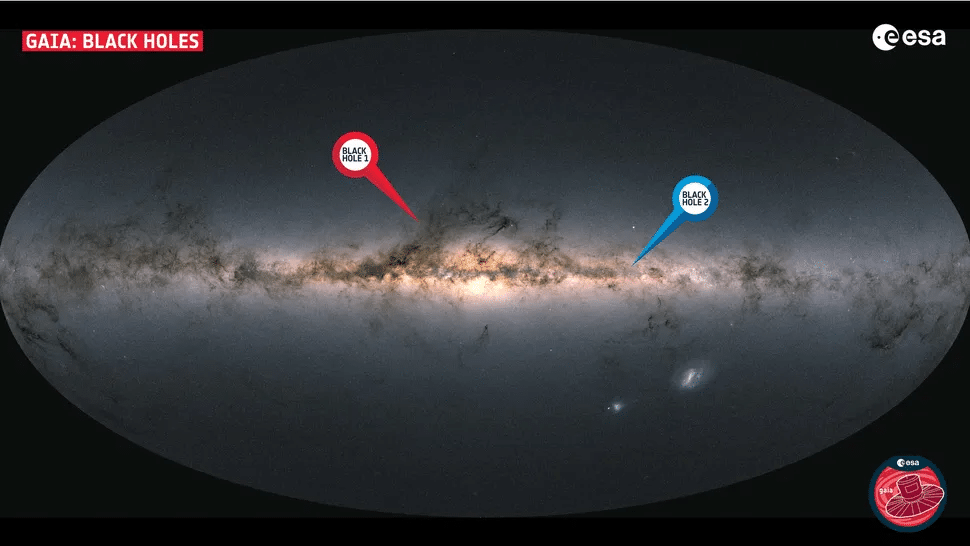 An image of the Milky Way showing the location of the first two black holes discovered by Gaia including Gaia BH2 which has a red giant companion. (Image credit: ESA/Gaia/DPAC; CC BY-SA 3.0 IGO, CC BY-SA 3.0 IGO)
The red giant in question, located in the Gaia BH2 system, has been studied for these exact oscillations. The data collected by TESS reveals the star’s internal composition and how it behaves under the gravitational pull of its black hole companion. The result? A star that has a far more complex history than astronomers originally anticipated. Hey continued, “These vibrations told us something unexpected about this star’s history,” indicating that the star’s evolutionary path is anything but straightforward.
The Unexpected History of Gaia BH2’s Red Giant Star
The red giant star in the Gaia BH2 system, which once lived as a relatively stable star, has gone through a series of turbulent changes. Red giants are typically older stars that have exhausted the fuel in their cores for nuclear fusion. However, the star in Gaia BH2 is much younger than expected—only about 5 billion years old. This age, paired with the star’s unusual chemical composition, raises intriguing questions. The star’s high abundance of heavy elements, particularly “alpha-rich” elements, is typically seen in older stars. Yet this red giant is still in its early phase, much younger than similar stars observed in isolation.
According to Hey, “Young, alpha-rich stars are quite rare and puzzling,” and the combination of youthful age and ancient chemistry suggests that the star’s story is far from typical. The star likely didn’t evolve in isolation. Rather, it most likely acquired extra mass from a companion, either through a merger or by absorbing material when the black hole in the system formed. This process would have fundamentally altered the star’s chemistry, making it an anomaly in the study of stellar evolution.
Rapid Rotation: A Clue to the Star’s Violent Past
The red giant’s rapid rotation is another key feature that hints at a dramatic history. Scientists observed that the star rotates once every 398 Earth days, a much faster spin than most red giants of a similar age. This rapid rotation is not characteristic of stars in isolation. According to Joel Ong, a NASA Hubble Fellow and team member on the project,
“If this rotation is real, it can’t be explained by the star’s birth spin alone. The star must have been spun up through tidal interactions with its companion, which further supports the idea that this system has a complex history.”
Such fast spinning can occur when a star undergoes tidal interactions with a close companion, such as a black hole, which exerts gravitational forces that accelerate the star’s rotation. This interaction also likely plays a role in the observed starquakes, a phenomenon that occurs when the star’s internal structure is disturbed by its companion. The faster a star spins, the more pronounced the effects of these tidal forces. This further supports the theory that Gaia BH2’s red giant star was influenced by its proximity to the black hole, or even interacted with another star in the system’s past.
The Mysterious Birth of the Black Hole: The Role of the Black Hole Companion
The presence of a black hole in the Gaia BH2 system adds another layer of complexity to the story. Black holes are notoriously difficult to study directly, but their gravitational influence on nearby stars can offer valuable clues about their formation and history. The discovery of Gaia BH2’s black hole, along with its red giant companion, has provided new insights into the role of black holes in stellar evolution.
The black hole likely formed when a massive star in the binary system collapsed at the end of its life, creating the gravitational well that the red giant star now orbits. The transfer of mass between the black hole and the red giant may have occurred at the time of the black hole’s formation, leading to the star’s current unusual properties. As Hey explains,
“The combination of youth and ancient chemistry suggests this star didn’t evolve in isolation. It likely acquired extra mass from a companion, either through a merger or by absorbing material when the black hole formed.”