
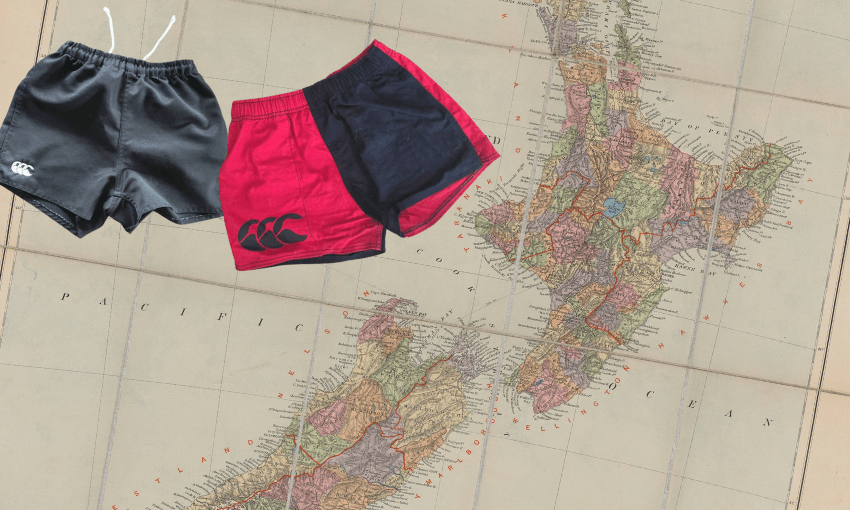
In praise of our national uniform.
This country disagrees about a lot of things: rates, regional councils and whether Ikea will be a net positive for the nation. Our economic recovery has been more uneven than the All Blacks’ 2025 season, but we’ve reached December in a year billed as “survive to through 2025” and as green shoots (reportedly) emerge, so do our legs.
Canterbury shorts are cropping up across the motu. They can be found in small, rural towns grappling with industrial decline and factory closures; they’re worn by teenagers who attend private schools armed with cutting-edge sports equipment and upward mobility; there were some ambling down New North Road recently to see Metallica (they’ll withstand even the hardest mosh pit and keep you cool).
A common sight year round (shorts in summer being a national pastime), they’re one of a handful of garments people point to when asked to define “the Kiwi look”, but that’s due to more than just popularity. They’ve earned a bit of cultural and social significance since they began freeing the nation’s thighs. Since then they’ve become a national uniform, quite literally.
The All Blacks wore them until 1999 (when Adidas won the uniform contract from Canterbury) and many club and school-level teams still do. As such they’ve come to represent national values of physicality and practicality. Cotton drill rugby shorts are in many ways the antithesis of state-of-the-art, moisture-wicking performance wear and speak to a time before efficiency and professionalism. Nostalgia is a powerful thing; many brands would kill for the good will and cultural significance Canterbury has earned in its 120 years.
 Portraits photographed by Tom Gould for Canterbury. (Images: Canterburyautwta.com, @tom_gould)
The best shorts make this passage of time clearly legible; the more faded and worn in they are the better. Ideally these qualities should be earned, but if you’re not phased by suggestions of stolen valour then plenty can be found secondhand. There are so many on Trade Me and Facebook Marketplace, photographed against floors, closet doors and duvets around the country.
Underneath all that cachet you’ll find what’s still a pretty solid garment. Durably made, they can withstand most kinds of activities. The standard fit isn’t too tight and doesn’t cling, giving you room to move, while sizing goes up to 6XL. The most classic of Canterbury shorts are still made from 100% cotton drill with flat felled seams, feature a three-inch inseam and – still! – have pockets. The brand’s familiar “harlequin” design comes in more colourways than you’d expect for 2025, even fuchsia. All feature that familiar, “mind-blowing” logo.
All Black Tana Umaga in Canterbury shorts in 1999 (Photo: Getty Images)
Reliably for a nation accustomed to the sunsetting of popular and culturally significant consumer goods, Canterbury’s shorts design has stayed more or less the same since. The price hasn’t varied too wildly either; a pair of drill shorts (now produced in China) costs $44.99. They were $26 in 1988 – the equivalent of $33.30 today when adjusted for inflation – while a pair of “ladies rugger shorts” bought in 1986 would cost you $18.50 ($26.24 adjusted).
This accessibility has earned them an egalitarian status, which appeals to New Zealand’s fantasies of classlessness and equality. Everyone could and should have a pair of rugby shorts.
There’s the Canterbury option obviously (spiritually related to a brighter, bolder successor, the NRL variety) and more basic, logo-free varieties Postie and Warehouse call “rugger shorts”. All fall into the more general category of “stubbies” – a genericisation of an Australian brand started in 1972. At a bare minimum, you’ll want twill fabric, an elasticated waistband, and inseam measuring no more than six inches.
Short shorts have a lengthy history here. (Images: A Canterbury advertisement that ran in a December 1988 issue of The Press from Papers Past, Stubbies made by Bradmill NZ Ltd from the NZ Fashion Museum archive)
I have had mine since I was a teenager. They’re white, stained and have seen a lot – including fish innards. Still the first thing I reach for on summer weekends, a similar ritual likely happening in thousands of other homes at even a slight inkling of warm weather. They’re easy, durable and make you look vaguely athletic.
Alex Casey bought a faded old pink and orange pair for summer, due largely to the nostalgia factor. “I had a couple of pairs of Canterbury shorts as a kid in the early 2000s (before girls got banned from wearing them at primary school because they were deemed too short),” she explains. “A while ago I saw Liz Stokes from The Beths wearing Canterbury shorts on stage in the States and I thought they were a cool and subtle patriotic nod, and felt kind of subversive to see them worn so far off the rugger field.”
Musicians are mad for them. Princess Chelsea’s bassist wore harlequin shorts on stage at the Aotearoa Music Awards in 2024, Hori Shaw obviously wears Canterbury shorts, and Marlon Williams wore unbranded black rugby shorts on the cover of his 2022 album My Boy in a tableau that’s so “Kiwi” you don’t even need a logo.
If there is, that can still divide the nation. Is it three Cs or a trio of kiwi?