
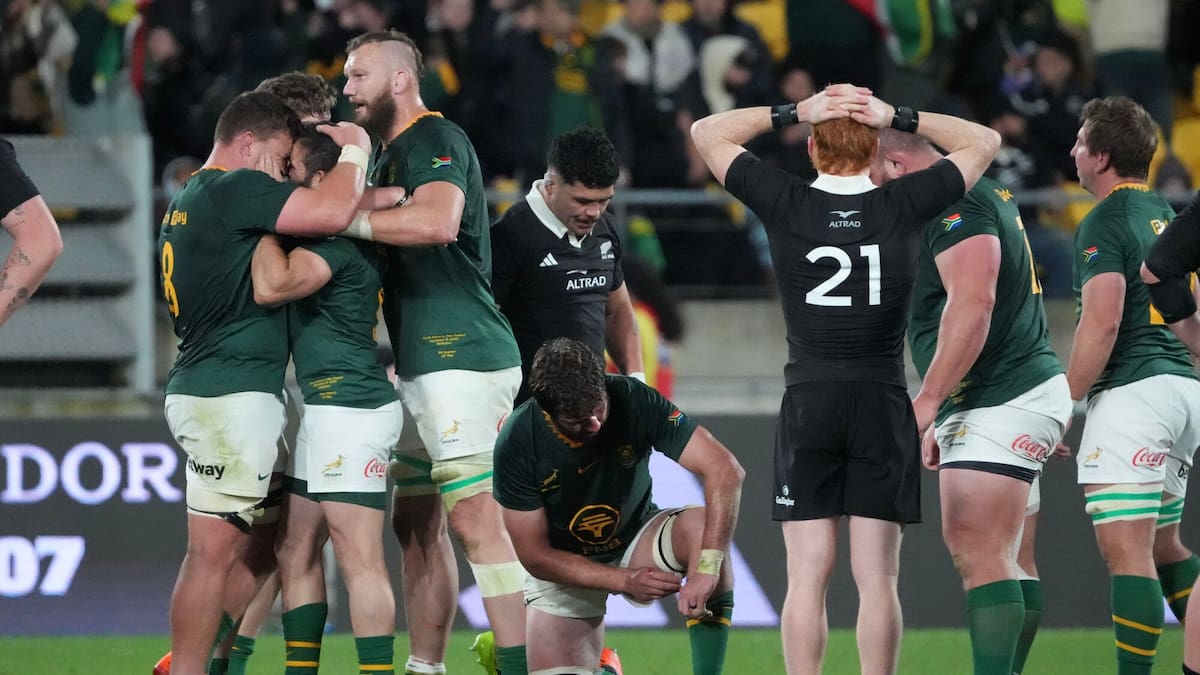
Right now, based on how the All Blacks have performed in the past two years, South Africa would start as heavy favourites, and England as slight favourites.
Maybe if a few things went the All Blacks’ way – the weather, the referee, injuries – they could sneak past England, but there is almost no scenario in which it’s possible to see them toppling the Springboks.
The vagaries can often be a swing factor in top-level rugby, but it feels as if the gap between New Zealand and South Africa is currently too big to be closed by a bit of rain or a referee missing a forward pass.
The straw to clutch as evidence of this assessment being hyperbolic is the All Blacks’ victory at Eden Park in September, but there is a sense that the Springbok team that lost that night are entirely unrecognisable to the one they are now.
Since that defeat, the Springboks have started phasing in their next generation of stars, have revamped their attack and sent themselves on a yet steeper growth trajectory. In contrast, the All Blacks continue to act much like New Zealand’s economy, in that they are perpetually promising to boom while continuing to stagnate.
For NZR’s chair, David Kirk, the specifics of the World Cup draw have not changed the fundamental question he must ask at the end of a season in which the All Blacks lost three games and again didn’t win anything of note, but it has given a more precise element to the wording.
Instead of asking whether there is sufficient reason to believe the All Blacks can win a World Cup with their current coaching set-up, he now must ask whether they can win it knowing they will have to beat South Africa – or England – in the quarter-final.
The difference is not semantic but fundamental, because prior to the draw being made, there was always the hope that fate would be kind.
That New Zealand could have found themselves assigned a softer route – one where they were destined to meet the budget end of the glitterati in the early knock-out rounds and hope that maybe South Africa, England, France and Ireland faced off.
Extending the number of entrants to 24 teams has, after all, ensured the 2027 World Cup draw is riddled with inequity and if New Zealand had been drawn in Pool D instead of Ireland, New Zealanders would be looking at the tournament with a significantly higher degree of optimism.
But fate has not been kind, and unless Australia transform themselves into genuine contenders over the next 18 months, or the All Blacks make a strategic decision to not play their best side in their pool clash against the Wallabies, they will meet South Africa in the quarter-final.
With South Africa looming much like the iceberg that sank the Titanic, the general theoretical musing about New Zealand’s ability to win the next World Cup has been replaced by a more focused debate about whether the All Blacks can survive a head-on collision with the Springboks.
The beauty of sport – its very essence in fact – is its capacity to surprise. History is full of stories about teams in peril recalibrating to become champions, and the All Blacks so nearly fell into this category in the last World Cup cycle.
But they reshaped their destiny by making significant coaching changes 18 months out from the tournament, and what Kirk has to determine is whether Scott Robertson is working towards a carefully considered master plan that has the All Blacks on course to succeed in 2027, or whether the team is likely to drift yet further behind the Boks unless there is some kind of enforced change made to the set-up.
What supports the former is that the All Blacks have built depth in many positions these past two years and may be looking to forge combinations and a more cohesive strategic approach next year.
Working against that, though, is that depth has not been built uniformly in all positions and nor has there been an obvious determination to use every available opportunity to select emerging players.
Of equal concern has been the inability to change the narrative around the consistency of performance and the third-quarter statistics in 2025, which show a points differential of minus 57, epitomising the propensity for the team to disappear into a mental black hole.
The inconvenient truth is that the evidence suggests that without some kind of enforced change, the All Blacks are not capable of beating South Africa at the World Cup.
Gregor Paul is one of New Zealand’s most respected rugby writers and columnists. He has won multiple awards for journalism and written several books about sport.