
Unlock the Editor’s Digest for free
Roula Khalaf, Editor of the FT, selects her favourite stories in this weekly newsletter.
The EU plans to restrict exports of some waste containing critical raw materials as it seeks to shore up supplies after China curbed exports of some metals.
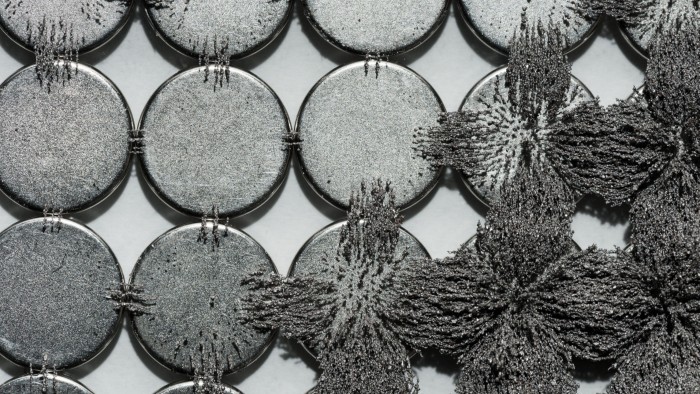
Brussels said it would next year propose restricting exports of permanent magnets so they can be recycled to cover a fifth of demand, as part of a plan to cut dependencies unveiled on Wednesday. The magnets are vital for products from electric vehicles to wind turbines and fighter jets.
The rollout of clean technologies has underlined the bloc’s need to rapidly diversify its critical minerals supply. China controls more than 90 per cent of processing capacity for several materials critical to the green transition including graphite and manganese. Its export controls introduced in April prompted European carmakers to shut down production lines and lay off thousands of workers.
“We want to be able to reuse this scrap in Europe,” a senior commission official said. The EU needs about 20,000 permanent magnets every year and demand is growing.
The magnets announcement follows a pledge to reduce aluminium scrap exports so that EU industry could remelt and use it.
“There’s a Chinese strategy to monopolise the market,” the EU’s internal market commissioner Stéphane Séjourné said on Wednesday. “Economic security has become a global challenge . . . but when it comes to [critical minerals] we have a certain number of dependencies, depending on the resource, on China to a great extent.”
The commission has also said that it will put €3bn of EU funds towards critical minerals projects, introduce a form of minimum prices for some metals, and set up a critical minerals centre.
The EU has been slower to secure supplies of critical minerals in comparison with the US, which has taken several equity stakes in mining companies and signed deals with Japan and Brazil this year to map resources.
The commission said the critical minerals plan should cut its dependencies on third countries for supplies by 50 per cent by 2029.
In an interview with the Financial Times, Fatih Birol, executive director of the International Energy Agency, said that despite the efforts of economies such as the US and EU to cut dependencies on China, they would only reduce its dominance of supply chains by about 15 per cent over the next 10 years.
“We may well see in the case of critical minerals the nightmare we had in the 1970s for oil,” he said.
Alongside the critical minerals plan, the commission also pledged tighter scrutiny of investment flows and said it would consider investing in high-tech start-ups to protect them from buyers deemed a security risk.
Foreign direct investment is regulated by national governments but they can refer cases to Brussels for guidance.
A senior commission official said it would monitor start-ups in critical technology areas such as quantum computing, especially where they could be “particularly vulnerable to hostile, foreign acquisitions”. Brussels would also work with regulators to keep an eye on portfolio investment in such sectors, which is not covered by FDI rules, the official said.