
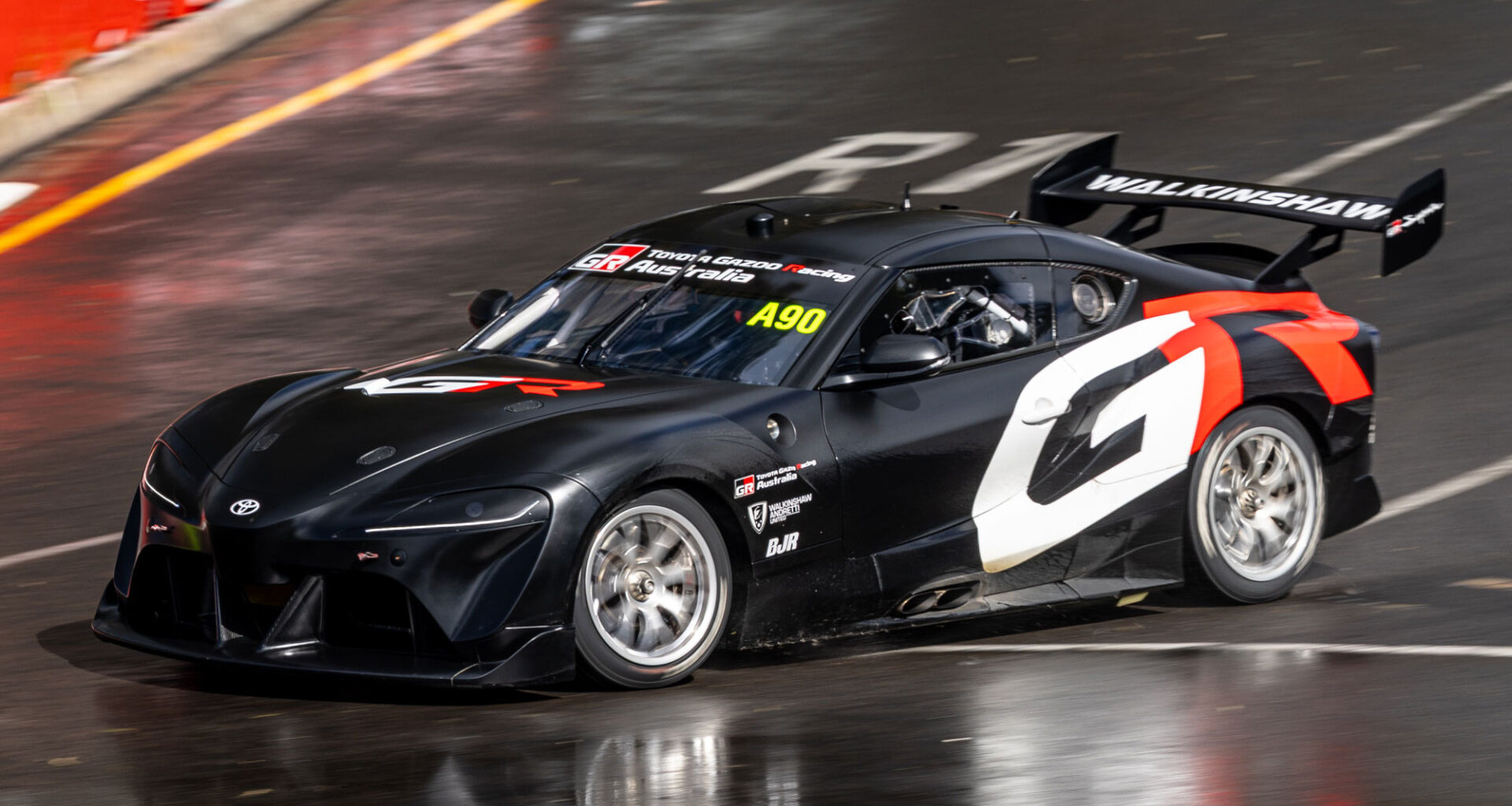
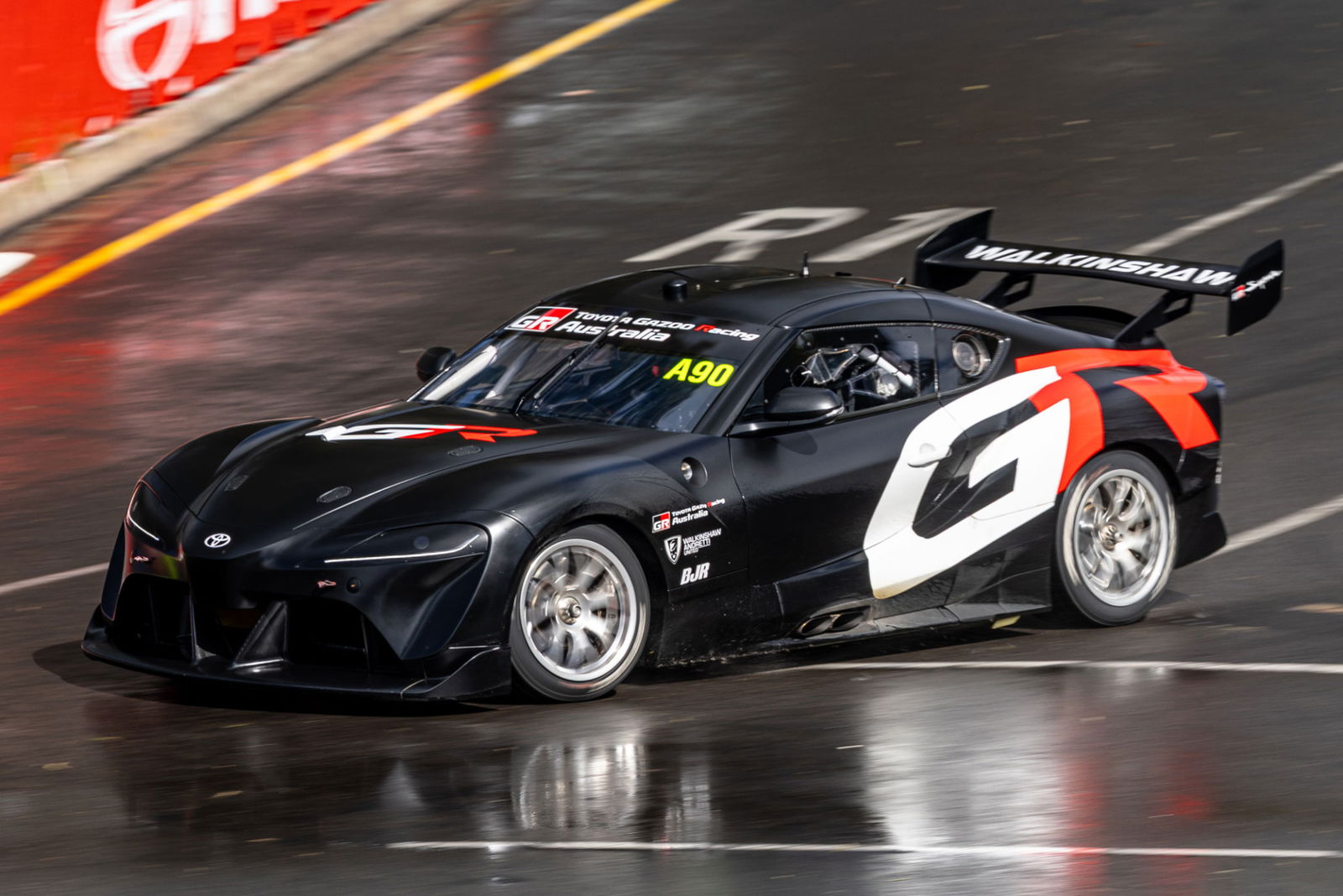
The Toyota Supra on track in Adelaide. Image: InSyde Media
Testing is set to begin at the Windshear facility in Concord, North Carolina, on Thursday evening local time, with the Ford Mustang, Chevrolet Camaro and Toyota Supra under evaluation.
The cars were prepared in Australia by homologation teams Triple Eight, Team 18 and Walkinshaw Andretti United and dispatched to the US via sea freight in late September.
Each HT has been allowed five staff at the tunnel this year, two engineers, two mechanics and one addition of their choosing, with Supercars staff and contractors completing the crew.
Some flew out directly from the Adelaide Grand Final, while others were afforded a brief trip home to see family before heading Stateside.
It marks a return to Windshear for the category following two runs over the 2023/24 off-season, and the first with the distinct Supra shape in the mix.
The Team 18 Camaro will be used as the baseline for the test, to which a Triple Eight-tweaked Mustang and the WAU Supra must be matched.
Overseeing it all is Supercars motorsport boss Tim Edwards, who admits getting all three cars inside the designated “parity box” will be a tough ask.
“We are trying to throw a dart in the centre of the dartboard and hit a bullseye,” Edwards told Speedcafe.
“It is a very small box and all of us are aware that it’s going to be a huge challenge to get the three cars into the box.”

Triple Eight’s first Ford Mustang. Image: Supplied
While the goal of getting the three cars to produce the same downforce and drag numbers sounds simple enough, they must do so across various ranges.
A 20-page document – beefed up significantly since the previous trip to the tunnel – governs the testing and features a matrix of requirements.
“There’s a massive table of different ride heights, yaws, pitches, etcetera, and then there’s different weightings based on the amount of time you spend in all these areas,” he said.
“We’re older and wiser, and we’ve been running these cars for two more years since the last time we did it, and cars aren’t being run at the same ride heights that they were two years ago.
“We’ve been running laser ride height sensors over the last few rounds, in eight cars across different teams, capturing that information.
“So we’ve got a way better picture of where everybody’s running the cars these days compared to where they were running them in 2023.”
Supercars has put months of effort into refining the process, working alongside the three HTs and its aerodynamic partner Dynamique.
Why all three US-bound Supercars have grey liveries
“We were novices when we went last time and we’d only been in partnership with Dynamique for a couple of months before we went,” he said.
“They’d never even been to a Supercar race, they’d never even seen a Supercar, so two years on, they’ve got a huge amount of knowledge of the category.
“They’ve got a very robust CFD model that they didn’t have before we went last time.
“They were able to do some correlation with having actually been at the wind tunnel and they’ve been intimately involved with the CFD of the Toyota for the last 12 months.
“It puts us in an infinitely better position.”
The Supercars contingent at the tunnel will be away for almost three weeks. As Edwards details, it’s no end-of-season holiday.
“This week we’ve got the night shift,” he said of the strict scheduling at the big-dollar Windshear facility.
“We’ve got 6pm till midnight on Thursday, we’ve got 2pm till midnight Friday, we’ll have the weekend off and then go into day shifts next week, which is 6am to 6pm.
“You’re there at 5am and everything’s been warmed up, but the tunnel door opens at 6am and in you go. They turn the fan off at 6pm and then you’ve got to digest everything you’ve learned.
“So a typical day is 5am till 9pm.”
