
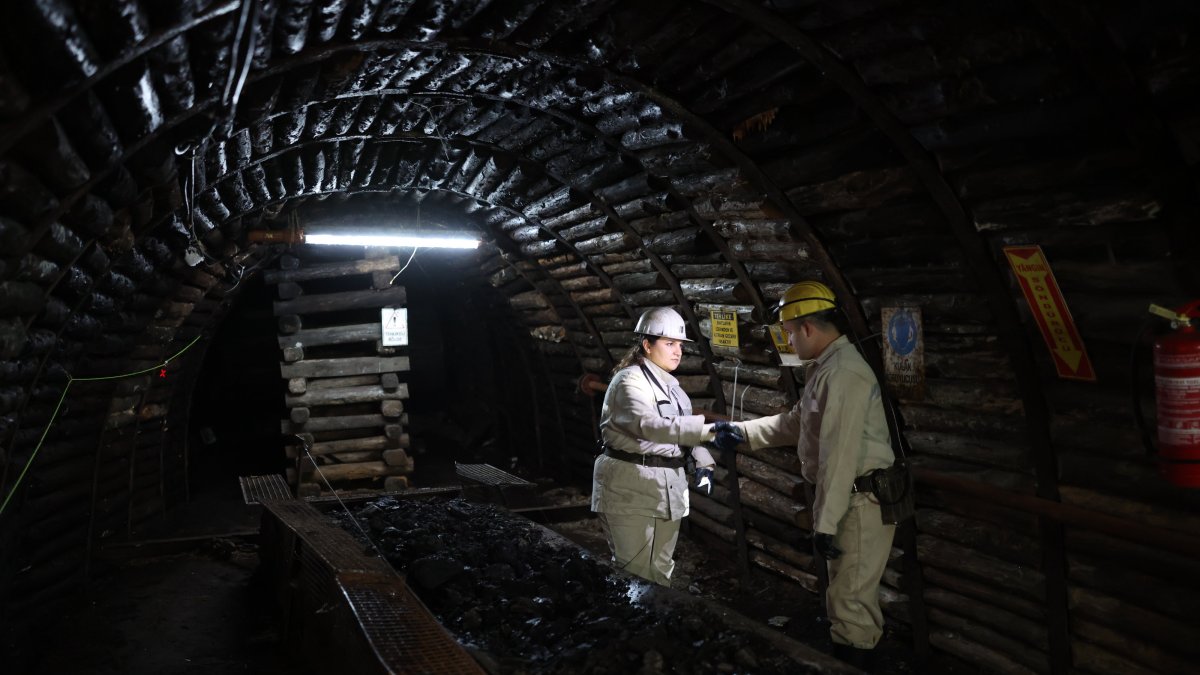
Türkiye’s mining sector expects to cross the $10 billion (TL 424.46 billion) export threshold in 2026, driven by a stronger investment appetite and growing demand for critical minerals, the head of the top association said Wednesday.
Exports reached $5.1 billion in the first 10 months of 2025, and meeting medium-term economic targets will require expanding capacity in metallic minerals and industrial raw materials, according to Turkish Miners Association (TMD) President Mehmet Yılmaz.
He spoke to Anadolu Agency (AA) ahead of Dec. 4 – World Miners Day.
Yılmaz pointed to the World Bank’s latest Commodity Markets Outlook, noting that demand for copper, nickel and lithium is set to continue rising through 2026.
He said Türkiye’s ability to shift from exporting raw ores toward semi-processed or end-use products would be central to lifting export revenues into the medium-term target range.
“Our goal for next year is not just to pass the $10 billion mark – we aim to settle firmly into the $11-12 billion range,” Yılmaz said, noting that expectations of a global rate-cut cycle and an improvement in industrial output strengthen the likelihood of Türkiye reaching that band.
He also explained that selective credit mechanisms under Türkiye’s medium-term program are supporting investment appetite, particularly in value-added processing. Prioritizing processed output in chromium, copper and aluminum, rather than exporting raw ore, is expected to lift unit prices.
According to Yılmaz, 2026 will mark a structural shift from volume-driven growth to a value-focused production model.
The TMD head said improvements in predictability regarding forest and pasture permits during 2025 have already begun easing project bottlenecks.
He recalled that regulations enacted on July 24 simplified environmental impact assessment, forest and pasture authorizations, and were followed by digitalization steps such as e-Government-based applications, three-month approval timelines and up to 24 months of cost-free pre-permission periods.
“These steps are already easing the pressure on projects and creating a more predictable permitting environment,” Yilmaz said, emphasizing that the reforms will significantly reduce cash-flow strain during exploration phases and pave the way for faster investment decisions in 2026.
Gold production
Commenting on Türkiye’s limits on unprocessed gold imports, Yılmaz said the monthly 12-ton cap reflects broader economic conditions but stressed that a sustainable solution depends on higher domestic output.
He noted that global gold demand remains elevated and said Türkiye is on track to approach the 2020 output level of 42 tons again as new mines start operating.
“As permitting improves and investment appetite strengthens, we see a clear pathway toward lifting domestic gold output into the 50-60 ton range from 2026 onward,” he said, adding that higher production would ease import pressure and help narrow the gold component of Türkiye’s current account deficit.
REEs to remain at center of mining debate
Furthermore, Yılmaz said 2025 has been marked by heightened geopolitical sensitivity around rare earth elements (REEs), and strong demand linked to energy transition technologies suggests these materials will remain high on the agenda in 2026.
He pointed to pilot-plant progress at Türkiye’s flagship Eskişehir Beylikova REE project and said the goal is to lay the foundations of a 570,000-ton-per-year industrial facility around 2026, advancing to commercial production roughly two years later.
“Beylikova stands out as a project that can fundamentally shift Türkiye’s position in the global critical-minerals landscape,” Yılmaz said, adding that the country aims to cut import dependence and bring domestic strategic mineral resources into full use under the medium-term program.
2026 outlook, priorities
The 2026 outlook includes completing engineering and permitting for major projects such as Beylikova, while accelerating exploration and pilot production in battery metals, including lithium, cobalt, nickel and graphite.
Yılmaz said clarifying the “public interest” definition will be among the sector’s top priorities for 2026.
He argued that license security must be as strong as property rights to ensure predictable investment conditions. He also noted that recent fiscal changes in the Mining Law increased state royalties but reduced some collateral burdens, a balance the industry considers necessary to sustain investment appetite while maintaining public revenue.
He stressed the need for fully harmonized environmental, rehabilitation and licensing procedures, as well as a digital and integrated system linking forest, water, pasture and environmental permits – all key areas awaiting resolution in 2026.
Yılmaz also emphasized the importance of establishing a national strategy for critical minerals and rare earths. While the medium-term program highlights the goal of reducing import dependency, he said that fulfilling that objective requires concrete regulatory steps and a long-term mining road map.

The Daily Sabah Newsletter
Keep up to date with what’s happening in Turkey,
it’s region and the world.
SIGN ME UP
You can unsubscribe at any time. By signing up you are agreeing to our Terms of Use and Privacy Policy.
This site is protected by reCAPTCHA and the Google Privacy Policy and Terms of Service apply.