
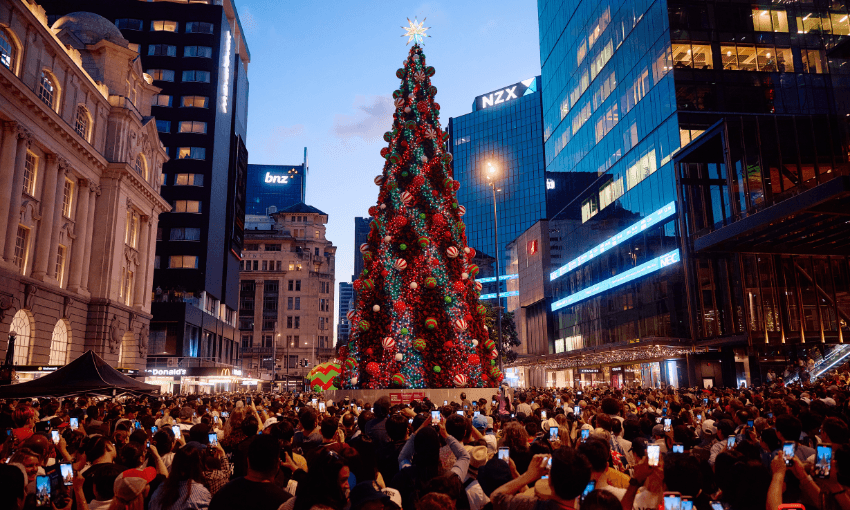
There’s a case the square outside Waitematā station is the city’s best public investment since the northern busway. Its success shows people gravitate to places with fewer cars, not more of them.
Te Komititanga was packed as the lights flickered to life on Auckland’s giant $1 million Christmas tree. People oohed and aahed. They took photos. “Not Melbourne, not Sydney, not London, not New York. Auckland,” tweeted one attendee above an aerial shot of the occasion.
The enthusiasm might have been a bit much. “Not Melbourne, not Sydney, not London, not New York. Twizel,” wrote one acerbic commenter alongside a picture of the Twizel Four Square. It’s hard not to get carried away about Te Komititanga though. Just a few years ago, a large crowd gathering outside Britomart would have been run over almost instantly.
 Te Komititanga in 2016. (Image: Greater Auckland)
The space that’s now Te Komititanga was a four-lane road occupied by taxi stands and the city’s main bus interchange until 2016. In 2017, it was closed and spent three years under construction before reopening in its pedestrianised form in December 2020.
The square was paid for out of the $5.5 billion city rail link budget, and there’s a case it’s our best public investment since the northern busway. It’s quickly burrowed its way into the heart of Auckland’s cultural fabric. The giant Christmas tree lighting last week was a big event, but the square plays host to an array of smaller ones every day. Street performers juggle and breathe fire on its central pavers. Buskers play Led Zeppelin outside H&M. Children scurry through the gaps between huge Christmas baubles in another. Tides of commuters flow in and out of Waitematā station and Commercial Bay. Every so often protesters flood in from Queen St.
Ngāti Whātua Ōrākei gifted Te Komititanga its moniker, which means to mix or merge, while the architect Tessa Harris (Ngāi Tai Ki Tāmaki) arranged the tiles outside Waitematā station to resemble a woven welcome mat, or whāriki. The square’s name and design suit it perfectly. Te Komititanga has become Auckland’s primary meeting place, its hub, and the numbers bear that out. Pedestrian counts have risen steadily in the area since crashing during Covid, but have leaped 61% at the square’s intersection with Queen St in the last year, from 445,686 in November 2024 to 719,341 last month. Another 438,000 pedestrians were recorded at its Quay St end. A space that was a bus thoroughfare five years ago is now Auckland’s real town square.
Auckland Council’s priority location director Simon Oddie says it’s no surprise Te Komititanga is well-used given its location outside the city’s most frequented train station. But its popularity is underpinned by council staff who organise regular events and light installations while ensuring the square is configured in ways that encourage people to linger. “The fact that it’s a drawcard as a destination, not just a pass through point, I think that’s through hard work,” he says.
The whāriki pattern on Te Komititanga’s pavers.
The square’s success is more stark when you take into account the economic struggles that still persist in the rest of the city centre. Pedestrian counts near the city’s other large public space just up the road, Aotea Square, hover at around 40% of Te Komititanga’s numbers and have dropped year on year. Midtown in general has been the subject of an array of negative headlines about rising homelessness, empty shops and alleged increases in criminal offending.
Every so often people will point to these issues and point the finger at big Woke. The Herald’s columnist Matthew Hooton once blamed the city’s crime problem on the council being suckered in by the “urbanist, public-transport, cycling and social-housing lobbies”. On Facebook, people will often post photos of Queen St from the 1960s, when the footpaths were packed with pedestrians, and the comments will fill with people saying we need to restore its four car lanes.
Te Komititanga under construction in 2017.
Te Komititanga’s popularity shows, if anything, the opposite is true. Pedestrians haven’t ditched Queen St and midtown because they’re yearning for the sweet scent of exhaust. They’ve migrated to the parts of the city centre where there are no cars at all. They’re hanging out on the benches at Te Komititanga eating a sandwich and watching an elaborately dressed man roll around inside a hula hoop. They’re having a beer at Wynyard Quarter, doing a manu into Browny’s pool or taking a Lime scooter down Quay St to one of Britomart’s restaurants.
Where the people have gone, the money has followed. Hundreds of millions of dollars have been invested into Britomart and Commercial Bay. Precinct Properties is looking to build a massive commercial and residential complex on the site of the Downtown carpark. Oddie says Te Komititanga is part of a wider shift in the city’s “centre of gravity” toward the waterfront.
Te Komititanga on a typical day. (Image: Auckland Council group)
But it’s not all doom and gloom for midtown. Hope is on the horizon. The city rail link is set to open in the second half of next year, and when it does, the train station next to Aotea Square, Te Waihorotiu, is projected to become the busiest in the country. The St James Theatre may one day reopen. The bizarro futurist paradise Sky World could still be restored or redeveloped.
For now, Te Komititanga holds the crown as Auckland’s town square, but Aotea may yet get it back. If it does, it won’t be because we returned car traffic to the area. It’ll be because we welcomed more people and gave them reasons to stay, just like we did a kilometre south, at the much-loved meeting place that was once a four lane road.