
Chemical structure of a trioxatriangulenium functionalized with phenyl.

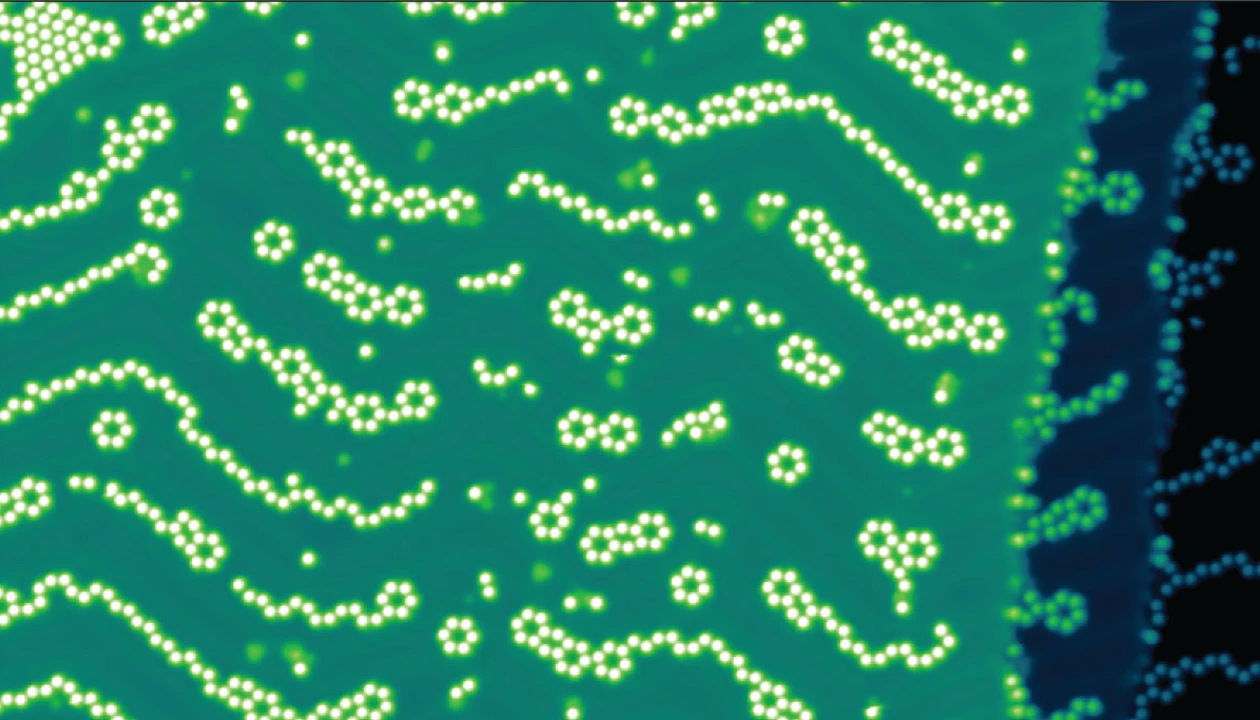
Each dot in these glowing green patterns is a molecule resting on a gold surface. Specifically, each is a phenyl-functionalized trioxatriangulenium (phenyl-TOTA), a molecule with a phenyl ring sticking out of a base shaped like an upside-down bowl. Behzad Mortezapour, a PhD candidate in Richard Berndt’s lab at Christian Albrecht University Kiel, captured these images using a scanning tunneling microscope (STM) and noticed that the molecules slotted into grooves in the gold’s regular crystalline structure, revealing hexagonal and linear patterns.
Using the STM, the researchers wanted to find out if they could rotate the phenyl ring on one phenyl-TOTA and affect the rotation on a nearby molecule. Because their microscope had such good resolution, they were able to zoom in and see how each single-molecule dot appears to split into two dots under certain conditions. They eventually concluded that this split reflected the alignment of each phenyl ring.
Ball-and-stick structures of triangular molecules are overlaid on top of a hexagonal array of white spheres representing a crystalline gold surface. Each molecule has a six-membered ring sticking out of it that is aligned with the rings of other molecules in its row and askew compared to the molecules in the next row, creating a herringbone-like pattern.

The phenyl rings (green) sticking out of molecules of phenyl-functionalized trioxatriangulenium can align with a metal surface (white balls) in a herringbone-like pattern.
Credit:
ACS Nano
In a scanning tunneling microscope image, six pairs of green dots are organized in the shape of a hexagon. Each pair is rotated sixty degrees compared to the pair next to it, creating a pinwheel like appearance among all the dots.

Under certain conditions, single molecules of phenyl-functionalized trioxatriangulenium appear as two dots, reflecting how the phenyl rings on molecules align themselves on the surface.
Credit:
Courtesy of Behzad Mortezapour and Richard Berndt
Credit: Behzad Mortezapour and Richard Berndt. Read the paper about this research in ACS Nano.
Do science. Take pictures. Win money. Enter our photo contest.
See more Chemistry in Pictures.

Chemical & Engineering News
ISSN 0009-2347
Copyright ©
2025 American Chemical Society