
Breadcrumb Trail Links
With food prices at a five-year high, the average Canadian family can expect to pay nearly $1,000 more for food this year
Published Dec 04, 2025 • Last updated 2 hours ago • 3 minute read
You can save this article by registering for free here. Or sign-in if you have an account.
 Getty Images/iStockphotoArticle content
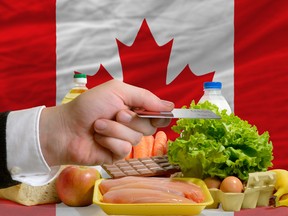
OTTAWA — With food prices at a five-year high, the average Canadian family can expect to pay nearly $1,000 more for food next year.
Advertisement 2
This advertisement has not loaded yet, but your article continues below.

THIS CONTENT IS RESERVED FOR SUBSCRIBERS ONLY
Subscribe now to read the latest news in your city and across Canada.
Unlimited online access to articles from across Canada with one account.Get exclusive access to the Toronto Sun ePaper, an electronic replica of the print edition that you can share, download and comment on.Enjoy insights and behind-the-scenes analysis from our award-winning journalists.Support local journalists and the next generation of journalists.Daily puzzles including the New York Times Crossword.
SUBSCRIBE TO UNLOCK MORE ARTICLES
Subscribe now to read the latest news in your city and across Canada.
Unlimited online access to articles from across Canada with one account.Get exclusive access to the Toronto Sun ePaper, an electronic replica of the print edition that you can share, download and comment on.Enjoy insights and behind-the-scenes analysis from our award-winning journalists.Support local journalists and the next generation of journalists.Daily puzzles including the New York Times Crossword.
REGISTER / SIGN IN TO UNLOCK MORE ARTICLES
Create an account or sign in to continue with your reading experience.
Access articles from across Canada with one account.Share your thoughts and join the conversation in the comments.Enjoy additional articles per month.Get email updates from your favourite authors.
THIS ARTICLE IS FREE TO READ REGISTER TO UNLOCK.
Create an account or sign in to continue with your reading experience.
Access articles from across Canada with one accountShare your thoughts and join the conversation in the commentsEnjoy additional articles per monthGet email updates from your favourite authors
Article content
That’s according to this year’s Canada Food Price Report, an annual snapshot of food trends, produced by the Agri-Foods Analytics Lab at Dalhousie University in Halifax.
Article content
Article content
While meat saw, and will continue to see, stark increases in cost, Dr. Sylvian Charlebois, the report’s lead author, told the Toronto Sun he was pleasantly surprised at how fruits and vegetable prices maintained their composure — falling 0.9% in 2025 instead of increasing the three-to-five per cent forecast.
“We were spared, thinking that the ‘buy Canadian’ or anti-American movement was going to hurt Canadians, but it didn’t,” he said.
“It’s just a matter of the dollar not really being a story — it was pretty stable. It did weaken a little bit, but it wasn’t really a big story, so that helped our importers’ buying power throughout the year.”

Your Midday Sun
Thanks for signing up!
Article content
Advertisement 3
This advertisement has not loaded yet, but your article continues below.
Article content
Skyrocketing beef prices expected to bring chicken along for the ride
Looking to the year ahead, chicken prices are set to increase substantially, thanks to increase consumer demand due to the high cost of beef — the price of which skyrocketed in 2025.
While beef prices rose 19% in the first quarter of 2025 alone and then stabilized, they’re still 23% higher than the national average.
That, according to the University of Saskatchewan’s Dr. Stuart Smyth, can be attributed to nearly a decade of drought conditions in Canada’s cattle pastures, shrinking the size of Canada’s beef herd to levels not seen since the late 1980s.
New beef import partnerships from Mexico and Australia are expected to lessen the burden, but conditions are expected to remain unsteady until at least 2027.
Advertisement 4
This advertisement has not loaded yet, but your article continues below.
Article content
Meat prices increased 7.2% over 2025, higher than what was forecast.
Read More

Interprovincial trade carveouts need to include food, restaurants urge

Government report predicts 2040 dystopia: Collapsed economy, hunting for food
Food insecurity continues to be dire problem
Roughly one quarter of Canadian households are considered food insecure, the study said, and overall food prices are set to increase by between four and six per cent over the course of 2026 — and currently sit at 27% higher than they were five years ago.
That means the average family of four is expected to spend $17,571.79 on food in 2026 — that’s a $996.63 increase from last year.
Alberta, Ontario, Quebec, Nova Scotia and New Brunswick are expected to experience food increases above national averages in 2026.
Advertisement 5
This advertisement has not loaded yet, but your article continues below.
Article content
Trade tension adding to uncertainty
Ongoing trade tensions between Canada and the United States will also impact food prices in the coming year, despite not wreaking nearly as much havoc this year as expected.
“It was rocky from March to September in Canada with counter-tariffs, we were very concerned that taxing food coming into Canada was going to be a factor,” Charlebois said.
“But now we’re finishing off the year on a good note, as both administrations, the U.S. and Canada, are recognizing that food is different.”
As soon as you slap tariffs on goods, Charlebois said, you end up compromising your own nation’s food affordability — something he said even President Donald Trump more-or-less admitted to last month when he ended sweeping tariffs on numerous food imports, including coffee, bananas, beef and tomatoes.
Advertisement 6
This advertisement has not loaded yet, but your article continues below.
Article content
Breaking down interprovincial trade barriers, Charlebois said, will also go a long way to impacting affordability — and that includes supply management.
“Ottawa has done its work, it’s job — it’s now up to the provinces to do the heavy lifting,” he said.
“We estimated that if you eliminate trade barriers between provinces, and of course, that would include supply management … so if you address the big elephant in the room and everything else, you’re looking at savings between $300 to $500 per Canadian.”
This is the 16th edition of the annual look at food prices — a study conducted in collaboration with Saint Mary’s University, the University of Prince Edward Island, Cape Breton University, the University of Guelph, the University of Alberta, Université Laval and the University of Saskatchewan.
bpassifiume@postmedia.com
X: @bryanpassifiume
Article content
Share this article in your social network