
While depth has advanced in some areas, strategically, tactically and from a pure performance perspective, the All Blacks are stagnating.
Stand still, and you will be overtaken.
The All Blacks remain second in World Rugby’s official rankings but after the humbling loss at Twickenham, there’s a strong case they could be fourth best behind South Africa, England and France. Argentina under Felipe Contepomi continue to improve, too.
Robertson was afforded a degree of breathing room as he ushered in the largest All Blacks management change in a decade.
Year one was marked by deep conservatism as Robertson and his coaching team attempted to cope with the pressures and contrasting challenges the international arena imposes every week.
An initial 10-4 return underwhelmed. Following that with a 10-3 season, which includes three victories over a decidedly second-string French team in July, hardly inspires optimism.
Robertson’s 20/27 record after two years in charge is not horrific, but a 74% winning return is concerning for All Blacks standards, and a long way from the transformational presence he pitched following seven straight titles with the Crusaders.
Red flag concerns
Two assistants, Leon MacDonald and Jason Holland, voluntarily exiting the All Blacks, the dream post, with neither having another job lined up at their time of departure, doesn’t reflect well on how the existing coaching team is operating.
Extensive time away from home and the relentless nature of the All Blacks is not for everyone but MacDonald and Holland arrived knowing full well their roles encompassed those demands.
That MacDonald and Holland both held responsibilities with the backs and attack points to deeper issues with how that portfolio is being run.
Several sources have outlined the All Blacks this year operating a tight, closed shop coaching trio comprising Robertson, Scott Hansen and Jason Ryan – all of whom worked together at the Crusaders.
Those three selected the team this season after Robertson allowed his five coaches to select in year one.
The roles and responsibilities of the All Blacks coaching team are certain to be high on the agenda of post-season reviews.
Robertson adopting a football-style managerial position focusing on culture and weekly themes, with assistant Hansen assuming the overall team strategy and tactics – as the Herald previously reported – has sparked alarm in some quarters.
Internally there may be a belief that structure is working.
But with the misfiring attack, consistent third-quarter fades raising concerns over halftime messaging (only three times this year did the All Blacks score more points than their opponents in this period), highly questionable on-field tactical decisions and the lack of ruthlessness, it’s clear change is needed.
Robertson may seek to address ongoing concerns under the high ball by adding a specialist kicking/aerial coach to replace Holland next year.
More profound changes are needed, though.
Bryn Evans’ inclusion to oversee the lineout and assist forwards coach Ryan proves the impact one figure can have.
Hiring a proven attack mentor, and allowing them scope well beyond Holland’s set piece strike move brief, could add more value and help address the lack of test coaching experience evident from the outset of Robertson’s reign.
Joe Schmidt would be the ideal inclusion, just as he proved as All Blacks assistant in 2022 and 2023, as he prepares to finish up with the Wallabies but he was alienated during the process to appoint Robertson while Foster was at the helm.
Waiting on Richie Mo’unga to be the silver bullet for the attack is not a long-term plan.
Scrutiny from within
Player-led feedback could be telling in shaping the narrative and, indeed, the future of the All Blacks coaching team.
Murmurings of frustration among senior players have grown louder since the end of the test season, with communication and trust cited among concerns.
If player feedback is consistently critical of communication and strategy, something or someone must swiftly change.
Lessons must be learned from the end of 2021 when player feedback on assistants John Plumtree and Brad Mooar failed to sway Ian Foster’s loyalty. That decision almost cost Foster his job.
Even at the depths of his tenure, though, Foster retained widespread support from senior players and the changing room.
This time around, sitting idle is not an option for a rugby nation that demands excellence.
As next year’s South African tour – which features four tests against the world champion Springboks – looms large, intervention is needed.
The complicating factor for NZ Rugby, as head of high performance Mike Anthony prepares to oversee the All Blacks review, is determining a decision-making process without the next chief executive in place.
Mark Robinson’s six-year tenure has concluded and while Steve Lancaster is fulfilling the acting CEO duties, Six Nations boss Tom Harrison is the frontrunner to assume charge.
Any new appointment, though, is not expected to take charge until March.
The landscape with which Robertson was appointed All Blacks coach, prior to the 2023 World Cup with Foster at the helm, has drastically altered.
The NZR board has since been largely overhauled. Former chair Dame Patsy Reddy and Robinson have moved on too.
Does Robertson garner the same internal support?
World Cup-winning captain David Kirk, a man with a ruthless edge, is a starkly contrasting chair to Reddy.
Robertson must now convince Kirk that significant improvements will come.
At this point, alternatives such as Jamie Joseph, without his attacking mastermind Tony Brown, as he’s contracted to the Springboks until 2027, aren’t overly compelling.
Yet the fact alternatives are a common public discussion is a sure sign all is not well, and that expectations are not being met.
Depth development
Robertson’s push to harness four deep in every position in this four-year cycle in the quest to claim a fourth World Cup progressed with nine more rookies inducted in 2025.
They were: Du’Plessis Kirifi (8 tests), Leroy Carter (6), Fabian Holland (12), Kyle Preston (1), Simon Parker (8), Timoci Tavatavanawai (2), Christian Lio-Willie (3), Brodie McAlister (2) and Ollie Norris (3).
How many of those rookies feature regularly from here remains to be seen but Robertson has blooded 19 new All Blacks in his two-year term.
Some selection decisions, such as retaining Sevu Reece and Finlay Christie, were difficult to fathom. And the All Blacks were far too slow to concede that Reece and Rieko Ioane are not the answers on the wing.
At least this year, though, Robertson tried to be more progressive with Billy Proctor handed eight test starts at centre, Tupou Vaa’i tested at blindside flanker and Peter Lakai finishing the year as the preferred No 8.
Those decisions didn’t always work. Proctor is yet to transfer his compelling Super Rugby form to the test arena to leave Quinn Tupaea and Leicester Fainga’anuku in pole position to contest the centre role.
Trial and error, though, provides more answers than no trial at all.
This year the All Blacks used 45 players which speaks to an injury toll that stripped Jordie Barrett, Vaa’i, Tyrel Lomax and Patrick Tuipulotu from the northern tour.
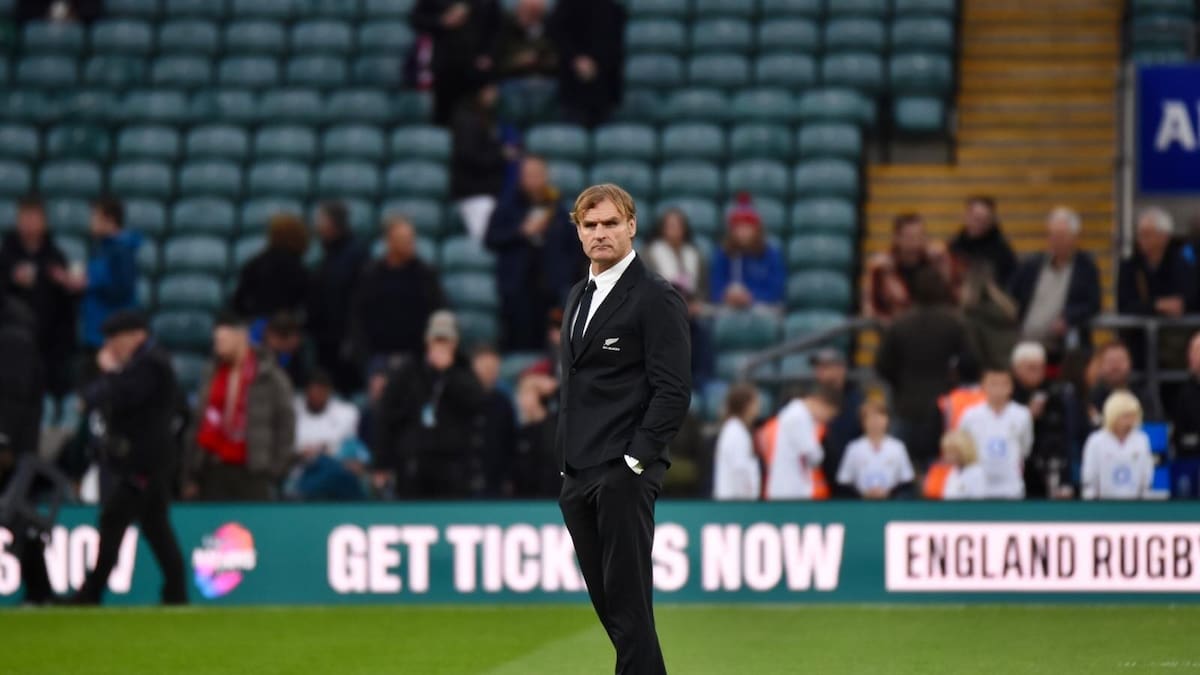
All Blacks head coach Scott Robertson. Photo / Smartframe
Caleb Clarke, the first-choice finisher in a problematic position, played four of a possible 13 tests and Cam Roigard, the All Blacks’ most influential player, missed four Rugby Championship outings against the Boks and Pumas.
Highlanders halfback Dylan Pledger must be top of the list for the next rookie intake. On the road to the next World Cup, his speed and vision are a potential game-changer off the bench.
Emoni Narawa, Kyren Taumoefolau, who will debut for the Chiefs next season after switching from Moana Pasifika, Highlanders flier Caleb Tangitau and Crusaders outside back Chay Fihaki will push hard for inclusion on the All Blacks’ right edge.
Ruben Love needs much more game time than his two brief stints off the bench and one start against Wales, too. Five tests in two years has stunted Love’s development.
To be fair to the All Blacks, rotation isn’t straightforward when you are expected to win every game and with a schedule that includes two tier two teams in four years.
The Springboks, by contrast, this year played Georgia, Italy (three times), the Barbarians and a vastly understrength Welsh side.
Rassie Erasmus did, however, have the confidence and faith to roll out two vastly different starting teams against the All Blacks in New Zealand.
The All Blacks finished their year with uncertainty clouding their premier right wing, centre and blindside flanker.
From a future-proofing perspective Holland, Lakai and Pasilio Tosi – notably all forwards – were the success stories.
Last year’s player of the year Wallace Sititi, having started his second test campaign underdone following knee surgery, only recaptured his best form in the final match in Cardiff.
Set piece
The lineout was, largely, a shining light this season. Bryn Evans’ inclusion to the coaching team proved something of a masterstroke as his knowledge of the northern hemisphere game and the intricacies of this vital platform came to the fore.
The lineout was particularly impressive given three senior locks – Scott Barrett, Tupou Vaa’i, and Patrick Tuipulotu – were often sidelined. Fabian Holland and Josh Lord revelled with exposure to fast-track an area that was a major concern in the post-Sam Whitelock/Brodie Retallick era.
The scrum, though, did not perform as expected. The All Blacks pride themselves on utilising the scrum as a weapon. While they did this at times, South Africa and England savoured the upper hand to leave plenty of work to do against the world’s best scrummaging teams.
New Zealand’s propping stocks are in great health but for all the modern game’s desire to promote mobile, athletic front rowers, the core set piece duties come first.
Player of the year
Cam Roigard.
It’s perhaps a tad harsh on Holland, the World Rugby breakthrough player of the year, after he featured in all but one All Blacks test to stamp his sizable frame on the international scene.
Ardie Savea has claims, too, although he was at his best assuming the captaincy.
Quinn Tupaea enjoyed a big moving season to surge past veterans Anton Lienert-Brown and Rieko Ioane to establish his direct, powerful midfield presence in the first-choice squad.
Roigard played seven of 13 tests due to injury which only served to further underline his influence.
Cam Roigard was the standout performer for the All Blacks in 2026. Photo / Photosport
The All Blacks lost one test Roigard played – against England at Twickenham – and he departed early in the second half of that match with an ankle injury.
Roigard’s absence was telling, too. With Noah Hotham injured, it was Roigard and daylight to impress the need to fast-track Pledger’s call-up next year.
While he debuted in 2023, this was Roigard’s first genuine season as a bolted on starter. After 17 tests he remains in the infancy of his career but is already rivalling Antoine Dupont for the mantle of world’s best halfback.
Best win
It’s easy to forget the intense backdrop that greeted the All Blacks before their Eden Park showdown with the Springboks.
Interest in a one-off rugby match had not reached this fever pitch level since the third 2017 British and Irish Lions test at the same venue.
Putting Eden Park’s 31-year unbeaten status on the line against the back-to-back world champions was long marked on the calendar.
Backs were firmly pressed to the wall following the All Blacks first loss in Argentina to significantly intensify pressure on Robertson to instigate a swift response.
Respond the All Blacks did, to deliver under consuming duress.
After four straight losses to the Springboks, the All Blacks clung to 17-3 and 24-10 leads to hold on for their most treasured win of the year.
Ardie Savea, fittingly, earned a crucial late penalty to celebrate his 100th test in style.
Savea’s post-match call for the All Blacks to front in the same manner at all venues, though, was not heeded.
Worst lost
The heaviest defeat in history – to the Springboks in Wellington – is the obvious answer. The way in which the All Blacks folded, to spark stinging criticism from former All Blacks, should never be repeated.
Losing to England at Twickenham was worse, though. Firstly, losing to England is always grim. There was more on the line, too, with the Grand Slam hopes crushed.
By that point of the year, in their penultimate test, the All Blacks should have significantly improved to know their tactics and combinations. The second half instead exposed familiar flaws to leave a frustrating sense of a lack of progress.
Liam Napier is a Senior Sports Journalist and Rugby Correspondent for the New Zealand Herald. He is a co-host of the Rugby Direct podcast.