
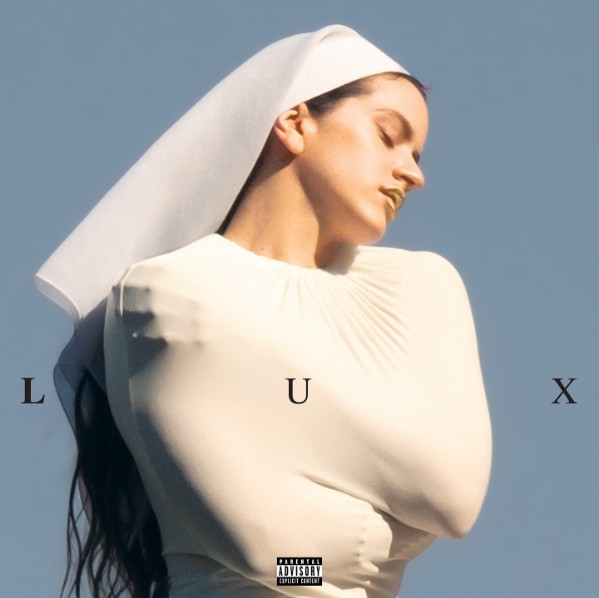
Rosalía’s LUX is a journey between two worlds – the human and the divine.
The album shifts Rosalía’s sound to a spiritual landscape, filled with grand vocals and divine orchestras. LUX is pop reaching for the heavens.
The album’s opening track, “Sexo, Violencia y Llantas” sets the tone with a question: “Who could live between the two? / First, I’ll love the world, and then I’ll love God.”
In two lines, Rosalía situates herself between chaos and paradise.
The transition into “Reliquia” deepens this duality as she lists the parts of herself she has lost in love – her faith in Washington D.C., her smile in the UK – offering her heart as something others may keep “for when I’m not here”.
Themes of self-sacrifice, devotion, and mortality echo throughout the album, appearing in tracks like “Divinize”, “Porcelana”, and the lead single “Berghain” where she sings with dejectedly sings, “I know well what I am […] I’m just a sugar cube”.
The image of dissolving so others may taste sweetness captures a core theme in LUX: love as sacrifice.
Rosalía’s exploration of the divine reaches its most dramatic expression in “Mio Cristo Piange Diamanti”. Sung entirely in Italian, with power and nobility, she refers to “love that cannot be chosen and cannot be let fall”.
Spirituality is not the album’s only thread. “La Perla” is a waltz berating an ex-partner, awarding him an “Olympic gold medal for being the biggest scumbag” – many fans link this to former fiancé Rauw Alejandro.
Across LUX, Rosalía moves between earthly wounds and other-worldly longing. On “Mundo Nuevo” she considers leaving this world to search for truth in another.
Its lungful reflection contrasts with “De Madrugá”, inspired from the legend of Saint Olga of Kiev, fusing flamenco heritage with themes of revenge. Rosalía’s ability to knot folklore and theology into contemporary pop is on full display here.
These reflections then get interrupted. “Dios es Un Stalker” brings an amusing intrigue to the album.
Rosalía likens God’s modus operandi to stalking. “I don’t like doing divine intervention, but today I’m going to stalk my baby to make them fall in love” she sings, pairing unsettling lyrics with fun production, highlighting the strange nature of omniscience.
In “La Yugular” Rosalía shifts to contemplation, describing God no more as a distant figure behind us, but as a presence closer than her own jugular vein.
The song elaborates on the interconnectedness of all things; what is small can also be immense, and what is near can feel far.
The album’s final stretch weaves between the sacred and the personal.
“Sauvignon Blanc” explores leaving the past behind to follow God’s call, while “La Rumba del Perdón” returns to flamenco to tell the exciting story of an inattentive partner who was robbed and abandoned her, but she forgives him because of love.
“Memória” is the album’s most touching moment, reflecting on the cruel nature of memory: “Whenever I remember something, I always remember it in a different way, and however that memory may be, it’s always true in my mind”. Rosalía asks the listener: “Do you still remember me?”
LUX closes with “Magnolias”, a depiction of Rosalía’s funeral. She imagines magnolias thrown over her as a celebration rather than just mourning.
The choir sings: “God descends and I ascend, we meet in the middle” – Rosalía finally finds her answer of being between two worlds.
The physical edition adds three tracks: “Focu Ranni” celebrating personal freedom, reflecting on her broken engagement; “Jeanne” honouring Joan of Arc; and “Novia Robot” a sharp critique of misogyny and the sexualisation of women.
With appearances from Björk, Yahritza Y Su Esencia, Estrella Morente and more, LUX becomes a testament to Rosalía’s evolving artistry.
From a motomami to a saint, Rosalía has achieved the omnipresence her music envisions.
Featured Image credit: Lux cover by Rosalía / Columbia Records

Like Loading…
Related