
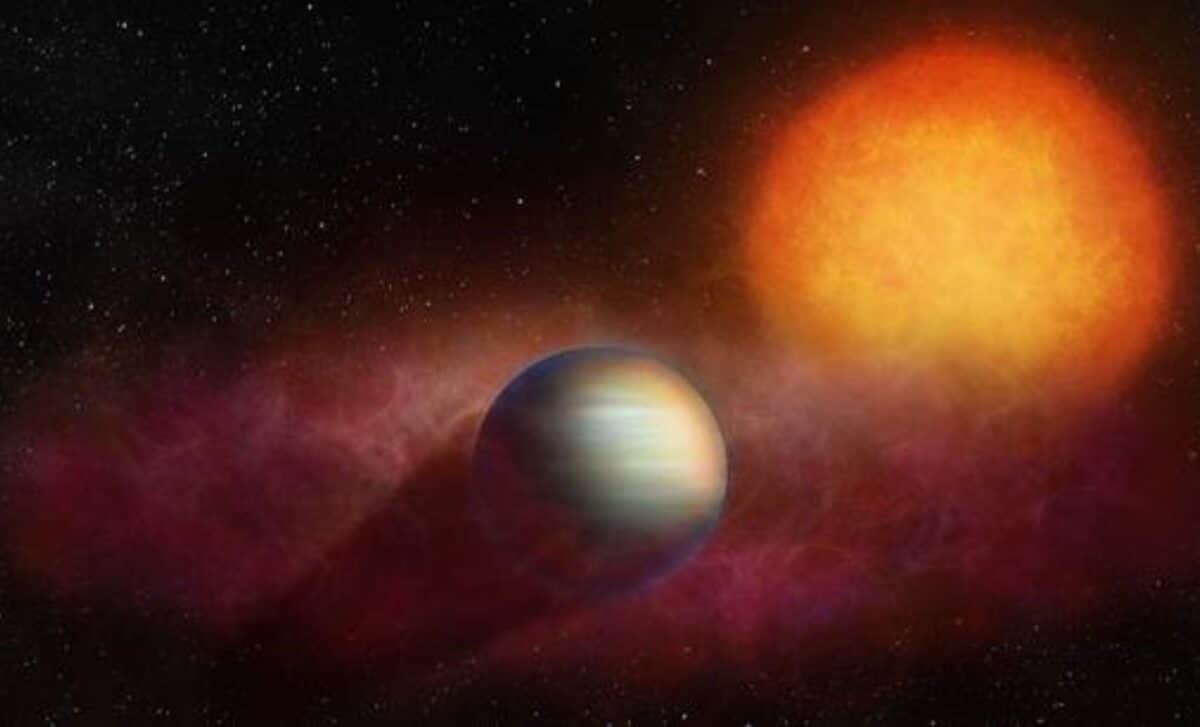
The James Webb Space Telescope (JWST) has just made a fascinating discovery, capturing an exoplanet shedding its atmosphere in real time. The planet, known as WASP-107b, is releasing a massive helium cloud that stretches across space, drifting ahead of the planet as it orbits its star. This event is the first of its kind to be observed in such detail.
WASP-107b is no ordinary exoplanet. It has a radius nearly as large as Jupiter’s but only a fraction of the mass. This makes it incredibly light and, as a result, very vulnerable to losing its atmosphere. The planet orbits its star at a distance only seven times greater than that between Mercury and the Sun. With such a close proximity to its star, the heat is enough to gradually strip away its gases, making it a prime target for study.
The Mystery of Super-Puff Planets
WASP-107b is often classified as a “super-puff” exoplanet, a term that can sound a bit whimsical but reflects a very real phenomenon. Despite its enormous size, the planet’s density is incredibly low, making it much lighter than one would expect for its size. Because of this, it’s especially prone to losing its atmosphere, especially given its proximity to its star. According to a press release from EurekAlert!, being so close to its sun exposes WASP-107b to high levels of radiation, which gradually causes its atmosphere to evaporate.
The helium cloud that JWST spotted was actually stretched out across a vast are, nearly 10 times the planet’s radius. What’s even more remarkable is that this cloud precedes the planet in its orbit, traveling ahead of it like a mini-transit, and dimming the light from the star just before the planet itself passes.
Scientists observing the exoplanet WASP-107b with the James Webb Space Telescope say that the planet has clouds of sand high in its atmosphere. @skrishna joins us to tell us the story. pic.twitter.com/ofJkbDMAEQ
— Science Friday (@scifri) December 7, 2023
A New Era in Astronomy Begins Now
The role of the James Webb Space Telescope in capturing this event cannot be overstated. JWST’s Near Infrared Imager and Slitless Spectrograph (NIRISS) made it possible to detect the faint infrared signature of the escaping helium. Based on the study published in Nature Astronomy, this is the first time scientists have been able to observe atmospheric escape on an exoplanet in such real-time detail.
“The amount of oxygen in the atmosphere of WASP-107b is larger than what we would expect if it formed on its current close-in orbit,” says Caroline Piaulet-Ghorayeb, co-author of the study.
By capturing the escaping gas just before the planet’s transit, the JWST created a kind of “mini-transit” of the celestial body’s atmosphere. This phenomenon causes the star’s brightness to momentarily dip. The fact that such a process could be observed with such precision speaks volumes about the capabilities of the JWST and its role in advancing our understanding of exoplanets.
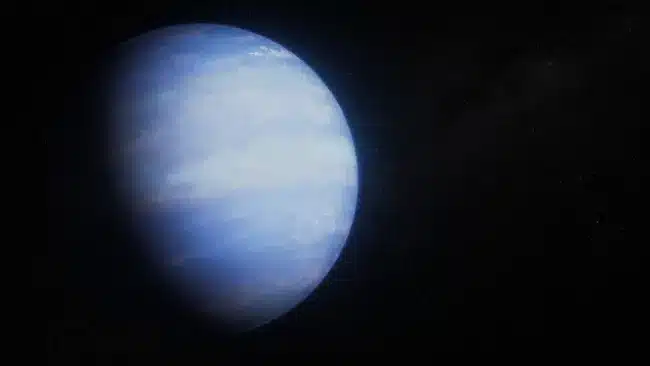 The JWST detected a vast helium cloud streaming from the super-puff exoplanet WASP-107b. Credit: NASA, ESA, CSA, Ralf Crawford (STScI)
Earth’s Past Revealed by Clouds: A Treasure of Knowledge!
Along with the helium, the JWST detected water vapor high in the atmosphere. However, no methane was found, suggesting that the sphere’s atmosphere is actively being mixed. This could mean that the hotter, methane-poor gases are being pulled upward into the atmosphere due to the extreme heat from the star.
The chemical patterns observed in the atmosphere support the idea that WASP-107b might have originally formed farther from its star before migrating inward, where it became exposed to intense heat that started stripping away its outer layers.
This theory is further bolstered by the presence of another orb in the system, WASP-107c, which orbits at a much greater distance. Astronomers suggest that the gravitational pull from this distant celestial body may have caused WASP-107b’s inward migration. It’s a small but important piece of evidence that helps explain how WASP-107b evolve under extreme conditions.