
But Razor had everyone hooked. He was what the TV world calls talent. He was the point of difference rugby needed. In a world of often grey, austere coaches who came across with all the levity of KGB officers, he brought colour and vibrancy.
A dedicated surfer, he carried the spirit of the sea – a free-wheeler who didn’t seem to take life too seriously, always smiled and joked and rebuffed the myth that high-performance coaches need to be measured, careful with what they reveal and sceptical of the media.
There was this sense that while most of his coaching peers were buried in spreadsheets, GPS printouts and video analysis, he was wandering about in a kaftan, consulting with his crystals and taking note of whether the moon was waxing or waning.
He had a mystic vibe – a soothsayer that could pick apart the attack plans of the opposition and see into the souls of his players – but there was nothing kooky about him.
The fascination stemmed from the fact that he was enormously successful. The Crusaders kept winning on his watch and so it became clear there was nothing gimmicky or contrived about Robertson.
The breakdancing routines he’d bust out after each Super Rugby title win felt like an authentic part of who he was, and while rugby’s older, entitled fan base may not have liked the spectacle, Razormania gripped the rest of the nation.
Freelance journalist Jim Kayes who directed Razor for Sky, says: “We were keen to do something because he was the new All Blacks coach, but there also seemed to be something different about him.
“We hadn’t had a rugby coach breakdancing after his team had won a title ever before. We hadn’t had a rugby coach who skateboarded to training.
“He just seemed to break the mould of any other All Blacks coach that we had had. We were keen to show what sort of person he was in light of that.”
But two years into the All Blacks tenure, Razormania has faded. Doubts are growing about his ability to deliver the performances and results that the team needs and the legacy demands, and the rugby public appear to be wondering now whether the point of difference they celebrated and actively sought, was ever even there.
Radical departure
New Zealand Rugby has gone all-in to sell the All Blacks to the US sports market, and in the week leading up to the test against Ireland in Chicago earlier last month, there were several set-piece and informal events to showcase the brand.
One of the biggest get-togethers was put on by the Chicago Sports Commission, where the city’s mayor, and both Robertson and Irish head coach Andy Farrell spoke to an audience of about 500 people that included former All Blacks, Irish rugby legends, executives, politicians, professional baseballers, media and commercial movers and shakers.
Later that night, former All Black John Kirwan, who was in attendance in his role as what would be best described as ambassador for NZR, brand All Blacks and the game itself, made an astute observation.
He said: “It was interesting how one head coach [Robertson] went on stage and waited to be asked a question, and the other [Farrell], took control straight away.”
There was no judgement in Kirwan’s observation, he was simply stating facts about what he had witnessed and then talked a little about how he sees Robertson as “an empathy coach”, which he feels is a radical departure from the type of coaches the All Blacks’ have historically had.
An American journalist, working for the illustrious Forbes, pitched in by saying that Farrell looked at ease with the microphone in his hand, answered the questions and then successfully ad-libbed a few crowd-pleasing compliments about Chicago, while Robertson was a bit awkward.
Again, there was no intent to judge or extrapolate any meaning in the different demeanours and comfort levels of the two coaches as it pertains to their respective abilities to produce winning teams, but as brand ambassadors, Farrell more effectively sold Ireland than Robertson did the All Blacks.
But two days later at Soldier Field, Robertson delivered where it mattered most and in overseeing a 26-13 victory, brand All Blacks sold itself the way it wanted to.
America saw a team that had resilience and imagination (at least in the final quarter) and an All Blacks leader who was obviously more at home in the coaching box than he was at a corporate function.
The Newstalk ZB commentary booth at Soldier Field happened to be next to the All Blacks coaching box, and even through headphones it was possible to hear celebratory shouting, spontaneous exclamations and feel the vibrations from the desk next door being banged.
Previous All Blacks coaches have been poker-faced during games, occasionally animated when they sense they have witnessed a critical moment in a major game, but Robertson rides the highs and lows.
He’s an emotional beast, and whether it’s a case of him not being able to resist his impulses to react during games, or a conscious decision to not mask and live in the moment, he cuts a different figure to his predecessors.
Everyone can have a view on whether they prefer their All Blacks coach to be stoic and unflinching in the box, or animated and expressive, but ultimately style is irrelevant.
What matters is substance and the ability for the head coach to be clear-headed and precise with his strategic thinking and in-game communication.
Only the players and coaching staff will be able to answer that, but what’s become apparent in Robertson’s two years at the helm, is that he’s able to give in-depth, fascinating and lucid analysis immediately after a game when he’s in a heightened emotional state.
He has talked before about how he thinks more readily and easily in pictures and many times in the last two years he’s conducted spontaneous post-match off-the-record debriefs where his memory for detail and ability to clinically assess the key moments has been stunning.
It’s apparent that he seems capable of bringing up a picture, frame by frame, in his own mind – each phase, each action and each player in high definition as if he recorded the game and stored it in a hard drive lodged in his brain.
He obviously sees the game being replayed in his head and commentates what he’s seeing in staccato form, broken sentences that are complemented with hand actions and while it’s hard to keep up, if you can, it’s educational as it’s almost as if Robertson watches the All Blacks from the fourth dimension.
Unfiltered, Robertson is compelling, and those who know him best say that his superpower at the Crusaders was his ability to hyperfocus on playing patterns and pick apart what opponents were trying to do.
But it’s in the public eye where he is judged, and increasingly it feels that the real Razor, the one that showcases his rugby genius and natural self, is being lost to the demands of the job.
Maybe it was inevitable that the enormity of the All Blacks – the power of the legacy, the weight of expectations and sheer scale of the organisation and its fiscal importance to the wider rugby system – would squeeze Razor into a tighter, more conformist version of the character he was at the Crusaders.
Publicly at least, when the cameras are on and phones recording, Robertson’s natural ebullience is buried and the colour fades into grey.
The bloke who used to skateboard to training seems now to belong to a forgotten age.
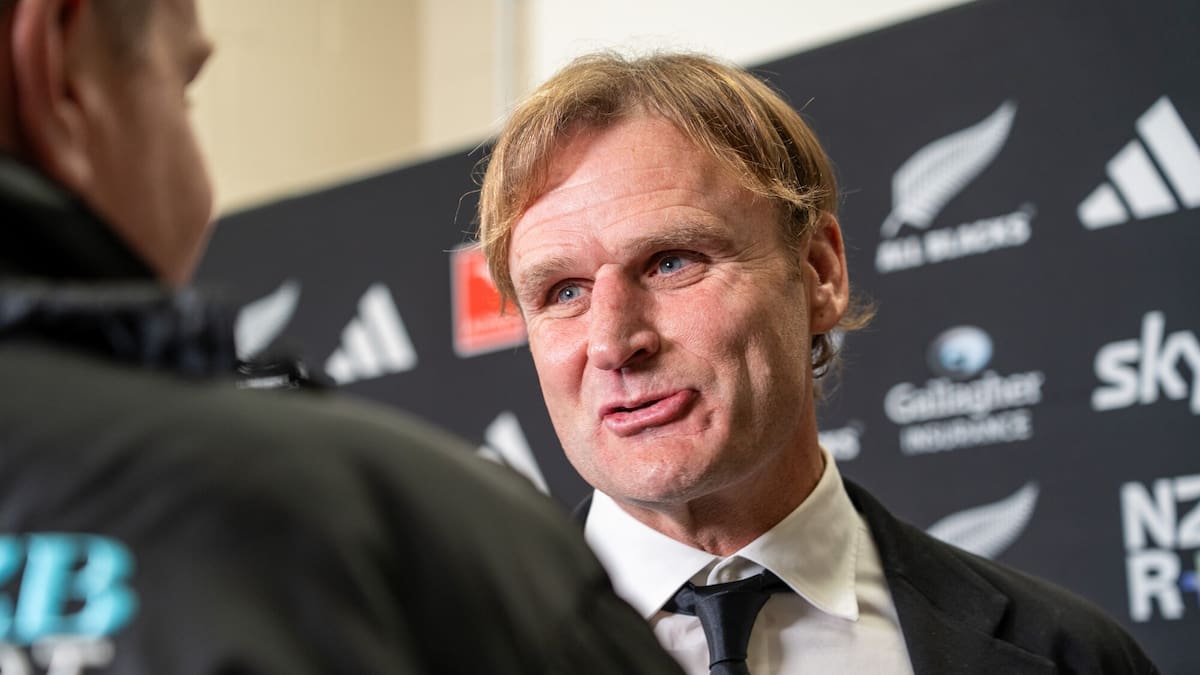
Robertson’s rugby intelligence didn’t come across on the Grand Slam tour and there was rarely style or substance to his media engagements.
The UK media didn’t know what to make of him. He’s affable, accessible and capable of a funny retort, but on the big issues – and even on the simple business of explaining selections – he’s locked in cliches and vagueness.
He likes to stand for his media engagements – as he feels that he, literally, thinks better on his feet – and while it’s apparent that he genuinely considers both the questions he faces and the answers he gives, there is little to no insight offered.
When he was asked in Cardiff to give some context to way he had picked Anton Lienert-Brown in the midfield, he said: “Look, they have been on tour Anton got a crack last week and Rieko is extremely experienced and has worked tirelessly to get an opportunity and now it is his.
“Everyone has had a crack, the balance of the squad everyone has had one two, three or four games. That is always how it is going to be.”
It was a question that needed a better, more detailed, contextualised answer as the public want to understand how Ioane and Lienert-Brown – hugely experienced players who have drifted to the periphery of the current squad – fit into the long-term thinking.
This is the people’s team, and they expect transparency and honesty – maybe not a seat in the changing room as such but enough intel to understand and buy into a coach’s vision.
But Razor, maybe because of the pressure of the job, has come across as a coach not willing to say anything for fear of how it could be used or perceived, and it reached the point where his 10-minute press conferences yielded nothing quotable or insightful, other than injury updates.
To keep fans – the very people who fund the multi-million-dollar business the All Blacks have become – in the dark, is a recipe to brew frustration and diminish the natural goodwill that every All Blacks coach is extended.
As Dylan Cleaver published in his Substack newsletter, The Bounce, after the All Blacks second test against France in July this year: “I made a note after the second test win in Wellington that Robertson’s post-match interviews had become very stilted and bland.
“Last year was a minor revelation as he joined the Sky panel on the field after the games, going into specific details about the tactics and strategies his team was trying to impose on the match and in particular what he was seeing from the opposition.
“Gradually he seems to have gone away from that. Some of it is the fault of the panellists, who far too often give statements that are posed as questions, but you can’t help wondering if there is something else at play.
“Has the enormity of the job already eaten away at some of his natural enthusiasm? Is he trying hard to sound like what he thinks an All Black coach is meant to sound like?”
History has not always been kind to figures who have brought alternative methods to established institutions and not been overly successful.
It’s human nature, possibly, to crave and celebrate someone who represents change, only to recast them as darker, villainous characters to be distrusted.
And now that the All Blacks are not performing with a clear identity or winning at the expected percentage, there are plenty of fans and media wondering whether Razor has the magical qualities they thought he did.
He’s clearly got a massive rugby intellect and a capacity to share it with passion and clarity albeit in an eclectic manner, but his public persona, stylistically at least, has morphed a long way from what it was at the Crusaders and his media interactions are feeding into a confusing narrative about where this All Blacks team is going.
None of this would matter too much if the All Blacks were playing an imaginative and compelling brand of rugby and running above their current 74% success ratio and winning something more than the Bledisloe Cup.
But when the results aren’t in line with expectation, the wishy-washing messaging that can’t shed any light on why the All Blacks used their easiest fixture (based on Wales’ world ranking) to give game time to two veteran midfielders, and a 30-year-old wing (Sevu Reece) who the coaching crew have not previously been sold on, becomes a problem.
If, as is presumably the case, Robertson believes Ioane and Lienert-Brown are precisely the sort of seasoned professionals he feels will be an important part of his likely 2027 World Cup – two versatile players who can be dropped into the team at late notice and handle the occasion – then he should just say that.
If he had, he would have been vindicated as they played well in Cardiff – both proving they can do exactly what it says on their respective tins.
Fans don’t like being shut out, and the media will create their own theories around questions that go unanswered, and there becomes a disconnect between the team and the people who support it.
And specifically with Robertson, there is a heightened sense of disappointment that he’s not been the enigmatic, charismatic front of house presence that everyone expected.
“I don’t think the fascination with Razor is still there,” says Kayes, two years on since making his documentary.
“All Blacks fans expect not only success but fantastic rugby in the process and his team has not delivered the fantastic rugby and at times they haven’t delivered the success.
“So the fascination with him has turned and there is plenty of comment now in the rugby public that Razor could be all froth and no substance.”
All Blacks fans want to be on the journey with the team – have some idea about the strategic vision, how the personnel might evolve, and understand what the coach is seeing in terms of the wider context of the global game.
If they have that, they can be more forgiving and patient about performances and results, and without it, and without access to the best version of Razor – the unfiltered, technical and tactical genius who can deconstruct a team’s attack in seconds – they start to wonder if the lack of clarity with which Robertson speaks at press conferences is the same way he speaks to the players.
The country believed in Robertson back in 2023, and if he’s willing to offer up more of his authentic self – be as forthcoming and open as he was at the helm of the Crusaders – then faith could be restored.
Gregor Paul is one of New Zealand’s most respected rugby writers and columnists. He has won multiple awards for journalism and written several books about sport.