
Three local designers say the ‘Ikea effect’ will quickly reshape Kiwi homes and tastes.
It’s been a long time coming. Ikea fans have been waiting patiently – and some not so patiently – for the Swedish homewares giant to arrive. That magical formula Ikea uses as a global positioning system
has been activated. The doors to New Zealand’s first Ikea store at Auckland’s Sylvia Park opened on Thursday, thanks to Auckland’s population density reaching the right level.
Kiwi consumers will have access to the full Ikea experience: a big box store offering Scandi design at great prices. While the arrival of the world’s largest furniture retailer, known for its flat-pack furniture, meatballs and unique showrooms, is good news for style-conscious shoppers on a budget, what does it mean for local retailers?
Ikea’s 34,000sq m Sylvia Park flagship has been seven years in the making. Photo / Annaleise Shortland
Wellington-based interior designer Samantha Rei, of Sustainable Spaces, says: “The Scandi aesthetic of Ikea will be massively appealing. The brand has done incredibly well providing homeowners worldwide with a tried and tested approach, retaining a clean minimalist look that works well in many interiors.”
She predicts that the “Ikea effect” will soon be evident in many homes here.
“There has been a lot of press about the opening of Ikea and there’s a level of excitement from Kiwis looking for a bargain, particularly when many people have been struggling over recent years with the cost of living.”
L-R: Designer Sarah Otley, who recently returned to Auckland after 15 years in Stockholm, Auckland interior stylist Melle van Sambeek, and Wellington-based interior designer Samantha Rei of Sustainable Spaces.
Are we about to see Billy bookcases appear in homes throughout the country? Auckland interior stylist Melle van Sambeek says some New Zealanders will see Ikea as a cost-effective way to decorate their home.
“There will be a sector of curious consumers that will flock to Ikea. I believe Ikea has a place in the interior market here in NZ. We are so far away from the design centres of the world. It can be frustrating when our choice often feels limited. Even with the ability to shop online, buying furniture and homewares can be a little challenging due to size, expense and of course – if you’re buying a large ticket item like a sofa – you want to try before you buy.”
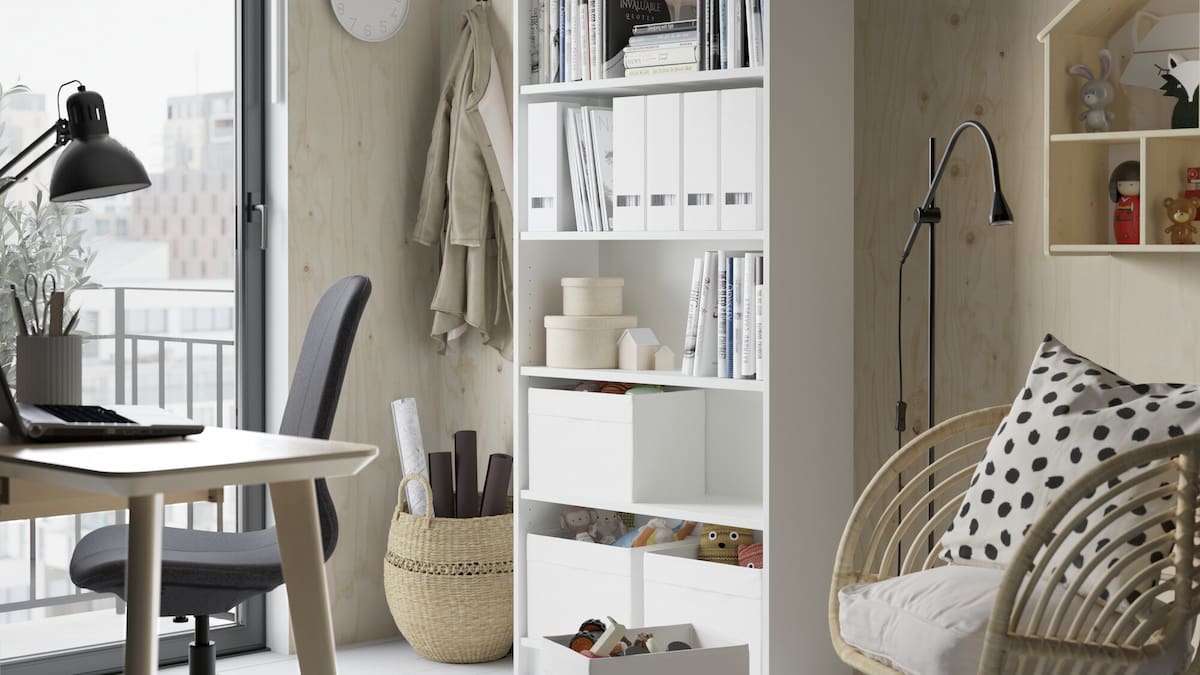
Ikea has become famous for its storage solutions.
Does this mean we will end up with a nation of homes that look like Ikea showrooms? Designer Sarah Otley, who recently returned to Auckland after 15 years in the fashion industry in Stockholm, believes that could be a good thing.
“There’s no doubt Ikea has contributed to the overall look and feel of interiors in Sweden, but they have made them homogeneously good, with comfortable and pleasurable spaces available to everyone regardless of financial standing. Beyond aesthetics, this is the role of great design – to serve the masses. And it is an inspiring example for the design idealists among us.”
Otley believes it’s just a matter of time before Ikea’s iconic products and prints are dotted throughout New Zealand homes.
“But I’m more curious to see how some of the modular systems will be used creatively by people. Flexible wardrobing and smart cabinetry may not have such an obvious aesthetic signature, but they are a toolkit that enable us to creatively shape our spaces to suit our needs,” she continues.
Is there a balance to make sure you don’t overload your home with too much of a good thing?
“The trick is in the mix,” says Otley. “If I was helping you to create a room that feels delightful there would be layers of some mass-produced basic elements, along with some of your existing items (possibly reimagined), some vintage and some natural or handmade pieces, along with great original art.”
“Ikea definitely has some great solutions, but I also believe style-conscious consumers in New Zealand who have an astute eye for design will curate interiors from a variety of sources.”
She’s a fan of the slow décor movement.
“A good interior evolves over time. Budget is a dictator but some of the best interiors are the ones that have been created slowly and thoughtfully, spaces that tell a story of the people who live there. A well-considered interior has a combination of old, new, collected, made, and found, with a sprinkling of high-end and classic vintage pieces. Ikea could work, too, of course – it’s how you tie it all together, that’s the key.
“Like fashion, we need to stop following trends. If you decorate your interior from the heart, instead of following what everyone else is doing, you’re less likely to want to constantly change things,” she adds.
“No home looks good when everything looks like it’s from a catalogue. You want your interior to express your personality, so look for some staples, but ensure you leave room for other pieces, too. Maybe try a mix of vintage and larger NZ-made pieces that you plan to retain for decades to come. Start small. Our homes don’t need to be furnished overnight. Finding keepsakes and one-off pieces in antiques shops and vintage stores is so much more rewarding.”
Ikea in the kitchen of Sarah Otley’s home in Stockholm. The pendant light and timber dining chairs are all Ikea, as are the kitchen drawers.
“Buy once, buy well” is an approach many interior experts favour.
“We need to consider how all Kiwis can consume sustainably, not just those fortunate to be able to consider this as an option,” says Otley. “The slow fashion conversation is spreading to interiors. We need to pause and consider how this impacts our choices. Quality might cost more in many instances, but great design can be found across mass-produced pieces (rice paper lampshades), second-hand products (shelving) and one-off hand-crafted items (such as a turned wooden bowl) if you are willing to take the time to hunt and gather.”
To offset Ikea’s arrival, local retailers would be wise to adopt some tried and tested strategies that have worked overseas. Furniture, homewares, art and storage solutions made locally need to trumpet their message. As well as driving money into their pockets, local creatives and entrepreneurs can offer consumers personalised service and detailed product knowledge that fosters strong relationships with loyal customers.
“I feel this is incredibly important, especially with the growth of online shopping,” says Rei. “Building trust with a real person or brand that you can rely on is essential these days.”
Van Sambeek is also passionate about supporting local, not just designers and makers, but locally owned interior retail stores.
“We can’t keep complaining that we don’t have enough choice here in NZ if we are not supporting the retailers and designers who are brave enough to open these beautiful homeware stores, or the makers who spend their day creating gorgeous, handcrafted pieces that give our homes depth and layers. A beautifully crafted ceramic is perhaps going to spark more joy and conversation than a glazed mass-produced vase,” she says.
Brightly coloured displays have been set up throughout Ikea’s new store. Photo / Annaleise Shortland
“In my work as an interior stylist I love to meet and talk to the wonderful retailers, artists and makers that often loan me beautiful wares that bring life to my photoshoots. I love hearing the stories behind why someone started a brand or what the inspiration was for a particular piece of art or meticulously crafted ceramic. You don’t get that in a large store.”
It’s clear from other markets around the world where Ikea has dominance that its place in pop culture is well cemented. Where Ikea goes, a golden glow descends on the interiors sector.
“This effect is well known,” says Otley. “I hope this focus creates opportunity for creative growth for everyone in New Zealand.”
More home design