
(Credits: Far Out / Bent Rej / Alamy)
Sun 7 December 2025 19:30, UK
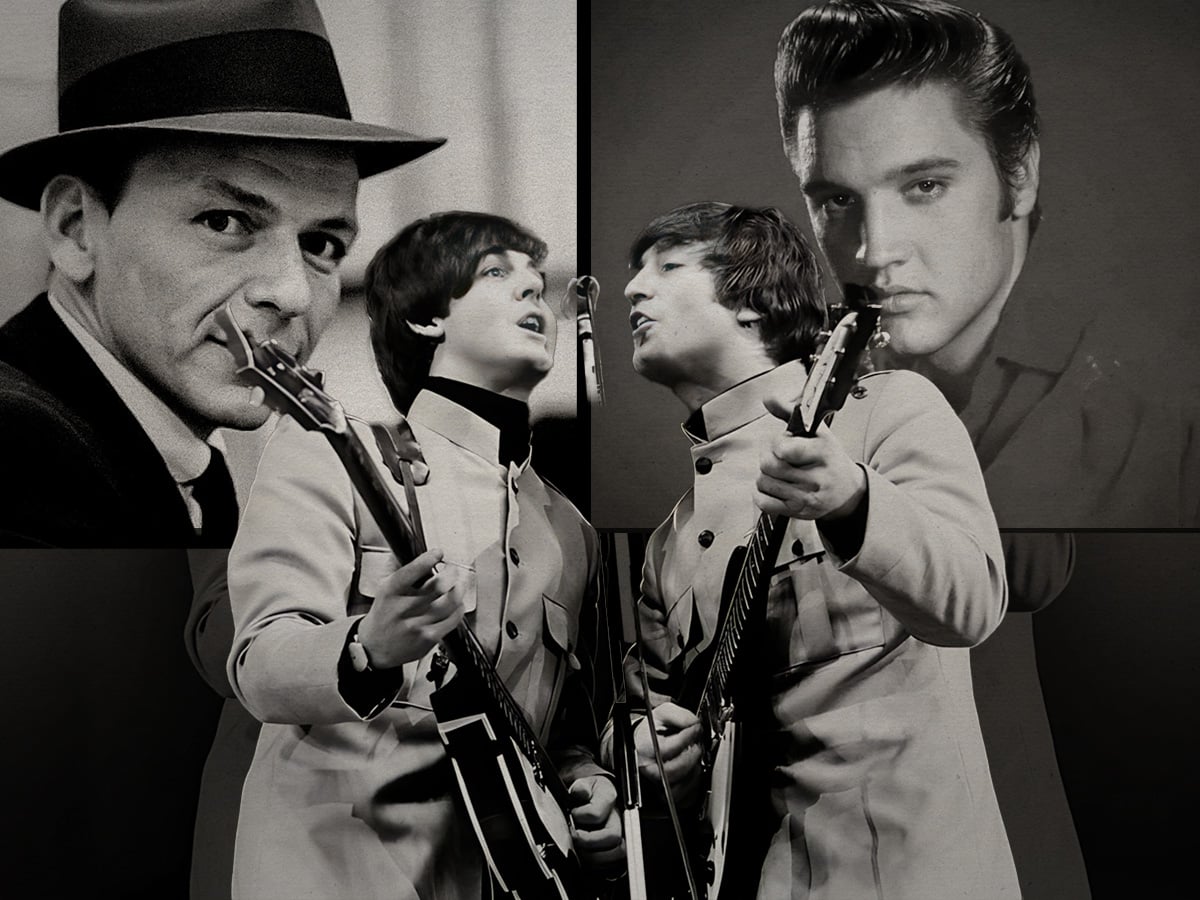
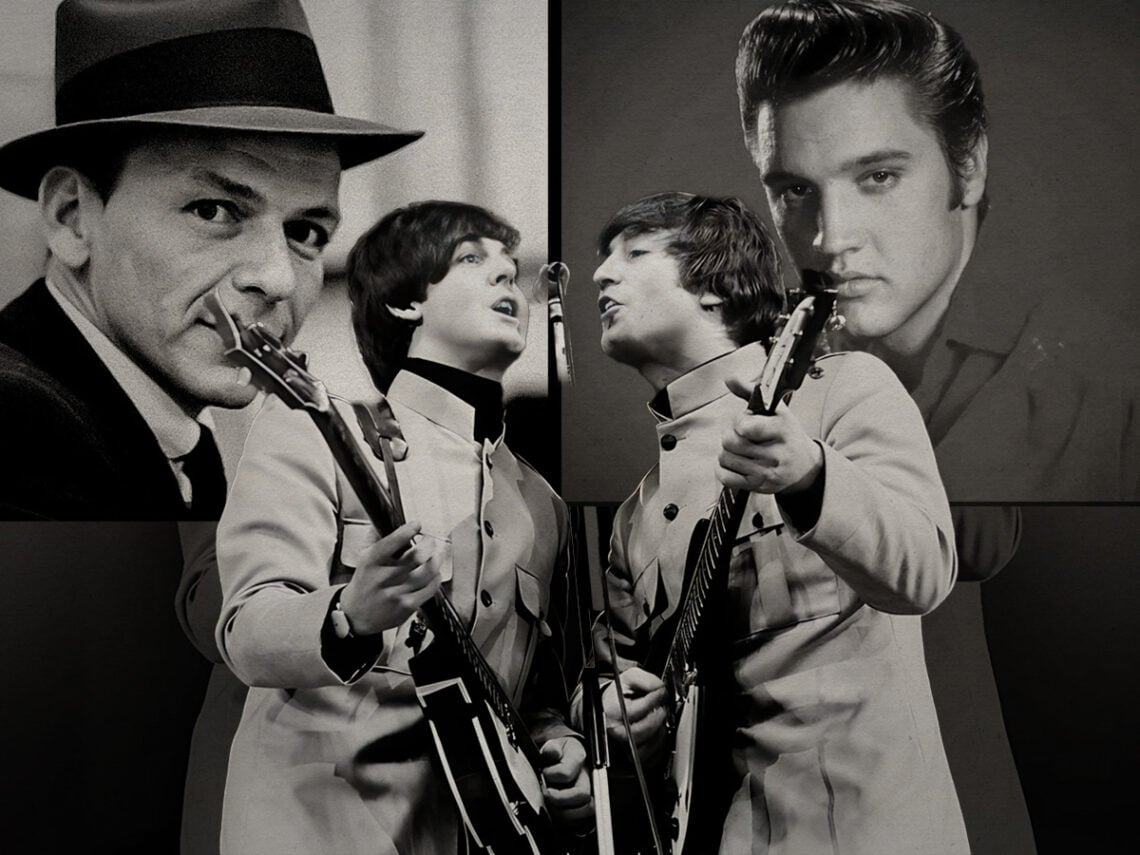
As smooth as buttered silk and powerful enough to propel a feather to the peak of Everest, the rare collision of Elvis Presley covering The Beatles feels like witnessing a blizzard storm over the sands of the Sahara.
They are not only giants of pop culture, but they are also the foundation of the whole bloody thing. And given the seismic size of their talents, the world is a better place for that brilliant buttressing. But before them both, there was Frank Sinatra.
It was December 30th, 1942. The world was in the dark depths of war, but a flicker of hope could be found in a corner of Manhattan. Or at least that’s how a clutch of frenzied youth viewed Ol’ Blue Eyes.
Before he even emerged from the wings, the ‘My Way’ singer heard the presentiment of an ear-splitting future. “The sound that greeted me was absolutely deafening. It was a tremendous roar. 5000 kids, stamping, yelling, screaming, applauding. I was scared stiff. I couldn’t move a muscle,” he later recalled. He declined to mention the potent smell of urine caused by over-excited fans refusing toilet breaks.
This scene was unprecedented in pop. There was barely such a thing as a solo artist at that point. But new alternatives were blossoming during a period where many were questioning where everything went wrong, and the press had begun peddling the notion that a new star was emerging from the ensemble of Harry James’ band.
All this excitement culminated in a fateful solo concert at the Paramount as 1942 came to a close. Radio personality Jack Benny was present as an older fellow somewhat out of the loop, and he recalled, “I thought the goddamned building was going to cave in.”
“I never heard such a commotion,” he continued. “All this for a fellow I never heard of.” But the youth had, and that was the crux of the matter: Frank Sinatra was their own. The whole gamut of culture was now their own, too. No longer would youngsters have to occupy their recreational time with art angled towards rich adults. The birth of ‘cool’ was upon us.
And ‘cool’ was proving a big, fat hit. In fact, when Frank himself would reflect on the matter, he put his finger on the cause of his rampant fandom, telling Jeremy Arnold, “Perfectly simple: It was the war years, and there was a great loneliness, and I was the boy in every corner drugstore, the boy who’d gone off drafted to the war. That’s all.”
 Frank Sinatra during his foray into acting. (Credits: Far Out / 20th Century-Fox)
When he played the Paramount two years later, the crowd was even bigger, and the infamous Frank Sinatra Riot unfurled as thousands of fans tried to force their way into the venue. This incident is perhaps the defining moment in the formulation of modern pop culture. The reports in the paper the next day were split down the middle: old folks bemused about how the hell someone could riot over a singer, and youngsters wondering who the hell wouldn’t.
Almost exactly ten years later, the second chapter in pop culture’s cyclical story would tell a very similar tale. Elvis Presley was the new kid on the block, threatening to take Sinatra’s crown with something new. Once again, this newness seemed revolutionary and was thusly met with an equal mix of biblical adoration and liturgical condemnation.
This pop culture vs conservatism-driven dichotomy is perfectly elucidated in the FBI vaults. As one letter from a former Army Intelligence Service officer, who had ‘spied’ on an Elvis concert, to FBI director J Edgar Hoover stated in 1956: “[Elvis is] a definite danger to the security of the United States”.
Continuing: “[His] actions and motions were such as to arouse the sexual passions of teenaged youth. One eye-witness described his actions as ‘sexual self-gratification on stage,’ – another as ‘a strip-tease with clothes on’.”
Before troublingly positing: “It is known by psychologists, psychiatrists, and priests that teenaged girls from the age of eleven,” which doesn’t even make them teenagers, evidencing the officer’s unscrupulous approach to facts, “and boys in their adolescence are easily aroused to sexual indulgence and perversion by certain types of motions and hysteria, – the type that was exhibited at the Presley show. There is also gossip of the Presley Fan Clubs that degenerate into sex orgies.”
It comically concluded: “From eye-witness reports about Presley, I would judge that he may possibly be a drug addict and a sexual pervert.”
While that decree might seem ludicrous in retrospect, embittered by seeing his status as the leading star of pop culture take a kneeslide, Sinatra seemed to agree with it. “His kind of music is deplorable, a rancid-smelling aphrodisiac,” he once said. “It fosters almost totally negative and destructive reactions in young people”.
He thought the new King’s bedevilling music would not only derail the prominence of the crooners, but the whole morality of the world. Why wouldn’t he? The recurring pattern of pop culture is thus: a new movement emerges as a liberating force that battles against conservatism until the mechanism of capitalism absorbs it, and the cutting-edge stars of yesteryear become the commercialised status quo, battling against the next rupture in turn.
After all, the crux of conservatism can always be surmised as thus: why would you want things to change, even for the better, when the current situation suits you?
 The late, great Elvis Presley in his prime. (Credits: Far Out / MGM)
That would be evidenced, once again, almost exactly a decade later, when The Beatles touched down on American soil, and things began to sour between them and their bequiffed ‘Hound Dog’ hero very quickly.
Once again, lodged in the FBI vault is a 663-page report on “Presley, Elvis A”, within which we learn that the ‘King of Rock ‘n’ Roll’ thought The Beatles had been a real force for anti-American spirit. He was also “of the opinion that The Beatles laid the groundwork for many of the problems we are having with young people by their filthy, unkempt appearances and suggestive music.”
Sinatra, as is perhaps obvious at this stage, had a similar opinion. In a public press release which included the iconic line “tired of kid singers wearing mops of hair”, the crooner seemed to pit his more wholesome, mature, and sophisticated music against the rock ‘n’ roll that he once proclaimed was peddled by “cretinous goons”. He allegedly even went so far as to instruct the mob to pay The Mama’s and The Papa’s a visit.
The worry that Sinatra and Elvis shared about the unprecedented arrival of booming psychedelia and bloody Beatlemania was obvious. No matter how sizable their influence may have been, neither of them wanted to be assigned to history’s footnotes as The Beatles mounted culture’s crow’s nest and searched for newness once more.
But by 1989, that’s where Bob Dylan put them. “[Elvis is] a relic of the past,” the original vagabond – not a nickname either of them would happily abide by – said, “[Frank] is on the way to becoming a relic.”
However, their bitterness about The Beatles only tells half of the story. After all, they managed to seize the zeitgeist once themselves in the first place because they, similarly, had talents that awed the masses. So, while it might have been done with a begrudged grimace, both men did peruse the Fab Four’s profoundly popular back catalogue, and each proclaimed that one gem stood out from the pile of assorted hits.
What was Frank Sinatra and Elvis Presley’s favourite Beatles song?
Reflecting on the George Harrison-written ditty, ‘Something’, Sinatra would assert, “It’s one of the best love songs I believe to be written in 50 or 100 years, and it never says ‘I love you’ in the song, but it really is one of the finest.”
Compliments were rare from Sinatra by any measure, but especially when it came to The Beatles. However, with the track becoming a fixture in his set, he had no option but to heap praise upon it. Although he did, ironically, make it clear that he was certainly no student of their work by inadvertently stripping Harrison of his songwriter credit when he performed it. “I think Frank Sinatra used to introduce ‘Something’ as his favourite Lennon-McCartney song. Thanks, Frank,” Paul McCartney recalled.
Elvis faced the same predicament. Even though he would apparently “fly into a rage” at the mere mention of their name, according to his publicist, he also knew that ‘Something’ suited his pipes like a glass slipper. Of all five Beatles tracks he covered, ‘Something‘ was by far and away the one he favoured the most.
The Harrison-penned classic paired with his smooth crooning pipes perfectly when he performed it as part of his Aloha From Hawaii set. Almost to his chagrin, Elvis knew this too, and he began to weave it into his set throughout the ’70s. All told, he covered the track 28 times over the years, introducing it each time with the irked reverence of a man meeting his ex-wife’s undeniably stellar new husband.
Perhaps their love of the song is tied to its historical context. As Harrison explained in Anthology, “When I wrote it, in my mind I heard Ray Charles singing it, and he did do it some years later. At the time, I wasn’t particularly thrilled that Frank Sinatra did ‘Something’. I’m more thrilled now than I was then.”
He aptly adds, “I wasn’t really into Frank – he was the generation before me. I was more interested when Smokey Robinson did it and when James Brown did it. But I’m very pleased now, whoever’s done it. I realise that the sign of a good song is when it has lots of cover versions.”
It’s a timeless classic, written to be just that. In many ways, this makes ‘Something’ an anthemic emblem of the cultural loop that tied the three mighty icons of The Beatles, Elvis Presley and Frank Sinatra together. In the arts, the past inspires the present to seek out a new future, in a cyclical merry-go-round of influence and rebellion.
But every so often, a piece of music slips through that churn untouched by the tribalism of era and taste. ‘Something’ is that song: a masterpiece so true and timeless that it dissolved the boundary between the balladeer past of Presley and Sinatra and the psychedelic future heralded by the Fab Four, sitting unequivocally as a perfect piece of pop that unites the whole whirling mire of unfolding modern art.
Related Topics
The Far Out Beatles Newsletter
All the latest stories about The Beatles from the independent voice of culture.
Straight to your inbox.