
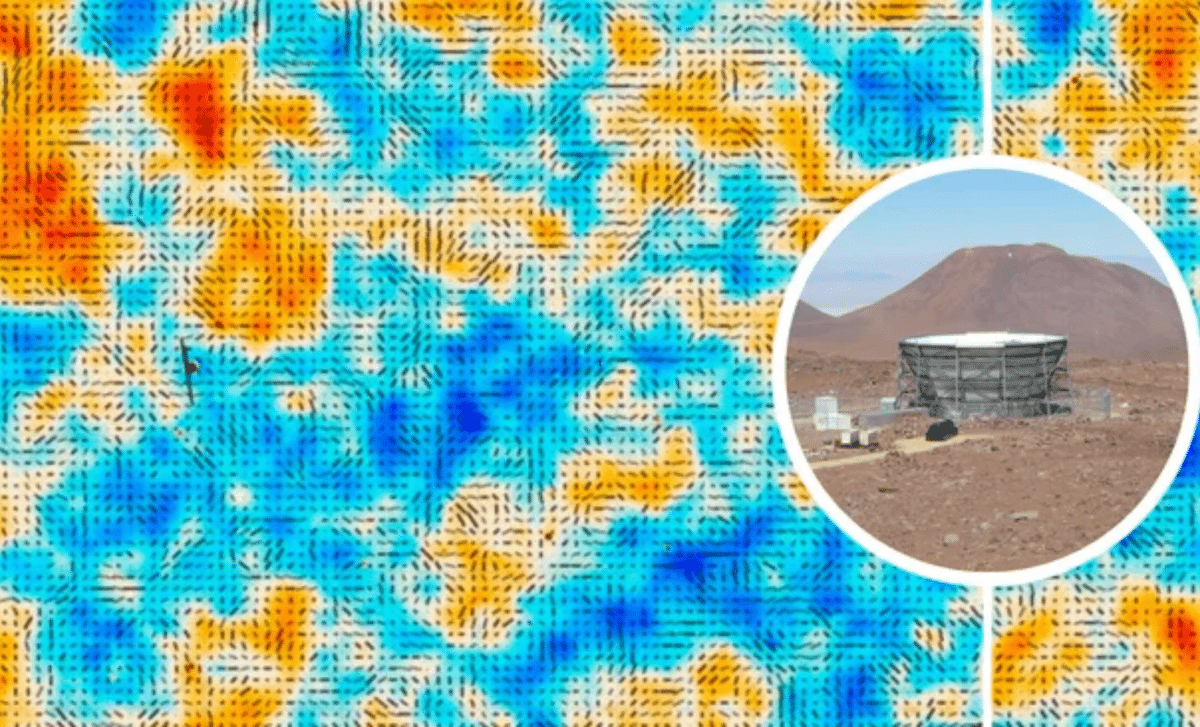
A new study, published on Arxiv, has deepened the cosmic puzzle surrounding the “Hubble tension,” an ongoing debate about the universe’s expansion rate. The findings come from the Atacama Cosmology Telescope (ACT), which has delivered highly precise measurements of the Cosmic Microwave Background (CMB) radiation. This new data intensifies the mystery of why two different methods of calculating the Hubble constant yield contradictory results. As researchers dig deeper into these cosmic discrepancies, a clearer understanding of the universe’s evolution might be closer than ever.
The Hubble Tension: What Is It and Why Does It Matter?
The Hubble constant is a fundamental measurement in cosmology. It indicates the rate at which the universe is expanding. For years, scientists have been measuring this rate using two different techniques: one based on local measurements involving Type 1a supernovae, and the other using distant light from the early universe, specifically the Cosmic Microwave Background (CMB). However, these two methods produce conflicting results, a discrepancy known as the “Hubble tension.”
This tension has puzzled scientists for years, raising questions about the accuracy of existing models of the universe or possibly pointing to new, unknown physics. The new findings from the Atacama Cosmology Telescope (ACT) add a new layer to this mystery by offering incredibly detailed maps of the CMB, particularly its polarization. This data, which complements the temperature maps obtained by the European Space Agency’s Planck spacecraft, presents a more refined picture of the universe’s early stages.
The study confirms that the Hubble constant inferred from the ACT’s measurements of CMB polarization aligns with results from Planck, further cementing the existence of the Hubble tension.
“When we compare them, it’s a bit like cleaning your glasses,” said Erminia Calabrese, a cosmologist at Cardiff University and a member of the ACT collaboration.
The new observations reveal a clearer, sharper image of the cosmos, with the tension between local and distant measurements becoming more pronounced.
New Data Challenges Existing Cosmological Models
The new results from ACT are significant for cosmology. ACT’s team has reached a milestone in observational capability, matching the precision of the Planck mission, which has been the gold standard for CMB research.
“It’s the first time that a new experiment has reached the same level of observational capability as Planck,” said Thibaut Louis, a researcher at the Université Paris-Saclay, France.
ACT’s advanced measurements have provided not only higher resolution temperature maps of the CMB but also polarization data, which had been lacking in earlier missions. This polarization data is crucial because it can reveal more about the universe’s early history and the forces that governed its expansion. By comparing the polarization maps with temperature maps, the researchers were able to confirm the robustness of the Hubble constant discrepancy, further validating the Hubble tension.
“Our new results demonstrate that the Hubble constant inferred from the ACT CMB data agrees with that from Planck — not only from the temperature data, but also from the polarization, making the Hubble discrepancy even more robust,” said Colin Hill, a cosmologist at Columbia University.
The Implications for Cosmological Models and Theories
The study’s results, available on Arxiv, along with with two companion papers also published to the same site, have significant implications for cosmology. The researchers have essentially narrowed the field of potential explanations for the Hubble tension. By comparing their results with various cosmological models, they were able to rule out several of the proposed theories that suggested the Hubble constant should be the same across the cosmos.
“We assessed them completely independently,” Calabrese explained.
“We weren’t trying to knock them down, only to study them. And the result is clear: The new observations, at new scales and in polarization, have virtually removed the scope for this kind of exercise. It does shrink the theoretical ‘playground’ a bit.”
This means that while there are still many unanswered questions, the findings eliminate some of the simpler solutions and leave only the more complex models to explain the Hubble tension. The next steps in cosmology will likely involve revisiting the basic assumptions about the universe’s structure and exploring new theories that could account for the discrepancies.