
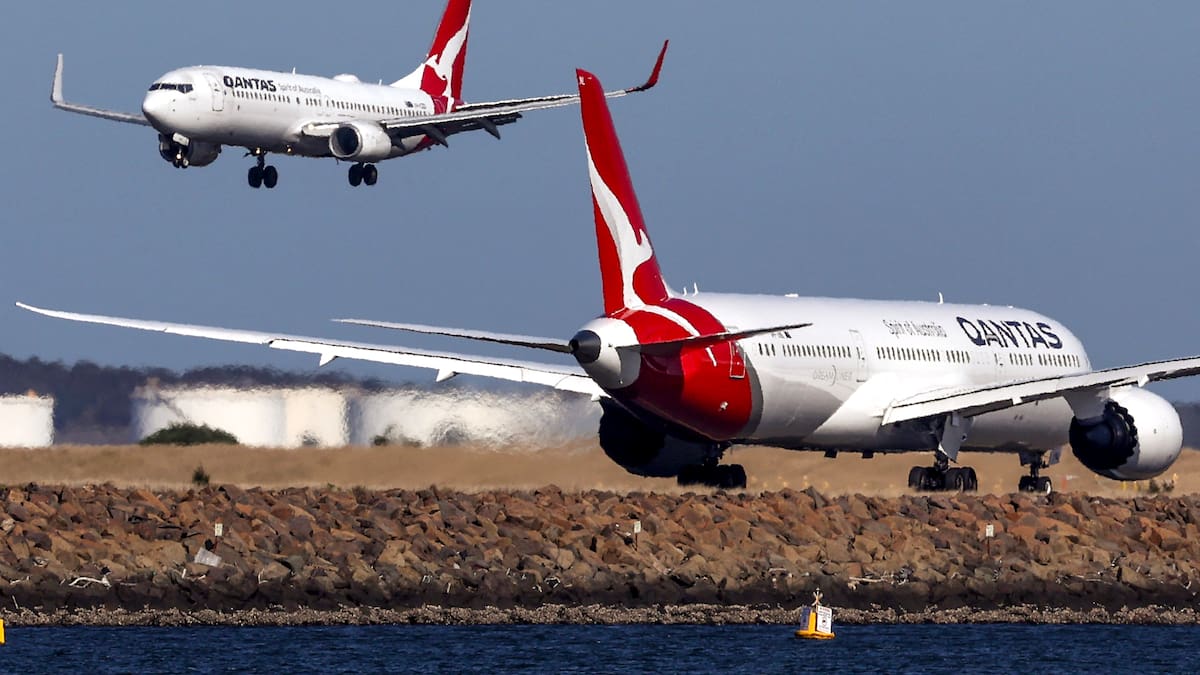
“They’ve got competitors internationally. We’re just another one,” said Cam Wallace, chief executive of Qantas International & Freight.
New Auckland-Samoa and Gold Coast routes were announced a day after Qantas ran its first Auckland-Perth direct flight since 2018.
Australian Government funding for the relevant border control and biosecurity departments at Perth was credited for making the Perth journey possible.
“We fly from Terminal 3 at our own terminal in Perth, and there was a kind of a pinch point of congestion for Border Force and the Department of Agriculture and Fisheries,” Wallace said.
“So they needed to build out the area and they needed some more staff.”
Wallace, formerly Air NZ chief revenue officer and Mediaworks chief executive, said Perth Airport and the relevant tourism board supported that build.
“We didn’t want to announce those flights until those facilities were efficient, because it’s just not a great customer experience for people having to queue and things like that.”
Talk of subsidies or Government funding for aviation in New Zealand can be controversial.
Air New Zealand’s new chief executive Nikhil Ravishankar has complained of an uneven playing field.
“Me and my 11,500 colleagues at Air New Zealand love competition,” he told the Herald soon after taking over as CEO.
But Ravishankar said some competitors cherry-picked routes and were effectively given subsidies by airports to do so.
He said that created a “weird distortion where regional customers end up subsidising somebody else’s air travel”.
The New Zealand Government has shown little appetite to fund regional routes, beyond $30 million in loans from the Regional Infrastructure Fund announced in September.
“It’s really for the Government to decide what they want to do in terms of the influence,” Wallace said.
“One thing I would say is, Air New Zealand have an amazing market position in New Zealand, one of the strongest anywhere in the world,” he added.
“We’re focused on our business, growing in New Zealand, providing customers with choice and competition, and this is a market that doesn’t have a huge amount of that.”
The rivalry might intensify next year.
Qantas subsidiary Jetstar in September launched its biggest-ever New Zealand and transtasman expansion.
But Air NZ is boosting capacity on some domestic routes from March, especially Christchurch to Hamilton and Auckland to Queenstown.
Next stop, USA
The new Auckland lounge is designed for long-haul and transit customers, with various artistic nods as well as practical facilities for such travellers.
Just as Auckland is now a linchpin in China-South America services, it is a stepping stone for Perth and Adelaide denizens travelling to the United States eastern seaboard.
“We’ll have a lot of transit customers, I suspect, for, Auckland-JFK,” Wallace said.
The airline’s friends in the oneworld alliance will also be influential.
“We’ve got a joint venture partnership here with American Airlines. They travel to LA and Dallas, and Emirates as well to Dubai.”
The alliance played its part when for eight months during the Auckland lounge rebuild, the nearby Emirates lounge hosted the Aussie airline’s passengers.
And at the refurbished lounge, there should be many guests from late next year connecting to Apia, the capital of Samoa.
“We see an opportunity there. There’s a strong demand profile,” Wallace said.
That will be mostly outbound leisure travellers, and New Zealand residents visiting their Samoan family and friends, he said.
Wallace said Qantas felt Samoa had potential.
“It’s probably an under-served outbound leisure destination, and we think that market can be stimulated through competition and choice.”
Resurrected routes
Some new routes on Qantas out of Auckland are in fact revived routes.
The Perth service had an almost eight-year absence, and the Adelaide service was ditched in 2007 before its resurrection in October.
Wallace said these revivals were partly a by-product of the airline’s fleet renewal.
Key to that was the Airbus A321XLR, a large narrowbody twinjet which Qantas started taking flight bookings for on September 12.
“As the XLRs start coming into the fleet, it’s providing us more flexibility with our other narrowbodies,” Wallace said.
That part of the fleet includes dozens of Boeing 737s.
And on Friday, Qantas welcomed back its 10th and final giant A380 double-decker quadjet after nearly six years in storage.
Covid-19 and its aftermath were not kind to many airlines, with border closures, layoffs, and then supply chain logjams or engine issues hobbling recoveries.
“All airlines around the world have had challenges, whether it’s engines or slowness of aircraft coming into the fleet,” Wallace said.
“For us, we’ve got seven A320s, but our initial order book would have meant we had a lot more. We’ve got two XLRs, but we would have liked to have a lot more.
“So, like all airlines, we have been constrained by the supply chain,” he added.
“That’s starting to loosen up for us now, which is providing us more flexibility to be able to open up new markets, drive for growth, and target new opportunities.”
John Weekes is a business journalist covering aviation. He has previously covered consumer affairs, crime, politics and courts.
Stay ahead with the latest market moves, corporate updates, and economic insights by subscribing to our Business newsletter – your essential weekly round-up of all the business news you need.