
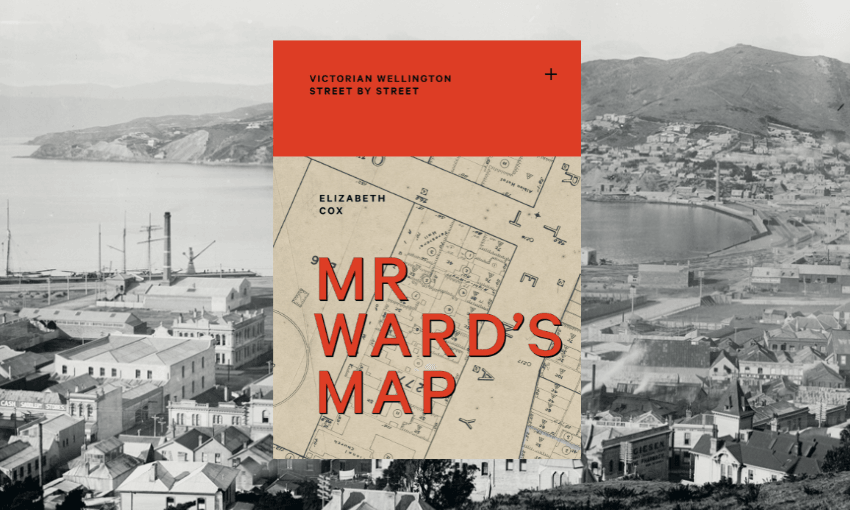
A window into a landmark new book exploring Victorian Wellington.
In Mr Ward’s Map – a doorstopper treasure trove of a book – Elizabeth Cox tells social history stories that emerge from each of the 88 sheets of the titular map. Most were filled with buildings and life, but other sheets presented Cox with more of a challenge – for example some sheets cover areas that were mainly Town Belt, or depict land only recently reclaimed from the sea. In this excerpt, Cox captures some stories about the reclaimed land in the area of Victoria, Mercer and Harris Streets and Jervois Quay, to the south of Queen’s Wharf. / Claire Mabey

A number of circuses, many originating in Australia, constantly circled New Zealand in the 1890s, and would arrive in Wellington sometimes several times a year. A small team would come before the circus itself to decorate the town with bright advertising hoardings and to construct the big top. The circus performers would then arrive by train or steamer, and parade through the streets to the tent. The circus needed only to advertise its location as “on the reclaimed land” as by the time the tent was erected everyone would know where it was. Journalist Pat Lawlor, who grew up in Wellington at the time, recalled “the mere presence of the huge tent on the reclaimed land would keep us spellbound for a week. And the elephants were so big that you could see them for nothing”.
In 1894, the FitzGerald Brothers circus arrived in Wellington from Australia with a team of 80 human performers, including an orchestra, acrobats, gymnasts, contortionists and horses riders, along with 70 horses and eight cages of wild animals, including lions, tigers, wolves and a dingo. The FitzGerald Brothers promoted themselves as offering not simply a spectacle but scientific learning to the youth of the city, with their “zoological garden on wheels”. During their visit two years later, the Wellington southerly gale caused a sensation when the wind ripped a hole in the canvas tent and snapped its support poles. The tent was repaired, and the show went on. The final act of the night was “Professor Peart”, a high diver, who dived into a small tank of water from a platform fixed 60 feet (18 metres) up the circus pole. Peart died in Sydney just months later, performing this same stunt.
A poster advertising the arrival of the Australian FitzGerald Brothers’ ‘Circus and Menagerie of Performing Wild Animals’, showing in Wellington for seven days in December 1894. Eph-E-CIRCUS-1894-01-1, Alexander Turnbull Library, Wellington.
When Ward first drew his map, almost all the land on this map sheet had recently been reclaimed from the sea and had not yet been built upon. It became the venue for many special events, including open-air election and trade union meetings, and the 1896–97 Wellington Industrial Exhibition, whose buildings included a concert hall, a “hall of mystery” and an art gallery. A cycling and running track and grandstand were also built nearby. The New Zealand Times considered the exhibition a great success, although it admitted that the architecture of the buildings was perhaps deficient. It said, possibly rather defensively, “It is not an exhibition of architecture, it is an exhibition of products natural and manufactured. No one cares about the buildings which house them . . . and all round without and within much bunting has covered deficiencies with gaiety and colour”.
The front of the exhibition’s main building, which faced Cuba Street, had towers and a large stained glass window illuminated by electric light. Inside, a large fountain featuring a statute of a Māori girl with a basket of pipi on her head and a nīkau was lit up by coloured electric lights. The fountain was constructed from clay by the Wellington tile and brick firm Peter Hutson and Co. and the figure had been modelled by W. H. Barrett, the modelling teacher at the School of Design, with the rest, including dolphins, built by Hutson’s head potter Thomas Dee.
The city’s newly-built public library sits on reclaimed land at the centre of this image taken in the late 1890s. Some of the empty land in the area behind the library later became the site of the Wellington Town Hall. Until it was filled with buildings, this empty reclaimed land was used for a variety of city events, election meetings, circuses and exhibitions. The area to the left of the library is now Mercer Street, and the tall striped chimney on the left is the coal-powered electric power station on Harris Street. At the harbour’s edge are the boat sheds for the Naval Volunteers, Star Boating Club and Wellington Rowing Club, and, further around the curve of the harbour, the Te Aro railway station and the chimney of the city’s rubbish “destructor”. The spire of St Mary of the Angels Catholic Church on Boulcott Street is in the foreground. Alexander Turnbull Library, 10×8-1022-G.
Many of Wellington’s companies displayed their work, and there were exhibits by the School of Design and displays of “home industries” organised by a committee of women. Both Walter Turnbull and Briscoes, both significant importers of tea, built tea kiosks — in the case of Briscoes, in the style of a Chinese pagoda. Whitcombe and Tombs exhibited their stationery and the New Zealand Candle Co. had an “attractive design”, Messrs Yerex and Jones exhibited typewriters and Mr Fear sewing machines. Robert Martin displayed his Wellington-made stained glass windows, wallpapers and other wares. The notable engineering firm Cable and Co. displayed some of their machinery, and the Railway Department a New Zealand-manufactured saloon car and locomotive.
The concert hall was the venue for the opening events, attended by the governor, who was entertained by the Wellington Garrison Band and a choir of 300 children. Numerous other events were held over the months of the exhibition. This was the height of the bicycle craze and the cycling track was very popular; 1000 people were estimated to have attended one race and there were events such as the “best decorated ladies bicycle” competitions.
Miss Bannister – winner of first prize for Best Decorated Ladies Bicycle at Wellington Industrial Exhibition Cycling Sports, November 1896.
A special room was set aside for the kinematograph, the newly arrived technology to project moving pictures. Two new and competing pieces of technology — the kinematograph and the kinetoscope — were circulating the country at the time. The kinetoscope, which had been developed in Thomas Edison’s laboratory, was an early motion picture device that could be experienced by one person at a time through a small viewer window. Alfred Whitehouse exhibited a kinetoscope throughout towns and cities in New Zealand, together with a phonograph to play music that matched the actions on the screen: “Japanese girls are seen dancing, in perfect time, to a New York Orchestral Band”, he advertised. Whitehouse must have also recorded the Wellington Garrison Band, as their music was added to his advertising.
The kinematograph arrived in the city just in time to be a part of the exhibition. The promoters of this technology, which the inventors, the Lumière brothers, had only publicly screened for the first time a year before, advertised it in direct competition to Whitehouse’s kinetoscope: “No Miniature Picture; No Waiting your Turn; No Toy or Peep-show; but Actual Reproduction of Life of Every Variety”. Their films included one of Eugen Sandow, the famous German muscle man, dancers and a re-enactment of the execution of Mary, Queen of Scots. The once slow connections between early colonial Wellington and the wider world had changed in the face of technological advancement.
In the 11 weeks the industrial exhibition ran, it was visited by 180,000 people, a remarkable figure given Wellington’s wider population was only 50,000. The buildings were demolished soon after, but the cycling track remained in place for some time.
The 1896–97 Wellington Industrial Exhibition buildings. Ref: 1/2-032452-F. Alexander Turnbull Library, Wellington.
On Harris Street, an unusual shape drawn on the map is the octagonal footprint of the chimney of the New Zealand Electrical Syndicate’s electricity generation plant, alongside the Gülcher Electric Light and Power Company’s building. Wellington’s streets had been lit by gas lamps since the 1870s (on moonless nights only). The city council called for tenders to provide electric lighting in the city in 1888. The successful tenderer would need to build turbines and supply 500 electric lamps, and the council itself would provide the water for the hydroelectric scheme from its own town water supplies in Karori and Wainuiomata.
The winner of the tender was the Gülcher Electric Light and Power Company of London, which built two small brick hydroelectric stations, one on Manners Street, on what is now Te Aro Park, and one on Panama Street. Electric lights began shining on the streets of Wellington in 1889, the same year Ward began his project, and they are marked as little stars on his map. The city became the first in the southern hemisphere to be lit with electric street lighting. On the first night, The New Zealand Mail described the scene:
Soon after dusk, as far as the eye could see, street after street was dotted suddenly with tiny glowing glints of light, resembling so many isolated knitting needles heated to a dull red heat. Then these gradually increased in depth of colour, passing from the dull, cherry red into a crimson-like flame, verging rapidly into the full, pure white blaze of electricity. Then the city was brilliantly lit.
Wellington scientist William Skey, who also wrote poetry (described as often “deliciously awful” by his biographer), captured the moment in his poem ‘On the electric lighting of Wellington’:
‘Tis done!
And where but yesterday night, the gas-lights flare
To strive for man against the murky air,
To night from lofty shapes in trappings gay,
The Empire City’s bathed in mellow day;
To night a thousand suns resplendent shine,
From Lambton’s curve to Newtown’s far confine.
However, the project struggled from its earliest days. The two hydro stations required more water than the council could provide, without threatening its supply to residents and factories. The Gülcher company’s contract and operations were taken over by the New Zealand Electrical Syndicate. The syndicate applied for permission to supply electricity to private customers for the first time. In 1893, the operation moved to the new brick building on Harris Street shown on the map, with its large chimney, which burned coal from the West Coast landed nearby at Queen’s Wharf, creating steam to generate the electricity.
When the governor, Lord Glasgow, and his wife visited the building just after it opened, the turbines were set in motion for them to observe. They were also shown an “interesting collection” of electrical appliances, including kettles, irons, frying pans, pots for boiling shaving water, curling tongs and fans, and a model electric workshop, including a lathe, drilling machine and grindstone, all driven by an electric motor.
Mr Ward’s Map: Victorian Wellington Street by Street by Elizabeth Cox ($90, Massey University Press) is available to purchase from Unity Books.