
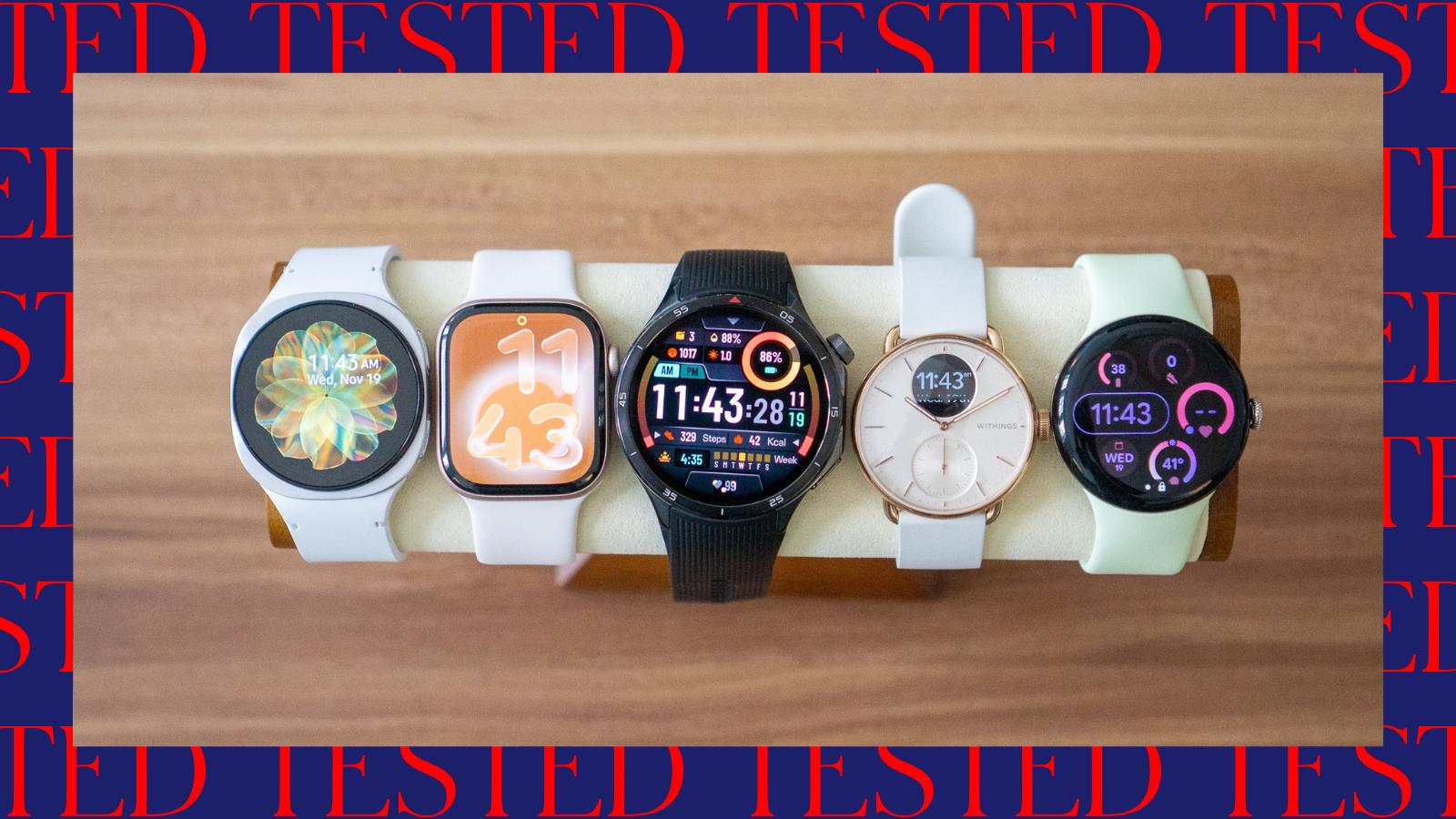
Smartwatches have evolved from a niche accessory to an everyday wearable for many of us—and with the myriad of options, the best watch today likely needs to go beyond text notifications to deliver advanced health tracking, seamless phone integrations and useful AI features. To find the best smartwatches, myself and my colleague, Katie Simpson, a certified personal trainer and senior content strategist, put over a dozen models to the test over the course of several months. After rigorous testing, we named the Apple Watch Series 11 the best smartwatch for most people. It offers robust—and innovative—health tracking features for detailed insights to your personal well-being.
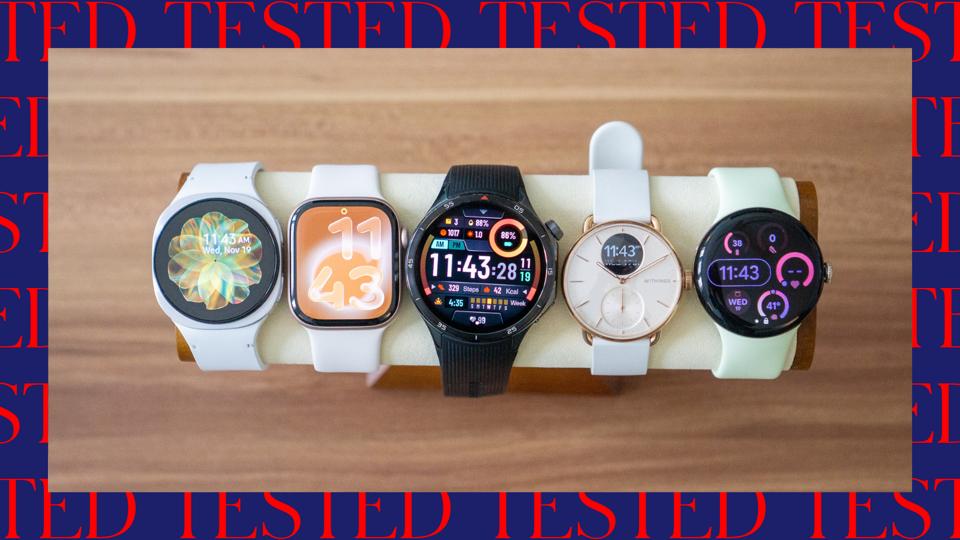
We tested more than a dozen models to find the best smartwatches from Apple, Samsung and more.
Illustration: Forbes / Photo: Rebecca Isaacs for Forbes
If you’re not already invested in the Apple ecosystem, you have a few more options. Android users should consider the Samsung Galaxy Watch 8, and for those who plan to track every fitness metric, the Garmin Venu 3 is built for training for your next marathon. When testing the best smartwatches, Simpson and I considered battery life, operating system, health and sleep tracking features, comfort and much more. After months of testing, here are the best smartwatches we found.
Forbes Vetted
Forbes Vetted ratings are based on thorough evaluations by our editorial team to help you choose the best products with confidence.
Display size: 1.7 inches and up | Weight: 1 ounce and up | Battery life: Up to 38 hours | Water resistance: 164 feet | Operating system: WatchOS 26 | Sensors: ECG, heart rate, blood oxygen, compass, gyroscope, depth gauge, sleep, temperature, ambient light, accelerometer, altimeter, spO2 tracking
Best for:
A truly seamless experience within the Apple ecosystemStrong array of health featuresExtra data like hypertension tracking
Skip if:
You don’t use an iPhoneSleep health details are essential
Want to save this story for later?
No need to bookmark—get it straight to your inbox.
Remind Me
We’ve sent this story to your inbox.
Multiple Size Options And Colorways
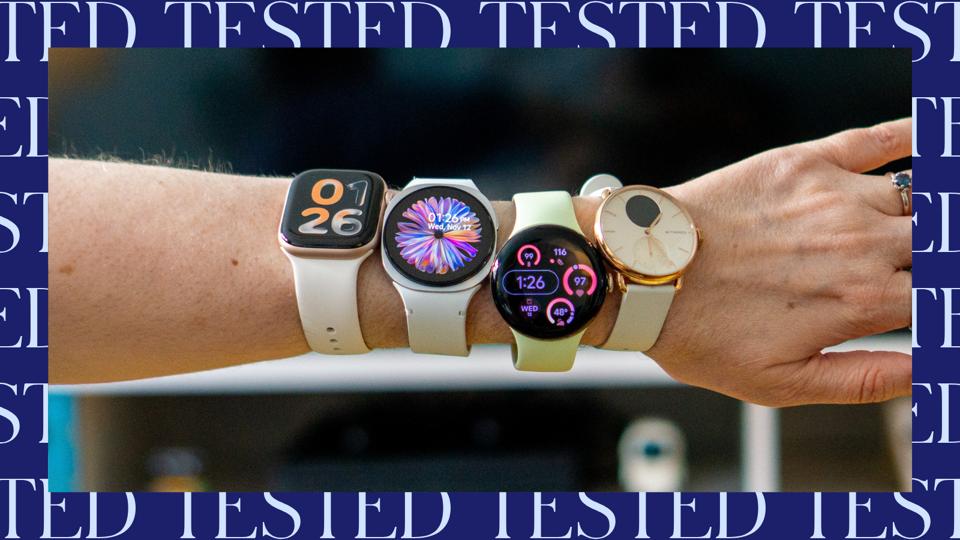
After weeks of testing, I found the Apple Watch Series 11 to be the best smartwatch overall: it offers an excellent balance of price, performance and seamless smart integrations with an iPhone. You can get the watch in two material options, aluminum and titanium, as well as two sizes, 42mm and 46mm. There are also multiple band colorways, so you can choose one that suits your personal style.
The OLED display on the Apple Watch 11 is bright and easy to read. I’m also a fan of this new watch face.
Rebecca Isaacs for Forbes
Useful Health Tracking, Including Sleep Apnea Detection
Apple has always offered an impressive array of health tracking software, from its accurate fitness tracking to detailed health insights, A-fib detection, sleep apnea detection and more. Now, you get what Apple calls Sleep Score, which synthesizes your sleep data and delivers a number showing how well you slept the night before. It’s a nice addition, but nothing innovative. Other brands debuted their sleep score software as early as 2021. While it’s useful to see what percentage of the evening I slept in REM and how it translates into how well-rested I feel the following day, Apple is still behind the competition. Samsung smartwatches offer more robust extras, like its sleep coaching, to promote better sleep habits. Most will be perfectly happy with this health data software, though.
New And Innovative FDA-Cleared Health Metrics
This year, Apple also debuted its new FDA-cleared hypertension tracking. Over the course of 30 days, the watch tracks heart measurements; after 30 days, the watch alerts can show signs of long-term hypertension. To be clear, it cannot diagnose heart conditions and emergencies, but you can use this technology to potentially prevent medical emergencies by being more aware of your heart health and sharing these insights with your doctor. This hypertension tracking is innovative—and helped to cement it as the best smartwatch I tested. The battery life is also improved over the Apple Watch Series 10. It now lasts 24 hours of normal use and 30 hours in power-saving mode. It also charges quickly; 30 minutes can charge up to 80% of the battery.
Forbes Vetted
Forbes Vetted ratings are based on thorough evaluations by our editorial team to help you choose the best products with confidence.
Display size: 1.6 inches and up | Weight: 0.9 ounces and up | Battery life: Up to 18 hours | Water resistance: 164 feet | Operating system: WatchOS 26 | Sensors: Heart rate, sleep, ambient light, accelerometer, altimeter, gyroscope, compass
Best for:
All the perks of the Apple ecosystem with a lower priceAn entry-level smartwatchTweens and teens
Skip if:
You want the latest health tracking featuresYou’re not an iPhone owner
Two Size Options, With Seamless iPhone Integrations
If you’re seeking a smartwatch that covers the basics, the Apple Watch SE (2nd Gen) offers a seamless setup in connection to any iPhone. The display is also large enough to easily read notifications, review health data and more. It comes in two sizes—a 40mm display or 44mm. During Simpson’s testing, she noted that it’s bulkier on her wrist.
The Apple Watch SE (2nd Gen) offers seamless iPhone integration and an easy-to-read display. This is the 40mm size on a woman’s wrist.
Rose Gordon Sala for Forbes
Limited Health Tracking And Shorter Battery Life
While it offers health tracking, keep in mind that it has no ECG, blood oxygen monitoring and temperature sensing. The latter may be more important to female users who need to track their cycle and ovulation estimates. Also, because it’s a value option, expect a shorter battery life. However, Simpson also noted during testing that this is a great smartwatch for beginners, provided that you’re in the Apple ecosystem.
Our parenting team also likes this smartwatch best for tweens and teens of iOS families thanks in part to its strong parental controls. And if you purchase it in the GPS and cellular version, they don’t need to also own an iPhone to wear it. Instead, it pairs with their caregiver’s iPhone and via their Apple Watch app. If you’re an Android phone user, look elsewhere for your next smartwatch.
Forbes Vetted
Forbes Vetted ratings are based on thorough evaluations by our editorial team to help you choose the best products with confidence.
Display size: 1.6 inches and up | Weight: 1 ounce and up | Battery life: Up to 40 hours | Water resistance: 164 feet | Operating system: Wear OS | Sensors: ECG, heart rate, infrared temperature, gyroscope, accelerometer, altimeter, geomagnetic, barometer, body composition, spO2 tracking
Best for:
Comprehensive fitness insightsImproving sleepGoogle Gemini integrations to help you accomplish more tasks
Skip if:
You prefer a more streamlined smartwatch in terms of features and looksYou’re an iPhone carrier
Impressive Ecosystem Complete With Robust Sleep Tracking Features
The Samsung Galaxy Watch 8 features an impressive ecosystem built for Samsung users. You can use a Google Pixel phone with it, but you lose access to a handful of features, such as heart tracking extras and sleep apnea detection. For fitness enthusiasts or anyone seeking more insight into their sleep patterns, the data and features here are terrific. You can track different workouts, including walking, treadmills, rowing and more, of course. But if you use a Samsung phone, the software allows you to line up videos and start recording from your wrist. The watch shares not only the whole time spent sleeping, but also sleep stages, the time spent asleep in each stage, movement, blood oxygen levels, skin temperature, heart rate and more. Sleep Coach also helps you learn more about your sleep habits.
I also found the battery life lasted about 36 hours on a full charge, which is on par with other smartwatches I tested.
The Samsung Galaxy Watch 8 offers detailed sleep insights, including sleep and an AI-based ‘Energy Score.’
Rebecca Isaacs for Forbes
A Design That Feels Off
But the Galaxy Watch 8’s design feels not quite right on my wrist. It features a distinctive cushion case, a classic style defined by a square shape and softly rounded corners. However, because the display doesn’t fully cover the cushion, it looks awkward. The display is also slightly raised from the cushion design, which isn’t something I loved. It also comes in two sizes: 40 or 44mm, and multiple band styles, so there might be a look that appeals more to you.
Start the Antioxidant Index test and press firmly on the back to receive your measurement score. I found it completely nonsensical, and you can have a great smartwatch experience without this health addition.
Rebecca Isaacs for Forbes
A Little Too Extra
While much of this software is intuitive, some of the software, such as the Antioxidant Index, feels frivolous, and that’s not solely because you need to remove the watch and place your thumb firmly on the back to run that test and receive the score. No matter how hard I tried, my “very low” score took months of wear before I could raise it, despite my plant-heavy and antioxidant-rich diet.
MOST POPULAR
Forbes Vetted
Forbes Vetted ratings are based on thorough evaluations by our editorial team to help you choose the best products with confidence.
Display size: 1.8 inches | Weight: 1.7 ounces with included band | Battery life: Up to 26 days | Water resistance: 164 feet | Operating system: Garmin OS | Sensors: ECG, blood oxygen, heart rate, compass, altimeter, accelerometer, thermometer, ambient light, gyroscope, spO2 tracking
Best for:
Detailed health insights, including recovery and sleepAccurate readingsBuilt-in workouts, including accessible ones
Skip if:
You want it to auto detect your activity You prefer a slimmer profile
The Garmin Venu 3 has received plenty of accolades from our team: It’s the best fitness tracker, according to Simpson, and it’s our pick for the best fitness smartwatch for women. After spending four months training with the watch, Simpson noted this smartwatch is built with fitness at the forefront, and she appreciated the useful recovery time predictions as well as its daily suggestions. It helped her plan her day, and it also offers more than 30 preloaded sports apps, which include workouts. The software does take some time to get accustomed to, but once you’re familiar with it, it’s easy to load exercises down to sets and reps, which Simpson found useful.
The Garmin Venu 3 helped one tester level up her fitness goals.
katie simpson for forbes
A Holistic Approach That Helps Improve Fitness Goals
Of all the smartwatches Simpson tested, as a personal trainer, she gravitated toward this one the most, sharing that the watch, “takes a holistic approach to fitness without being intimidating to use.” In addition to the fitness offerings, the watch provides sleep coaching and bedtime recommendations to help with post-workout recovery. Thanks to this blend of useful features, Simpson shared that this watch was the only one that actually helped her improve her fitness goals, so long as she stuck with its recommendations.
Plan To Manually Enter Your Fitness Routine
Simpson noted some drawbacks during her testing. In order to use the fitness tracking capabilities to their fullest extent, you need to constantly monitor your fitness. Unfortunately, it doesn’t automatically sense the type of activity you’re doing. She also noted that this was the bulkiest smartwatch she tested, although it still felt light on her wrist.
Forbes Vetted
Forbes Vetted ratings are based on thorough evaluations by our editorial team to help you choose the best products with confidence.
Display size: 1.5 inches | Weight: 2.9 ounces with included band | Battery life: Up to 16 days | Water resistance: 164 feet | Operating system: Wear OS by Google + RTOS | Sensors: Wrist temperature, optical heart rate, optical pulse oximeter, geomagnetic, light, barometer, acceleration, gyroscope
Best for:
An extra long battery life for those who don’t want to stop to charge Maximizing the use of the rotating crown
Skip if:
ECG monitoring is a priority for youYou need more preloaded workouts like rowing
A Big, Bulky Design—With A Fully Functional Rotating Crown
The OnePlus Watch 3 may be one of the biggest, bulkiest smartwatches I’ve tested to date. It’s so big that it looks borderline cartoonish when strapped to my thinner wrist. Still, it’s also lightweight, and that massive display makes it easy to read everything on the screen. The rotating crown is an added bonus. While most models, like the Apple Watch Series 11, as an example, feature a rotating crown, it’s not fully functional. You can’t use it as a full button press, as an example. The OnePlus Watch 3 allows you to click through watch face selections via the rotating crown.
Use the rotating crown to zoom in on the app library the OnePlus Watch 3 offers.
Rebecca Isaacs For Forbes
Battery Life Can Last Up To Two Weeks
The battery can last up to five days on a single charge—longer than the Samsung Galaxy Watch Ultra and the Apple Watch Ultra 2. This includes extras like sleep monitoring and other health tracking metrics enabled. Put it into low power mode, and you can get an impressive two weeks if necessary. It’s by far the longest battery life I’ve seen in a smartwatch with a fully functioning display.
Limited Exercise Options And No ECG Are Drawbacks
Some sports functions are limited; it registers my husband’s rowing as exercise, but it doesn’t offer a rowing exercise preload, as just one example. There’s also the ECG, which is not available in the U.S. because it didn’t receive FDA certification, according to the brand. “As the OnePlus Watch 3 did not receive official certification from the U.S. FDA on its ECG capabilities, the ECG Analyzer feature on the OnePlus Watch 3 will not be available to users in the United States or Canada,” shared a brand representative. You can read my full OnePlus Watch 3 review to learn more.
Forbes Vetted
Forbes Vetted ratings are based on thorough evaluations by our editorial team to help you choose the best products with confidence.
Display size: 1.9 inches | Weight: 2.1 ounces and up | Battery life: Up t0 72 hours | Water resistance: 328 feet | Operating system: WatchOS 26 | Sensors: ECG, heart rate, blood oxygen, temperature, depth, water temperature, compass, altimeter, accelerometer, gyroscope, ambient light, spO2 tracking
Best for:
Campers, hikers and fitness fans who want full Apple featuresIts long battery life—the best of all the Apple options we tested
Skip if:
You’re not planning weeklong camping tripsYou don’t want to spend $700 on an Apple Watch
Built For The Outdoors, With A Bright Display
Most Apple users are more than happy with the Apple Watch Series 11. But if you need something a little more rugged with extra health tracking features, consider the Apple Watch Ultra 2. The band is more heavy-duty and the large display gets impressively bright, so you can easily read your fitness insights and notifications in sunny conditions. The digital crown and side button are easy to use should you wear gloves while in the great outdoors.
You get access to all features currently found in Apple’s latest watch software like its new Workout Buddy motivational audio, Suggested Smart Suggestions and the ability to flick your wrist and flick away a call. Additionally, the titanium model offers GPS tracking and cellular compatibility. For those who spend lots of time outdoors, this software can be potentially life-saving, thanks to the Emergency SOS, a satellite-based offering that can help you call emergency services if there’s no cellular service available.
Too Much For Casual Users
That said, while this watch is impressive for its expansive offerings, it may be overkill for casual users. Simpson recommends it for those who, “love to camp, hike and participate in serious athletic activities (like marathons and triathlons) and are interested in a fitness tracker that also has smartwatch capabilities.” It’s also the most expensive watch our team tested and costs $700, which also may be overkill for most Apple enthusiasts.
Forbes Vetted
Forbes Vetted ratings are based on thorough evaluations by our editorial team to help you choose the best products with confidence.
Display size: 1.4 inches | Weight: 1.2 ounces | Battery life: Up to 30 days | Water resistance: 164 feet | Operating system: WatchOS 11 | Sensors: ECG, heart rate, sleep, temperature, accelerometer, spO2 tracking
Best for:
Basic sleep, fitness and cycle trackingIts battery life—it lasts weeks before needing a rechargeA more stylish and traditional watch look
Skip if:
You need texting and calling from your wristYou need more detailed and readily available health and fitness data
A Smartwatch That Looks “Dumb”
The Withings ScanWatch 2 masquerades as a traditional watch, but it offers plenty of smart features that make it a great hybrid option. Its smaller and more typical watch face display looks subtle on wrists, so much so that it’s hard to tell it is actually a smartwatch. It also comes in plenty of colorways and interchangeable watch bands to better complement professional clothing and suiting versus the more typical sporty smartwatch that blends in better at the gym.
The Withings ScanWatch 2 doesn’t look like a typical sporty smartwatch, but it does offer plenty of smart features, including in fitness and health tracking.
Rebecca Isaacs for Forbes
Useful—But Basic—Tracking Features
The watch’s health tracking features are pretty simple: a step tracker, flights of stairs counter and other basic metrics. You access most of this data, not on the smartwatch but in the app on your phone instead, too. You’ll find detailed insights on distances walked, sleep oxygen, sleep quality and more—in the app. That’s going to be frustrating to anyone who wants all of that information visible right on the watch, but for those seeking a more streamlined smartwatch light, this might be just about right. It also appeals to those seeking to tune out some of that constant data stream from their wearable device like, “Time To Stand!”
Battery life is also stellar. While the OnePlus Watch 3 can last up to five days on a single charge, the ScanWatch 2 can last up to a month on a single charge while using most of its features. That said, when I turned on all power-hungry features, it lasted 10 days before it dropped to 20%. Even then, it could have lasted a few extra days before setting it on the charger.
Some Downsides For Anyone Seeking A More Robust Smartwatch
Because it’s more of a basic smartwatch, I found some fitness tracking features to be lackluster, too, especially in comparison to more typical smartwatches. One evening, a quick glance at my watch after getting home revealed I’d turned a planned 35-minute walk into a 50-minute trek—and it was still counting.
You also can’t receive or place calls or send text messages on this smartwatch hybrid. You can, however, get an alert that you’ve received a text or an email. Also, since the display is small, it takes a minute to read longer text the watch displays—and it doesn’t repeat any notifications. Still, this watch is promising limited smartwatch features paired with a more polished and professional looking package, so it might be just right for those seeking a compromise.
Other Smartwatches We Tested
In addition to the top picks above, we tested over a dozen smartwatch options. Below are some watches that we found are still very good, but they didn’t quite make the cut for various reasons.
Best Smartwatch Overall Runner-Up: Apple Watch Series 10 (4.3/5 stars): The Apple Watch Series 10 is our former top pick. The 1.7-inch OLED display gets plenty bright at 2,000 nits, and you can view it at most angles in direct sunlight with ease. That said, the newer Apple Watch Series 11 has an Ion-X glass that is twice as scratch-resistant than the Series 10. The newer model also gets a little longer battery life.
Best Fitness Smartwatch Runner-Up: Garmin Lily 2 (4.5/5 stars): Simpson found the Garmin Lily 2 easy to set up, and it’s durable and more lightweight than other options she tested. It has a “super-impressive battery life—it lasts five days.” Simpson also found its heart rate tracking accurate and noted that it could track reps and sets with ease.
Best Smartwatch For Android Runner-Up: Google Pixel Watch 4 (4/5 stars): The new Google Pixel Watch 4 features a lovely domed-shape that looks sleek when worn, and it features plenty of software upgrades. Just one example: Should you wish to use it, you can raise your wrist to speak and ask Google Gemini questions. Google’s claim of a 40-hour battery life fell a little short during testing. I only received around 36 hours of life between charges. The LTE model also offers the SOS satellite communications feature, a feature that helps provide emergency services even when you’re off the grid.
Best Value Smartwatch For Android Users: Samsung Galaxy Watch 7 (4/5 stars): The Samsung Galaxy Watch 7 sports a classic circular design. I appreciated how effortless it was to log workouts, reply to messages, and access my apps thanks to its seamless integration with my Samsung phone. Keep in mind, though, this model is Samsung’s previous generation of smartwatches. If you want a solid mix of affordability and performance while staying in the Samsung ecosystem, this is a great pick. However, for advanced features like Vascular Load, plan to upgrade to the Watch 8.
Best Rugged Smartwatch For Android Users: Samsung Galaxy Watch Ultra (4/5 stars): The Samsung Galaxy Watch Ultra is the same size as the OnePlus Watch 3, and its battery is more powerful than the Samsung Galaxy Watch 8—590mAh compared to 325mAh/435mAh, depending on the dial size you choose. The display lets you pack plenty of important health and fitness tracking information so you can review it without it feeling cramped. However, during long-term testing, the battery life dramatically reduced and it barely lasted one day. Previously, I could get up to two days of life. I’m also not a fan of Samsung’s cushion case design with a circular Super AMOLED touchscreen.
Apple Watch SE (3rd Gen) (Rating coming soon): The Apple Watch SE (3rd Gen) looks like a solid value pick, offering an Always-On Display, sleep apnea alerts and faster charging. We’re still putting it through its paces, so stay tuned—once testing wraps up, we’ll share our full verdict here.
Apple Watch Ultra 3 (Rating coming soon): The Apple Watch Ultra 3 is Apple’s newest rugged smartwatch, and it’s shaping up to be our top pick for those training for triathlons and other intensive fitness routines. Our team is still putting it through extensive testing; so far, we’ve used it for runs, cardio sessions and endurance training. We’re also incorporating military-style ruck marches, which is part of why our full verdict is taking longer than usual. Once we’ve gathered all of our in-depth insights, we’ll update our findings here.
How We Tested The Best Smartwatches
To test the best smartwatches, Simpson and I tested over a dozen devices. We spent months strapping smartwatches to our wrists, and wore each smartwatch for a minimum of three weeks to get a well-rounded picture of each device’s offerings. As we wore each daily, we considered the following features.
Health tracking: While we wore at least one smartwatch at a time for three weeks, we cross-checked the health tracking features by wearing two smartwatches and one smart ring for 24 hours. We noted any tracking discrepancies, ranging from sleep cycles and time spent in sleep stages to sleep and energy score calculations.
Fitness tracking: Your smartwatch should effectively double as an accurate fitness tracker. We ran, walked, swam, rowed and more. When possible, we logged hours in these exercise modes to track accuracy, from distances traveled to hear rates and more.
Battery life: We wore each smartwatch from a 100% setting all the way down to 0%. If a smartwatch offered a low power or battery saver setting, we noted when (and if) it turned on and how much longer the battery life lasted. We also charged each smartwatch from 0% back to 100% and noted how long it took.
AI integrations: Almost every updated and top-rated smartwatch in 2025 available offers some kind of AI assistant like Google Gemini or Apple Siri, as examples. We tested them to see whether they were intuitive to use and how they performed.
Design: When wearing the smartwatches, we considered how they looked and felt on our wrists after hours of wear. If it looked bulky or felt heavy, we noted it. We also considered button and crown placements.
What To Consider When Looking For A Smartwatch
When it comes to finding a smartwatch, there is no shortage of options. In addition to using our own testing criteria to determine the best smartwatch, I also consulted with several experts to narrow down what’s most important. Here are the four most important features to consider when selecting a smartwatch.
Design And Aesthetics
A smartwatch should be able to monitor your health data and respond to messages and calls, but it also should look sleek and fashionable when strapped to your wrist. It’s also not just about style, says Joe Braier, a smartwatch user and CEO and president of Lake Country Advisors, an M&A firm in the midwest. “Durability is also very important. The smartwatch is exposed to extreme temperature changes, physical contact and bumps, and to perspiration and sweat during factory tours, client site visits, and coaching sessions,” he says. That daily wear and tear, “weakens less durable models,” he adds.
Health Tracking Features
A smartwatch should be able to track your steps and monitor your heart rate when worn. Most go further, offering an array of health tracking and safety features like ECGs, A-fib detection and car crash detection. “ECG and heart rate monitoring can be meaningful tools for those with cardiac conditions or known arrhythmias, primarily to help monitor patterns between healthcare visits,” says Dr. Christopher Gold, assistant professor of medicine in the division of general internal medicine at ISMMS-Mount Sinai West in New York. “However, given the variability in accuracy, these readings should never be used alone to guide treatment,” he adds.
For runners, in addition to health tracking features, consider extras like a GPS integration. “As a runner, GPS accuracy isn’t just a nice-to-have—it’s essential,” says John Kehrli, senior director, product management for Snapdragon Wear at Qualcomm Technologies. “If I’m training for a half-marathon, I want to know that every mile I run counts.” If you’re training for any kind of long distance event, it’s best to find one with accurate tracking because if the smartwatch, “is off by even a fraction, I could end up running less than the race distance or pushing myself farther than planned,” Kehrli adds.
Sleep tracking should also be a standard on your smartwatch, according to Dr. Gold. “Sleep tracking provides tangible data that helps people identify what lifestyle changes are improving or hurting their sleep—anything from bedtime routines to stress levels to exercise habits,” he says. If you’re prone to issues with sleep, this may be one way that a smartwatch can help. Still, Dr. Gold says that while these are helpful tools, a professional is needed to help diagnose actual conditions. In particular, he identified sleep apnea as one example. “Some watches can even detect breathing irregularities that may signal possible sleep apnea; if these appear consistently, it can be a good reason to talk with a primary care physician about whether further evaluation is needed,” he says.
Denise Chakoian, certified personal trainer and founder of Core Studios in Providence, Rhode Island, says that your fitness tracking should also reflect your lifestyle needs. “Step counting and basic health tracking are helpful but don’t need to be overly advanced,” she says. “Serious fitness enthusiasts should look for precise GPS, heart rate monitoring and customizable training features for performance tracking.” In short, make sure that your smartwatch offers the health tracking that reflects your lifestyle, and don’t spring for more than you plan to use.
Battery Life
If you’re running around all day, you want a smartwatch that lasts much longer. If you have a particularly hectic schedule, Braier says to opt for one that lasts for days. Ideally, you want one that, “will last you two days of mixed use combined tracking workouts, checking emails and taking phone calls, providing consistent support and avoiding the inconvenience of needing to constantly charge your smartwatch,” he says.
Operating System And Security
Your smartwatch’s operating system should pair seamlessly with your phone. More importantly, the operating systems should also sync seamlessly with each other. To be blunt, if you’re using an iPhone, plan to pick up an Apple Watch: It has a truly seamless experience, and the watch feels like an extension of an iPhone. However, if you prefer an Android phone, you have plenty of options to choose from, including Google Pixel, Samsung Galaxy watches and more.
Whatever you choose, make sure you have strong app support which, “gives you regular updates with new features and efficiently syncs with smartphones,” says Amy Mortlock, vice president of marketing at ShadowDragon. “Software updates maintain the device security and give you the latest features, and keeps your smartwatch relevant over time. Additionally, long-term support can sustain your access to health or productivity tools,” she adds.
Why Trust Forbes Vetted
At Forbes Vetted, our tech team has tested and reported on plenty of smart wearables, including the best smart rings and the best wireless earbuds. We’ve published plenty of guides to help you buy Samsung phones, wireless headphones and more.
Consumer tech and electronics editor Rebecca Isaacs has been involved in consumer tech journalism for over six years. When she’s not testing smartwatches, smart rings and wireless earbuds, she tests gaming TVs and recommends the best TVs for bright rooms.
Tester and senior strategy editor Katie Simpson has been an ACE-certified personal trainer for over two years. Throughout her own training and sessions with clients, she’s used countless fitness trackers, which has helped her learn the most useful features to look for. She’s also been active for as long as she can remember: She was a competitive swimmer for 13 years, and she’s been strength training for over six years.
We tapped many unbiased experts to learn more about smartwatches. We spoke with the following experts to learn more about smartwatches: Dr. Christopher Gold, assistant professor of medicine in the Division of General Internal Medicine at ISMMS-Mount Sinai West; John Kehrli, senior director, product management for Snapdragon Wear at Qualcomm Technologies; Denise Chakoian, certified personal trainer and founder of Core Studios in Providence, Rhode Island; Joe Braier, CEO and president of Lake Country Advisors; and Amy Mortlock, vice president of marketing at ShadowDragon.