
As the retail industry rebounds from what experts have described as “one of the toughest trading environments New Zealand has faced in decades”, business owners are exploring innovative ways to improve customer experience and facilitate safer spaces for shoppers.
While trading conditions are far from perfect, the industry is seeing positive signs of growth, with sales adjusted for inflation rising by 0.5 per cent in recent months. To maintain momentum and attract more people back to brick-and-mortar shops, retailers are adopting new technologies.
From retail-based mobile applications and Augmented Reality experiences to sophisticated security and building management systems, retail is getting smarter, more secure and more interesting. Here’s how New Zealand retailers are rethinking operations through innovation.
Retail-based mobile applications
Retail-based mobile applications are providing modern shoppers with the ability to craft truly personalised retail experiences. Through convenience-focused features like click-and-collect and personalised recommendations, shoppers can engage with retailers on their own terms.
From an intuitive mobile interface, customers can check real-time stock availability, generate wish lists and browse offers tailored to their desires, all the while collecting loyalty points and personalised rewards to help add elements of excitement and value to the retail experience.
Studies suggest stores that offer app-based services enjoy higher levels of customer loyalty, with as many as 60 per cent of shoppers claiming they’re more likely to return to stores that provide personalised experiences and 57 per cent saying these benefits can influence them to spend more.
The growing popularity of retail-based mobile apps is actively transforming the retail industry, with increasing numbers of businesses merging digital and physical operations to build agile, hybrid environments and provide customers with a more convenient way to access services.
Smart safety and security systems
Maintaining safe and secure environments for customers and employees is a top priority for all businesses, but doing so can be complicated in high-traffic retail spaces. To help improve on-site security and optimise daily operations, many stores are exploring smart technologies.
Modern retail security systems leverage AI-driven, cloud-based features to efficiently address potential risks. Cameras equipped with AI analytics can detect anomalous activities like crowds forming in unusual areas or aggressive behaviour, then automatically notify staff.
This information can also be used to trigger automated responses, such as doors locking or alarms being raised in response to specific threats. Workers can access security feeds and review live insights remotely via any secure smart device to help maintain safe retail spaces.
Smart security systems also help to improve general operations, with insights from devices used to inform building management processes. Occupancy levels can dictate which doors and aisles are open, whether HVAC systems are engaged and where workers are stationed around the site, with custom automations programmed to keep things running smoothly 24-seven.
Augmented Reality (AR) experiences
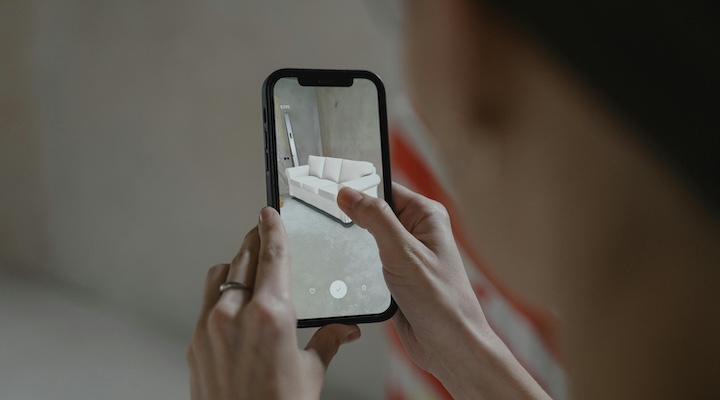
Advancements in AR technologies are helping retailers bridge the gap between digital and physical environments and make shopping more engaging and convenient for customers. AR solutions can be used to enhance real-world experiences by adding new digital content to physical objects, enabling retailers to turn traditional shopping into an interactive activity.
By simply pointing a standard smartphone camera at an AR-enabled object, customers can view a digital scene overlaid into the real world. This technology can allow users to virtually test products, try-on clothes and use images of their homes to see if items match their style.
In physical retail environments, AR technologies can also be used to create innovative, 3D displays and adverts, as well as gamified experiences throughout the store. AR campaigns can be easily adjusted in line with new promotions and seasonal events, with little need for expensive physical infrastructure that can often be time-consuming and challenging to install.
AR experiences also translate into digital shopping experiences, enabling online shoppers to see if clothing items suit their style or how homeware items might look in their homes. Data reveals that this style of AR-enhanced shopping can improve order conversion rates by 40 per cent.
Final word
As the retail industry continues to bounce back and more shoppers return to New Zealand’s plentiful brick-and-mortar stores, retailers are preparing to provide increasingly innovative, engaging and convenient shopping experiences inside safe and secure retail environments.
Guided by intuitive apps, intelligent security systems and interactive AR technologies, retail spaces are becoming more sophisticated and experience-driven. As these innovations help businesses to drive necessary growth, operations will continue to adapt to meet new needs.