
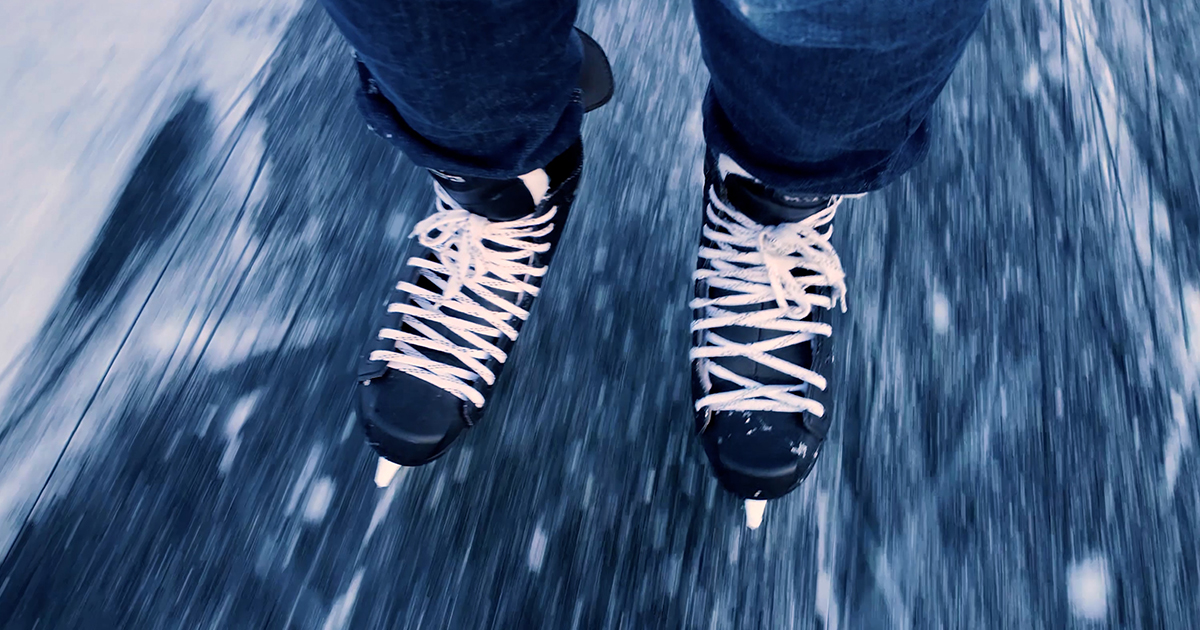
The reason we can gracefully glide on an ice-skating rink or clumsily slip on an icy sidewalk is that the surface of ice is coated by a thin watery layer. Scientists generally agree that this lubricating, liquidlike layer is what makes ice slippery. They disagree, though, about why the layer forms.
Three main theories about the phenomenon have been debated over the past two centuries. Earlier this year, researchers in Germany put forward a fourth hypothesis that they say solves the puzzle.
But does it? A consensus feels nearer but has yet to be reached. For now, the slippery problem remains open.
Hypothesis 1: Pressure
In the mid-1800s, an English engineer named James Thomson suggested that when we step on ice, the pressure we exert melts its surface, making it slippery. Under normal conditions, ice melts when the temperature rises to zero degrees Celsius (32 degrees Fahrenheit). But pressure lowers its melting point, so that even at lower temperatures, a layer of water might form on the surface. This theoretical relationship between melting point and pressure was experimentally confirmed by Thomson’s younger brother William, better known as Lord Kelvin.
In the 1930s, though, Frank P. Bowden and T.P. Hughes of the Laboratory of Physical Chemistry at the University of Cambridge cast doubt on the pressure melting theory. They calculated that an average skier exerts way too little pressure to significantly alter ice’s melting point. To do so, the skier would have to weigh thousands of kilograms.
Hypothesis 2: Friction
Bowden and Hughes suggested an alternative explanation for the formation of the water layer: that it melts because of heat generated by friction caused by whatever is sliding against it.
They tested their theory in an artificial ice cave in the Swiss Alps, using a complex contraption to measure the friction between ice and other materials. They found that the friction was higher with materials that are good at conducting heat, such as brass, than with poor conductors like ebonite. From this, they concluded that when ice is rubbed by a material that easily absorbs heat, less heat is available to melt the ice, making it less slippery. This supported their theory that frictional melting is responsible for ice’s slipperiness.
Although this explanation still appears in textbooks, many scientists disagree with it. “The problem with that is you only melt the ice behind you, not the ice you are actually skating on,” said Daniel Bonn, a physicist at the University of Amsterdam. Ice can be slippery the moment we step on it, before any motion has occurred that could cause frictional heating.