
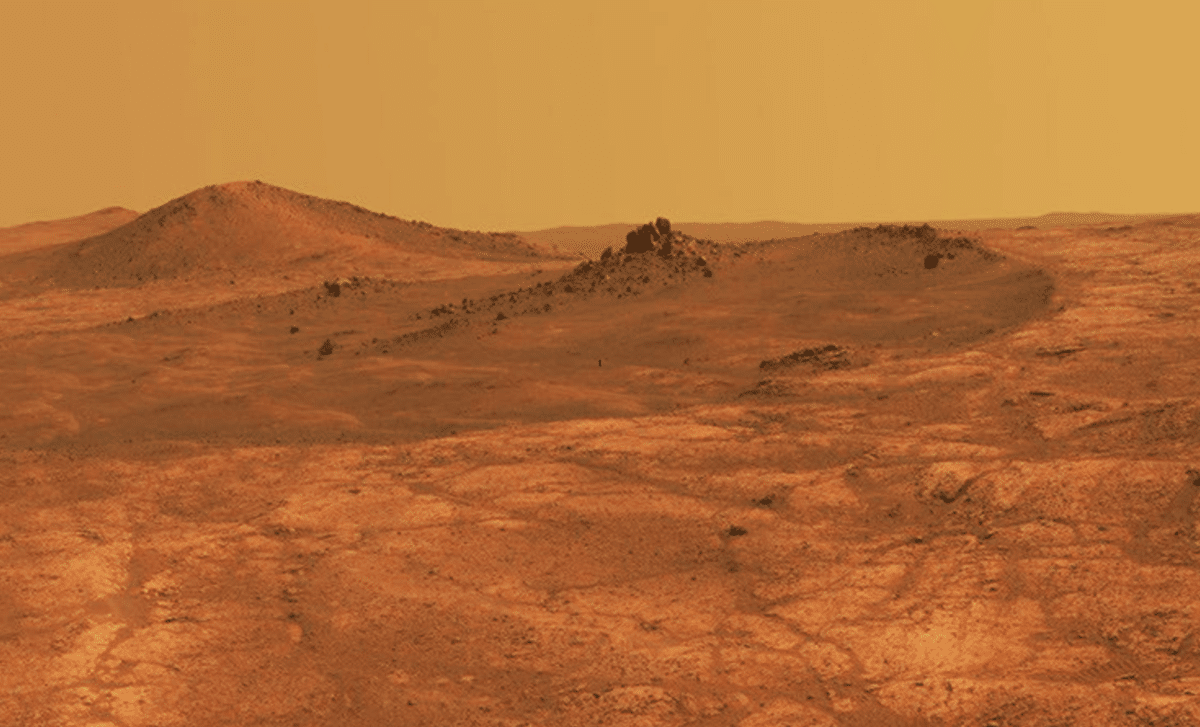
NASA’s new ESCAPADE mission is set to uncover the mysteries of Mars’ atmospheric loss, offering crucial insights into how the planet evolved from a potentially habitable world to the dry, barren landscape we see today. Launched in November 2025, the mission will study the effects of solar wind on Mars’ thin atmosphere and how these interactions may have played a key role in the planet’s transformation.
The Science Behind Mars’ Transformation
Mars once had the potential for liquid water on its surface, and scientists believe it may have even harbored a thicker atmosphere in the past. But over billions of years, this atmosphere gradually thinned, leaving Mars a dry and cold wasteland. The ESCAPADE mission, part of NASA’s planetary exploration strategy, aims to examine the underlying causes of this atmospheric loss. Scientists will focus on how solar winds, which are streams of charged particles emitted by the Sun, stripped away the Martian atmosphere. Without a strong magnetic field to protect it, Mars’ upper atmosphere remains vulnerable to these solar winds, which could explain why the planet lost much of its gaseous envelope.
The ESCAPADE spacecraft will use a suite of instruments to track the flow of charged particles and measure magnetic fields above Mars. These readings will allow researchers to study how the solar wind interacts with the planet’s atmosphere and magnetosphere at various altitudes, providing new insights into the delicate balance between a planet’s atmosphere and its environment.
Key Objectives of the ESCAPADE Mission
One of the primary objectives of the ESCAPADE mission is to map the Martian magnetosphere in three dimensions. This will be achieved by observing how the solar wind impacts the Martian atmosphere from different heights and at varying solar activity levels. By gathering data from both calm and stormy solar conditions, scientists can determine the most destructive factors that have led to atmospheric loss. The mission will also study the behavior of charged particles in Mars’ upper atmosphere, which will help scientists understand how and why these particles escape into space.
ESCAPADE’s measurements are expected to complement data from NASA’s MAVEN mission, which has already been studying Mars’ atmosphere since 2014. MAVEN, however, observes Mars from a single vantage point, while ESCAPADE’s two spacecraft will offer multiple perspectives, enhancing the accuracy and depth of the data collected. These combined insights will offer a more comprehensive understanding of how Mars transitioned into the planet we know today.
Understanding the Impact of Solar Wind on Mars
Solar wind, a continuous stream of charged particles emitted by the Sun, has a profound effect on planetary atmospheres. Without a magnetic field strong enough to shield it, Mars’ atmosphere is directly exposed to this cosmic barrage. The ESCAPADE mission will closely monitor how the solar wind interacts with Mars’ upper atmosphere, shedding light on how the planet lost its protective gas over time.
The ESCAPADE spacecraft will measure the movement of the gas in Mars’ upper atmosphere, track electric and magnetic fields, and analyze the density of charged particles. This real-time data will reveal the effects of solar wind during periods of low and high solar activity. By understanding how solar storms exacerbate the atmospheric escape process, ESCAPADE will help scientists predict how similar processes could affect other planets in our solar system, and even exoplanets in distant star systems.
The Crucial Role of Atmospheres for Planetary Life
A planet’s atmosphere plays a critical role in sustaining life. It helps maintain surface temperatures, prevents harmful radiation from reaching the surface, and allows for liquid water to exist. Mars, however, lost much of its atmosphere over time, leading to surface temperatures too cold for liquid water to remain. As a result, the planet is now a barren desert, unable to support life as we know it.
Understanding how Mars lost its atmosphere provides crucial insights into the fate of other planets, both within our solar system and beyond. The ESCAPADE mission aims to determine how much solar wind contributed to this atmospheric loss and why Mars was so vulnerable to these forces. The lessons learned could inform future space missions, including those aimed at exploring other planets, moons, and asteroids, where atmospheres might also be at risk.