
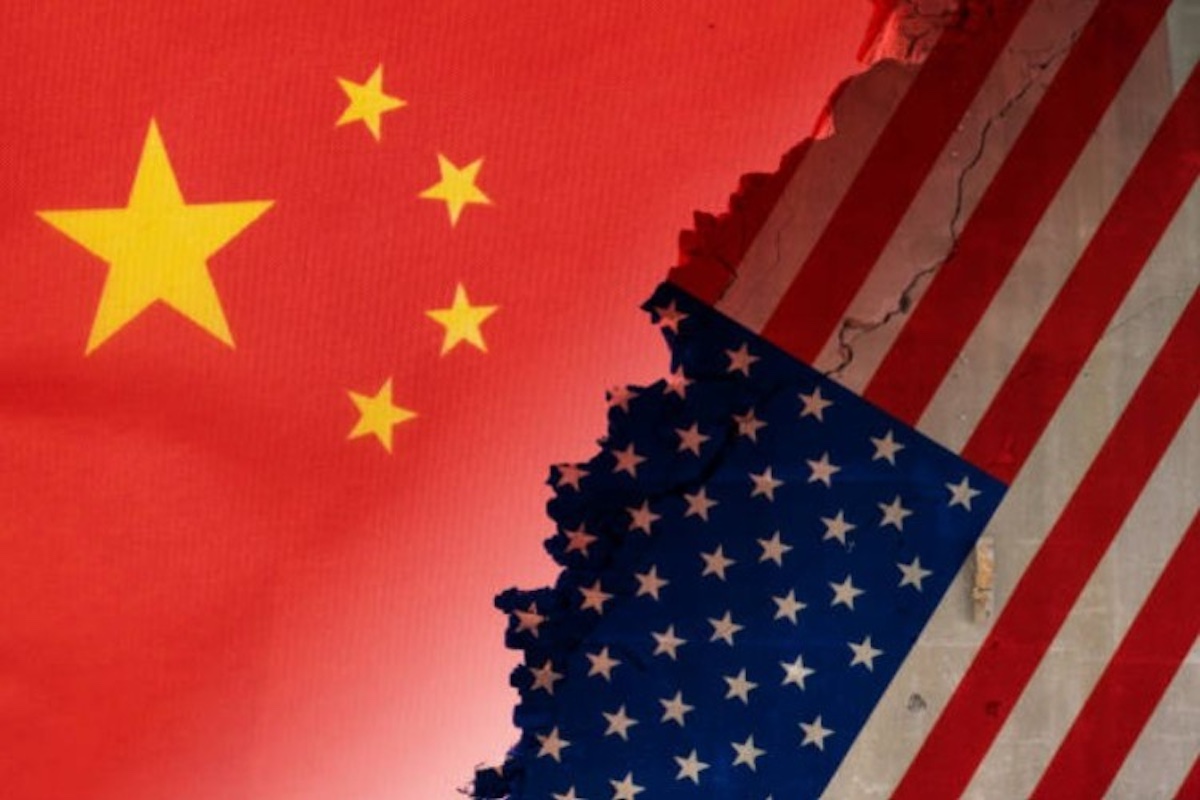
While the Trump administration’s recently published National Defense Strategy (NDS) represents a significant realignment of US foreign policy objectives, the NDS continues a longstanding bipartisan effort on at least one key front.
As a passage on page 20 of the document reads: “If America remains on a growth path—and can sustain that while maintaining a genuinely mutually advantageous economic relationship with Beijing—we should be headed from our present $30 trillion economy in 2025 to $40 trillion in the 2030s, putting our country in an enviable position to maintain our status as the world’s leading economy.”
Pundits and analysts understandably focus on the differences between the foreign policies of Trump and his predecessors. Nevertheless, the language from the 2025 NDS mirrors key comments from the Biden administration.
During his first press conference in early 2021, former President Biden said, “China has an overall goal … to become the leading country in the world, the wealthiest country in the world… That’s not going to happen on my watch because the United States is going to continue to grow.”
When claiming credit for key foreign policy successes shortly before leaving office in 2025, Biden went on to say: “Many experts believed it was inevitable that China’s economy would surpass ours. According to the latest predictions on China’s current course, they will never surpass us.”
The US government, regardless of the party in power, openly states its intention to perpetually maintain America’s position as the world’s largest economy when measured in nominal terms. In practice, this means keeping China in second place indefinitely. This aim inevitably leads to high-stakes contention with both Beijing and other powers.
National governments seek to maximize their domestic and global power. And since nominal GDP is a key measure of economic influence, Washington’s goal of maintaining primacy in this area is logical. The US has held its position as the world’s largest economy since around 1880 (when measured against the United Kingdom alone) or 1910 (when compared to the entire British Empire).
This longstanding dominance has massively benefited the US in terms of industrial capacity, scientific output and global financial sway. No presidential administration wants to be blamed for “losing” US economic dominance to a rival power.
The fundamental problem arises from exactly how the US government intends to maintain its position. While Biden’s 2021 statements argued the US would maintain a leading position specifically because the US “would continue to grow”, that prediction is unlikely. The only realistic path for the US to maintain a perpetual nominal GDP lead over China is by hobbling China’s growth potential.
China currently has around four times the US population and around 62% of US nominal GDP. While China faces significant structural economic issues, there is no fundamental reason why its economy should not eventually overtake the US in nominal terms. China’s nominal per capita GDP is roughly the same as South Korea’s was in 2001.
Jiangsu, China’s richest province, currently has a per capita nominal GDP of about $22,560. If everywhere in China were as rich as Jiangsu (and two provincial-level cities already exceed it), then China would surpass the US in nominal GDP.
Unless the US develops and subsequently monopolizes a massively GDP-boosting technological advance, or China faces a prolonged and severe economic crash, the only way the US can maintain a perpetually larger nominal GDP than China is to purposefully restrict China’s economic potential. The Chinese government complains that this is exactly what the US has tried to do in recent years.
Washington’s bipartisan policy record of extensive tech controls on China, along with a sustained pressure campaign on third countries to limit their economic cooperation with Beijing, supports this view.
Often the messaging discipline is lost and top US officials overtly state their aim to thwart China’s potential. As the Biden administration’s commerce secretary directly stated: “If we really want to slow down China’s rate of innovation, we need to work with Europe.”
Washington’s attempts to maintain its edge in nominal GDP by limiting China’s potential are misguided for several reasons. First, nominal GDP is not an ideal proxy for overall economic power. China overtook the US in terms of purchasing power parity (PPP) GDP–which accounts for the practical differences in costs between different countries–in 2014.
China generates more than twice as much electricity and produces over 12 times the volume of steel as the US. In the raw productive capacity needed to build physical infrastructure, robots, vehicles and weapons, China already surpasses the US handily.
Second, Washington’s attempts to maintain perpetual nominal GDP dominance invariably cause problems for third countries – the very nations the US must keep within its orbit to successfully compete with China for global dominance.
China has been the world’s largest trading nation for over a decade and is the biggest trading partner of many key regional powers and US allies. Efforts to limit China’s economic potential directly hurts these countries.
Moreover, no other country shares the US imperative to forcefully maintain American economic dominance. Many actually prefer the emergence of an alternative economic pole, if for no other reason than to increase their options and bargaining power.
India – a key emerging power and potential counterweight to China’s influence – is closely watching US efforts to contain China’s potential and fears similar treatment if (or more likely, when) it emerges as a significant global economic competitor.
Finally, US attempts to maintain nominal GDP dominance by limiting China’s potential have likely come too late. The Chinese government has developed sufficient capabilities to ensure that any US efforts to impose economic pain will be met with proportional countermeasures.
That was evident when China used its rare earths leverage to strengthen its negotiating position in trade talks with the US. So far, China’s rare earths export controls have been narrowly targeted and fairly marginal. If they are expanded, they could cripple key US industries. Washington’s efforts at creating alternative supply lines, meanwhile will take sustained, long-term efforts.
Washington would be wise to let the Chinese economy succeed or fail on its own accord. Investing in US innovation growth is a better use of limited American resources than trying to constrain an emerging power.
There remains a possibility, however remote, that a US lead in key technologies could sustain nominal GDP dominance. China’s eventual overtaking the US in terms of nominal GDP is not the end of the world – or even the end of the US as an immensely prosperous and globally influential power.
A China with a larger nominal GDP than the US is unlikely to be more vindictive than the US itself was toward Britain after overtaking London as the world’s dominant economic power. But as China’s influence continues to grow, US efforts to limit its potential increasingly put the US itself at risk of painful and costly countermeasures.
Brendan P O’Reilly is a US-based geopolitical analyst and author of “Everyone is Wrong About China – The Myths and Realities of Sino-US Competition.” Follow him on X @oreillyasia