
At The General Intelligence Company, an agent monitors the support inbox. When a customer requests a feature, the agent writes the code, submits it for review, and pushes it toward production. No human touches it until the final approval. This isn’t a demo. It’s how the company actually operates.
“Over 95% of our code is written by AI,” says Andrew Pignanelli, the company’s co-founder and CEO. “Ideally we get that to 100%.” Andrew is on a mission to build the operating system for one-person, billion-dollar companies.
Today, the New York-based startup got some help to further his mission, announcing $8.7 million in seed funding led by Union Square Ventures, with participation from Acrew Capital, Compound, Untapped VC, Agent Fund, and The House Fund. The round brings total funding to more than $10 million – raised in less than 12 months since founding. But the funding isn’t the real story. What Pignanelli and co-founder Abhishyant Khare are building – and already running internally – is.
The General Intelligence Co. is on a mission to build the operating system for a one-person, billion-dollar companies.
Alpha
The Future Arrived. Most People Missed It.
General Intelligence’s founding premise sounds like science fiction until you look at what’s already working. The company is building highly-capable AI agents to run entire businesses autonomously. They’ve deployed “superoptimizers” – orchestration systems that coordinate AI agents across product development, code review, customer communications, and other business functions. Their first product, called “Cofounder”, launched in September and gained thousands of users in its first week. It functions as an AI chief-of-staff with a three-tier memory system the company claims outperforms existing approaches on standard benchmarks.
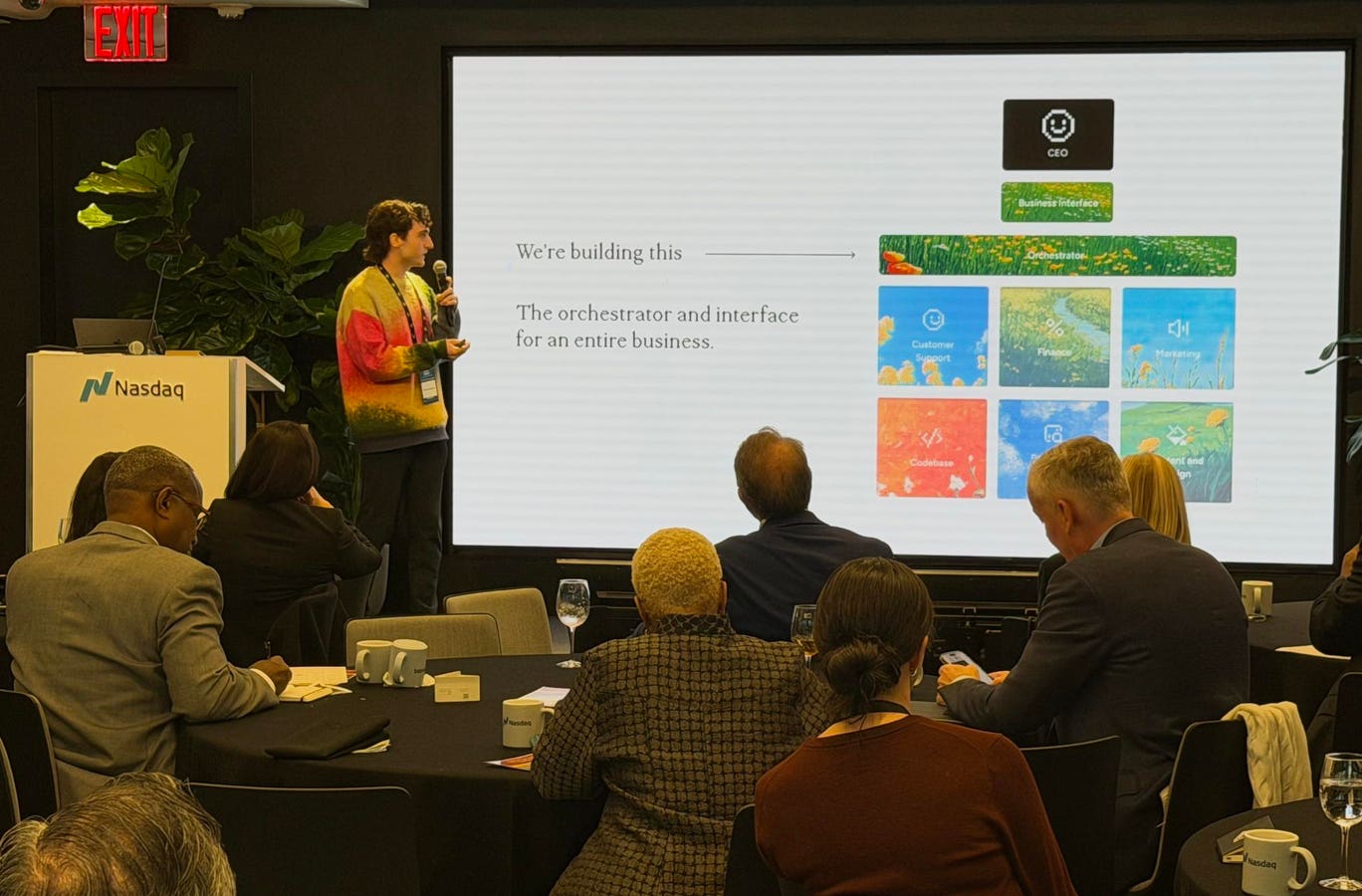
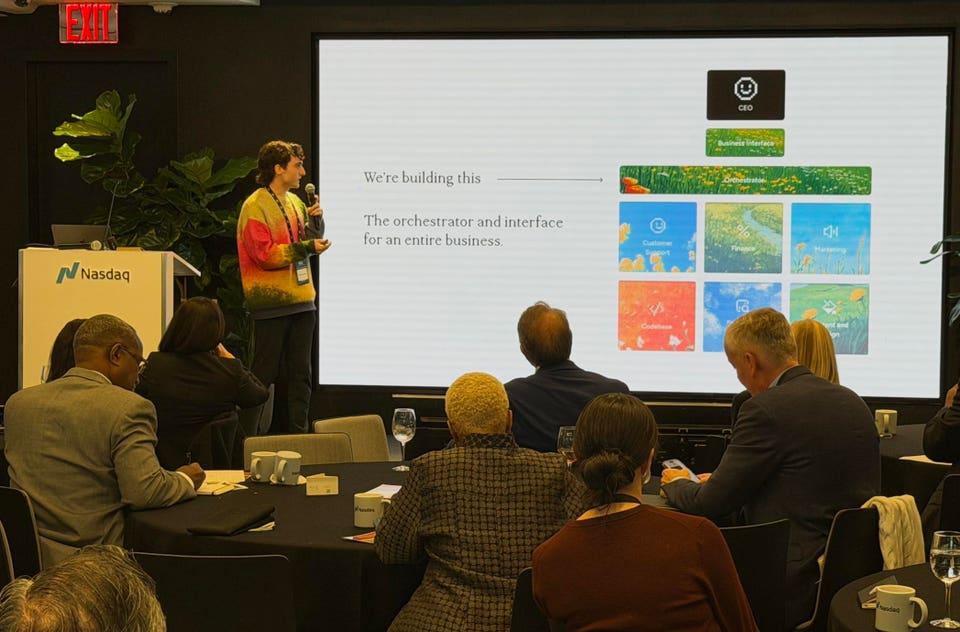
But Cofounder is just proof of concept. “We’re going to be the first ones to run a company entirely staffed by agents,” Pignanelli told me. “The infrastructure should be so good that one person with an idea and unique insight can build and run a billion-dollar business. Not alone – just surrounded by agents handling operations, product, support, sales, and everything else the company needs.”
The company is building Cofounder from an assistant into the first full-stack agent company platform. Teams will be able to run departments – product/engineering, sales/GTM, customer support, and ops – entirely with agents.
The General Intelligence Co.
This is the “one-person billion-dollar company” that Sam Altman described back in January 2024 – a concept he said his “little group chat with tech CEO friends” was betting on. Anthropic CEO Dario Amodei followed at his company’s May 2025 developer conference, predicting such a company would emerge by 2026 with “70-80% certainty.” Mike Krieger, Instagram co-founder and now Chief Product Officer at Anthropic, added context that makes it feel less theoretical: “It’s not completely crazy. I built a billion-dollar company with 13 people.”
The Entrepreneur Who’s Already Living In The Future
Pignanelli’s biography reads like a case study in what happens when someone grows up native to AI capabilities. He dropped out of college to build AI tools for venture capital. His first company, Velvet, created what he called the “first AI operating system for venture capital funds” in 2023, working with over 200 VC funds globally.
More remarkably, Pignanelli became the youngest person ever to own a broker-dealer company in 2021, working on transactions with companies like Anthropic, and CoreWeave. By his early 20s, he’d done what most people spend decades working toward. Now, he’s decided that wasn’t ambitious enough.
His co-founder and CTO Abhishyant Khare has been working on machine learning systems for years, previously leading engineering at Gantry who made waves in the early AI/ML observability market. The two met at South Park Commons, the San Francisco founder community that has incubated numerous AI startups like Cognition AI, Replit, and Profound. “We started working on a demo together and pretty quickly realized we would be the team to do this.”
The General Intelligence Co. Co-founders Andrew Pignanelli (CEO) and Abhishyant Khare (CTO)
The General Intelligence Co.
Union Square Ventures doesn’t make small bets. The firm backed Twitter, Tumblr, Etsy, Kickstarter, and Coinbase in their earliest days – companies that redefined how people communicate, create, transact, and coordinate. Their decision to lead General Intelligence’s seed round signals conviction that agent infrastructure represents a similar inflection point.
The other investors are equally forward-thinking. Agent Fund, run by Yohei Nakajima – creator of BabyAGI and credited with kicking off the autonomous agent movement in 2022 – operates semi-autonomously, using AI across its own deal sourcing. Acrew Capital manages over $700 million with Asad Khaliq on the deal and partners Lauren Kolodny and Theresia Gouw, both Forbes Midas List members. The House Fund brings Berkeley’s AI brain trust, with faculty partners including Databricks co-founder Ion Stoica and AI pioneers Michael I. Jordan and Pieter Abbeel.
The Race To Build The Agent Operating System
General Intelligence enters a market where $3.8 billion flowed to AI agent startups in 2024 alone – nearly tripling the prior year. Cognition’s Devin, the AI software engineer, rocketed to a $10.2 billion valuation by September 2025, growing from $1 million to $73 million ARR in nine months. Sierra AI, founded by former Salesforce Co-CEO Bret Taylor, recently raised $350 million at $10 billion for customer service agents. The market is validating the thesis in real-time.
How quickly can a company scale when AI agents are managing AI agents?
The General Intelligence Co.
But most agent startups are building point solutions – coding assistants, customer service bots, sales automation. General Intelligence is building orchestration infrastructure: the layer that coordinates agents across an entire business. That’s a different and potentially larger opportunity. Whoever builds the operating system for agent-run companies captures a platform position comparable to what AWS became for cloud computing.
“We know that a platform that totally transforms how businesses are built through leveraging agents is on the horizon” says Rebecca Kaden, Managing Partner at Union Square Ventures who led the funding round. “This is the most advantaged team to build it combining ambition, technical excellence, and a real sense of product touch and design.”
The company believes there’s less than two years until artificial general intelligence – their namesake – is equipped to run any company. That timeline puts them ahead of most expert forecasts but aligns with what AI lab leaders are saying privately. Metaculus forecasters now give 25% probability of AGI by 2027, estimates that plummeted from 50 years to 5 years over just four years.
The Real Test: Using What They’re Building
The most compelling evidence for General Intelligence’s thesis is General Intelligence itself. The company is running on its own infrastructure. Engineers average roughly 50 commits per day using AI assistance. Customer requests become shipped features without human intervention until final review. The support inbox feeds directly into product development.
This is the difference between pitching a vision and living in it. Most AI companies talk about autonomous operations. General Intelligence is showing what it looks like when a team actually trusts agents to run critical business functions. The results – thousands of users in week one, $10 million raised in under a year, USV leading – suggest the approach is working.
“We’re not just building tools,” Pignanelli said. “We’re building the operating system for the next generation of companies. The ones where the founder is the only human required.”
What This Means For Everyone Else
The AI agent market stands at approximately $7.6 billion in 2025 and is projected to reach $47-52 billion by 2030. Gartner forecasts 40% of enterprise applications will include task-specific AI agents by the end of 2026, up from less than 5% in 2025. By 2029, AI agents will resolve 80% of common customer service issues without human intervention.
For executives watching from the sidelines, the message is uncomfortable: the companies that figure out agent orchestration first will operate at fundamentally different economics than those that don’t. A startup with 3 people and sophisticated agent infrastructure could outexecute a company with 3,000 people and legacy processes. That’s not a future scenario. Based on what General Intelligence is demonstrating, it’s the present.
The question isn’t whether the one-person billion-dollar company will happen. It’s whether it will happen in 18 months or 36 – and whether you’ll be building it, competing with it, or working for it.
General Intelligence is betting this will happen sooner versus later. Given what they’ve already built, that bet is looking better every day.