
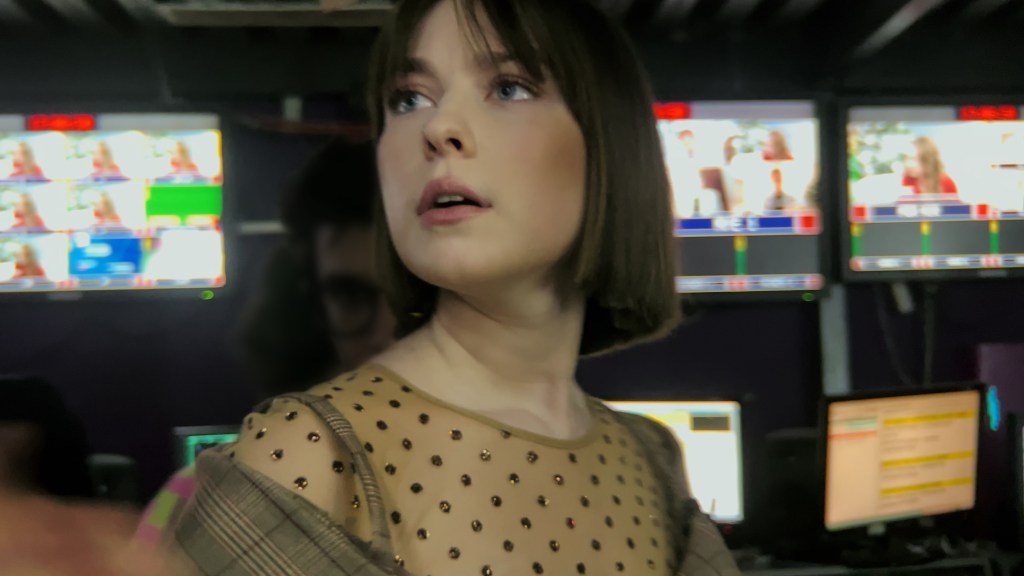
Julia Loktev’s documentary My Undesirable Friends: Part I – Last Air in Moscow enters Oscar shortlist voting with incredible momentum. On Sunday, the film was named Best Documentary/Nonfiction film by the Los Angeles Film Critics Association, just days after it won Best Documentary Film at the Gotham Awards and Best Non-Fiction Film at the New York Film Critics Circle Awards, and earned a nomination for the Film Independent Spirit Awards.
Loktev, who was born in the then-Soviet Union and immigrated to the U.S. at age 9, returned to Moscow in 2021 to make her film, which runs 5 hours and 24 minutes and is told in chapters. It was a fateful time to embark on a documentary about journalists dedicated to independent reporting in Putin’s Russia; within a few months of Loktev’s arrival, Putin launched his full-scale invasion of Ukraine and anyone who failed to toe the Kremlin line would soon find themselves a target of repression.
In fact, those who deviated from parroting Russian propaganda were branded “undesirable” (hence the film’s title).
“’Undesirable organization’ is actually a legal classification in Russia,” Loktev tells Deadline. “Russia has now deemed almost all independent media as undesirable organizations along with many, many civil rights organizations, NGOs, educational institutions; things like Greenpeace have been declared undesirable organizations, a few universities like Bard College, Yale… The list of undesirable organizations grows every day, as does the list of extremists and terrorists. Russia has basically declared independent media to be undesirable, journalism to be undesirable.”

‘My Undesirable Friends: Part I – Last Air in Moscow’
Argot Pictures/Marminchilla
The filmmaker’s “undesirable friends” include Anna Nemzer, talk show host at Russia’s last independent news channel, TV Rain; Ksenia Mironova, a reporter at TV Rain, and Elena Kostyuchenko, a journalist at Novaya Gazeta who has been compared to Joan Didion.
“It’s all a group of quite young, mostly women journalists who were working as independent journalists in Russia, which was possible to do in Russia in the fall of 2021, which is impossible to imagine now,” Loktev notes. “The important thing for me about this film is it’s about people. I’ve made fiction and I’ve made documentaries and I actually just make films about people, where you get to go through something with people that you come to know. And in this case, I was incredibly lucky that I got to capture history unfolding live.”
It’s a pure vérité film, meaning it’s observational, following the characters as the noose of censorship tightens around their necks. Moments of levity early in the film, as when the protagonists engage in gallows humor, become increasingly rare as the Kremlin cracks down on independent news media and scattered anti-war demonstrations in the streets.
“Sometimes it feels like a workplace comedy and sometimes it feels like a thriller,” Loktev explains. “I edit it in the way that I would a fiction [project] — in scenes… Literally, the film is one scene followed by another scene, followed by another scene. It’s scenes with characters doing stuff which we’re used to in fiction but strangely has become fairly rare in documentary.”
Archive is used sparingly, to illustrate the work of the journalists.
Russian President Vladimir Putin
Contributor/Getty Images
“You see why perhaps Putin was not fond of them — you need to see that,” the director says. “The archival footage we use, it’s like if I was doing a film about a painter, you’d want to see their paintings or a basketball player, you’d want to see them playing basketball.”
Putin’s attempt to redraw the map of Europe recalls a previous leader of Soviet times – a man responsible for tens of millions of deaths of his own people, as well as the establishment of the Gulag to incarcerate perceived dissidents – the “undesirables” of an earlier era.
“Obviously there is again a glorification of Stalin, a glorification of the past that is happening… But it is also how authoritarians work. It’s how you tell your history, how you tell your present,” Loktev observes. “I think we see that now in the States too. One of the things that happens in the course of the film is that Russia shuts down the oldest human rights organization, which was dedicated to preserving the memory of victims of political repression and investigating this. And they shut this down saying, ‘Why should we have to be ashamed of our history? We won World War II. Can’t we talk about pleasant things instead of unpleasant things like this?’”
That attitude rhymes with Trump administration, which has intervened to dictate what the Smithsonian Institution, for instance, can and cannot say about uncomfortable realities of U.S. history. “’Why must we talk about unpleasant things like slavery?’” says Loktev says, paraphrasing Trump administration talking points. “’Can’t we just talk about the nice things in our history and tell it in a glorified way?’ [That’s] very much part of how these things work. It is part of how authoritarians work. You tell your past so that you can enact your present.”
Director Julia Loktev
Dia Dipasupil/Getty Images for FLC
As Loktev’s documentary unfolds, her protagonists become branded in effect as enemies of the state, with dramatic consequences.
“Some of them have been declared terrorists and extremists in Russia,” Loktev says. “Some have been convicted in absentia and none of them can work openly in Russia now because over the course of the film, Russia basically shut down all independent journalists and all my characters had to flee the country with a suitcase, like a carry-on suitcase, within a few hours.”
There is precedent for a lengthy documentary earning Oscar recognition. Ezra Edelman’s 2016 film O.J.: Made in America – run time 7 hours, 47 minutes – won the Oscar. But after that, the Academy changed its rules to eliminate from competition any documentary perceived as being more in the realm of episodic rather than a single, unified film.
“We had to get the executive committee of the doc branch to rule on it,” Loktev shares. “There’s a simple rule that says [to qualify] a film has to play in a theater for one week, three times a day. And you can’t show five-and-a-half-hour film three times a day in a normal movie theater unless you’re playing it at really weird times that nobody wants to go to the movie theater… They had to look at it and say, ‘Yes, we consider it [eligible].’”
Argot Pictures
Given that the film’s subtitle says it’s “Part I,” does that mean there will be a Part II of My Undesirable Friends? Absolutely. Loktev is currently work on it.
“There’s a Part 2 that follows all the characters in exile,” she tells Deadline. “Part 1 starts from when people had no idea that a full-scale war would start and we lived through these months with them and then through the first week as they flee the country. And then Part 2 begins a few days later when they’re just in the first stages of having left with a carry-on [suitcase], their media has been shut down, they have no idea where they’re going, and then they have to get back up on their feet as journalists. It takes place in some 13 countries because people keep moving. We get to follow this process of exile… as it happens through these young journalists.”
Loktev adds, “I’m endlessly surprised by how people keep working, how people even now in exile, all of them work as independent journalists. How they find the strength to keep going, how you keep fighting when the fight seems lost.”