
Back to Article List
Here’s what’s launching Dec. 8–14: SpaceX flies for the NRO, Rocket Lab launches for JAXA, and China continues its space surge with multiple flights.
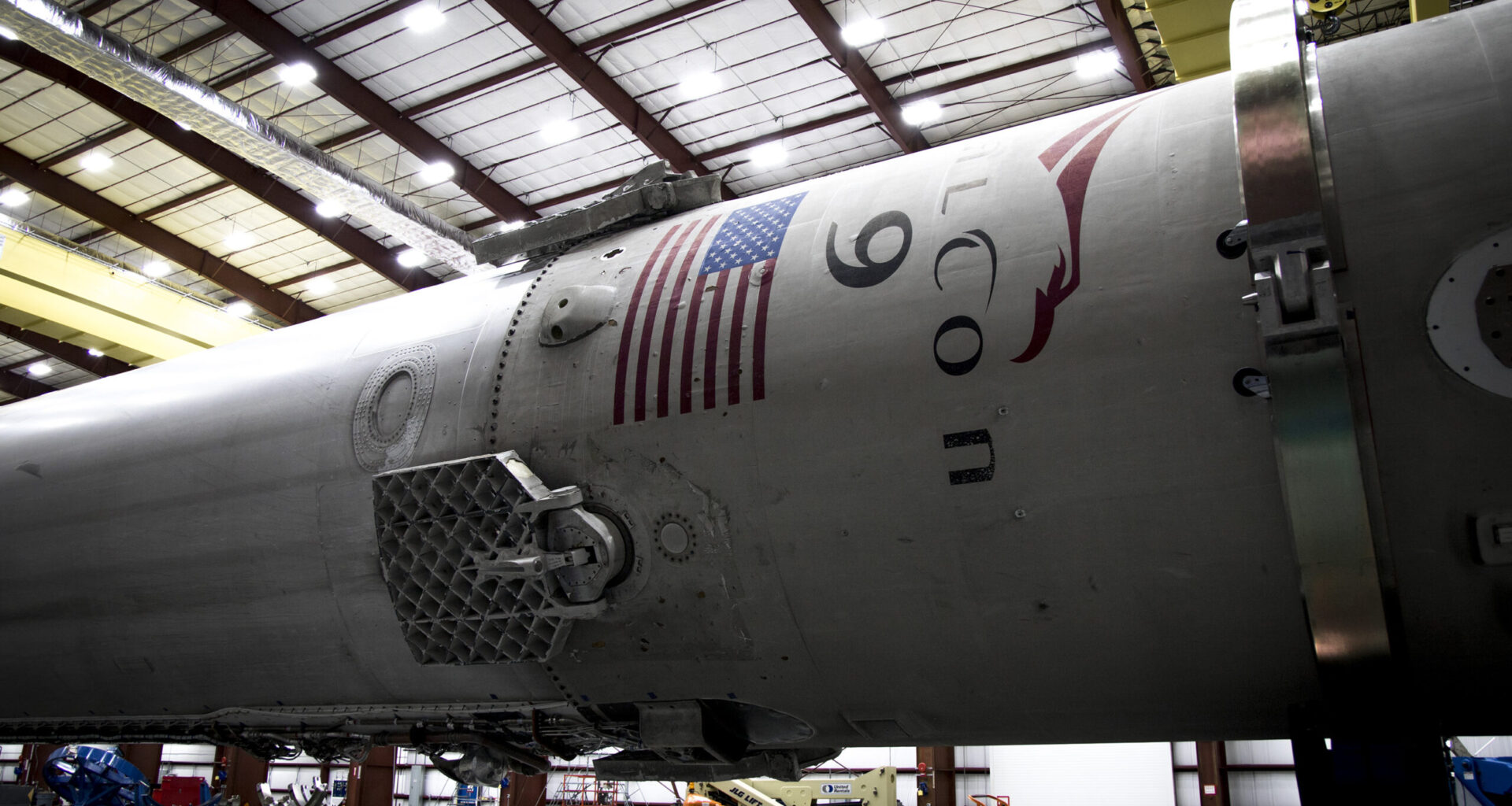
A SpaceX Falcon 9 first-stage booster sits inside a hangar in this 2016 photo. A rocket like this one is currently being prepared for the classified NROL-77 mission for the National Reconnaissance Office, scheduled to lift off from Space Launch Complex 40 on Tuesday, Dec. 9, 2025. Credit: SpaceX
SpaceX is scheduled to launch the classified NROL-77 payload for the National Reconnaissance Office (NRO) on December 9th, completing the NRO’s 2025 launch schedule and marking its second mission under the Phase 2 National Security Space Launch (NSSL) agreement.
The Chinese space sector is poised for a busy week with six launches planned from December 8th to 14th, encompassing missions from various Long March rocket variants and private firms, alongside developments in reusable rocket technology.
Eight additional international missions are slated for the week from the U.S., Russia, and New Zealand, including multiple SpaceX Starlink deployments, a Roscosmos radar satellite, and Rocket Lab’s “RAISE And Shine” mission for JAXA, featuring a technology demonstration satellite.
The previous week, December 1st-7th, saw a high volume of launches from China and SpaceX, as well as a successful Arianespace Vega C flight, while mid-December is set to feature significant launches from ULA, Arianespace, Blue Origin, and ISRO.
Mission Highlight: SpaceX launches NROL-77
The mission highlight this week is the launch of the classified NROL-77 payload for the National Reconnaissance Office (NRO). The mission is scheduled to lift off on Tuesday, Dec. 9, at 2:16 p.m. EST from Space Launch Complex 40 (SLC-40) at Cape Canaveral Space Force Station, Florida.
Founded in 1961, the NRO builds and operates the United States’ fleet of intelligence satellites. The agency provides surveillance data to the Department of Defense and the Intelligence Community, supporting missions ranging from global security to disaster response.
Tuesday’s flight wraps up the agency’s 2025 launch schedule, serving as its tenth and final launch for the year. It also marks the second time SpaceX has flown a payload for the NRO under the Phase 2 National Security Space Launch (NSSL) procurement agreement. Managed by the Space Systems Command (SSC) at Los Angeles Air Force Base in partnership with the NRO, the NSSL program utilizes commercial-style contracting to secure launch services for NRO payloads. The NROL-77 mission emblem depicts a flying squirrel, chosen to symbolize “hard work and endurance”, and is accompanied by the slogan “Another One Gone — Today, Tomorrow, and Beyond.”
The mission will launch aboard a Falcon 9 rocket. Watch the livestream here.
A busy week in China
With six launches scheduled, it’s shaping up to be a busy week for the Chinese space sector. The activity begins Monday, Dec. 8, with a Long March 6A launching from Taiyuan Satellite Launch Center at 5:10 p.m. EST, followed by a Long March 2D from Jiuquan Satellite Launch Center at 10:40 p.m. EST.
On Tuesday, Dec. 9, a Long March 3B/E lifts off from Xichang Satellite Launch Center at 10:10 a.m. EST, with CAS Space’s Kinetica 1 scheduled for 11:00 p.m. EST from Jiuquan.
Thursday, Dec. 11, a Long March 12 is launching from the Wenchang Space Launch Site at 6:00 p.m. EST, while Sunday, Dec. 14, sees private Chinese firm iSpace launching a Hyperbola 1 rocket from Jiuquan at 11:00 p.m. EST.
Adding to the excitement, the Long March 12A, a reusable variant of the CASC Long March 12, is expected to launch soon. This vehicle is critical to China’s reusable rocket ambitions — a capability also being chased by the private sector, as seen in last week’s crash landing of the first orbital launch of a reusable rocket by a Chinese firm: Landspace’s Zhuque-3.
There’s a barrage of Chinese launches in the coming days.
Dec. 8: Long March 6A at Taiyuan
Dec. 9: Long March 2D at Jiuquan
Dec. 9: Long March 3B at Xichang
Dec. 10: Kinetica-1 at Jiuquan
Dec. 11: Long March 12 at Wenchang
(Dec. ??: Long March 12A (Jiuquan))
& more to follow https://t.co/SUIQDZgZZi
— Andrew Jones (@AJ_FI) December 6, 2025
Other missions this week
The skies are just as busy elsewhere with eight missions from the U.S., Russia, and New Zealand.
Monday, Dec. 8: SpaceX kicks off the week with the Starlink Group 6-92 mission from Kennedy Space Center at 4:14 p.m. EST.
Wednesday, Dec. 10: SpaceX is set to launch the Starlink Group 15-11 mission on a Falcon 9 from Vandenberg Space Force Base, California, at 3:54 a.m. EST.
Thursday, Dec. 11: A busy day begins with Roscosmos launching the Obzor-R n°1 radar satellite on a Soyuz 2.1a from Plesetsk at 9:00 a.m. EST. SpaceX follows with the Starlink Group 6-90 mission from Cape Canaveral at 1:59 p.m. EST. Finally, Rocket Lab launches the “RAISE And Shine” mission for the Japanese Aerospace Exploration Agency (JAXA) from New Zealand at 10:00 p.m. EST. JAXA’s RApid Innovative payload demonstration SatellitE-4 (RAISE-4) serves as a testbed for eight technologies developed by universities and private companies in Japan, including a new deployable sail developed by Axelspace Corporation, designed to help de-orbit satellites more quickly.
Saturday, Dec. 13: SpaceX launches the Starlink Group 15-12 mission on a Falcon 9 from Vandenberg Space Force Base, California, at 12:34 a.m. EST.
Sunday, Dec. 14: The week concludes with two SpaceX flights: the Starlink Group 6-99 mission from Kennedy Space Center at 8:37 a.m. EST, followed by the Starlink Group 6-82 mission from Cape Canaveral at 9:43 p.m. EST.
Last week’s recap
The week of Dec. 1–7 was dominated by a high volume of launches from China and SpaceX, alongside a successful flight for Arianespace’s Vega C. Arianespace launched the KOMPSAT-7 Earth observation satellite for South Korea on Dec. 1, while SpaceX launched four Starlink batches and one mission from Vandenberg. Landspace conducted a test flight of its ZhuQue-3 reusable rocket from Jiuquan on Dec. 2. China ramped up activity with launches of the Kuaizhou 1A on Dec. 5 and the Long March 8A on Dec. 6. The Long March 8A flight was particularly significant, marking the first time the vehicle used coal-based rocket kerosene, which is more cost-effective than conventional rocket fuels.
Looking ahead
Mid-December brings heavy hitters to the pad. ULA is targeting Dec. 15 for an Atlas V launch carrying Amazon’s Project Kuiper satellites (Amazon Leo). Arianespace is preparing to launch two Galileo navigation satellites on an Ariane 62 on Dec. 17. Blue Origin targets Dec. 18 for its next crewed New Shepard flight (NS-37). Finally, ISRO is scheduled to launch the BlueBird Block 2 FM1 satellite on an LVM-3 on Dec. 19.