
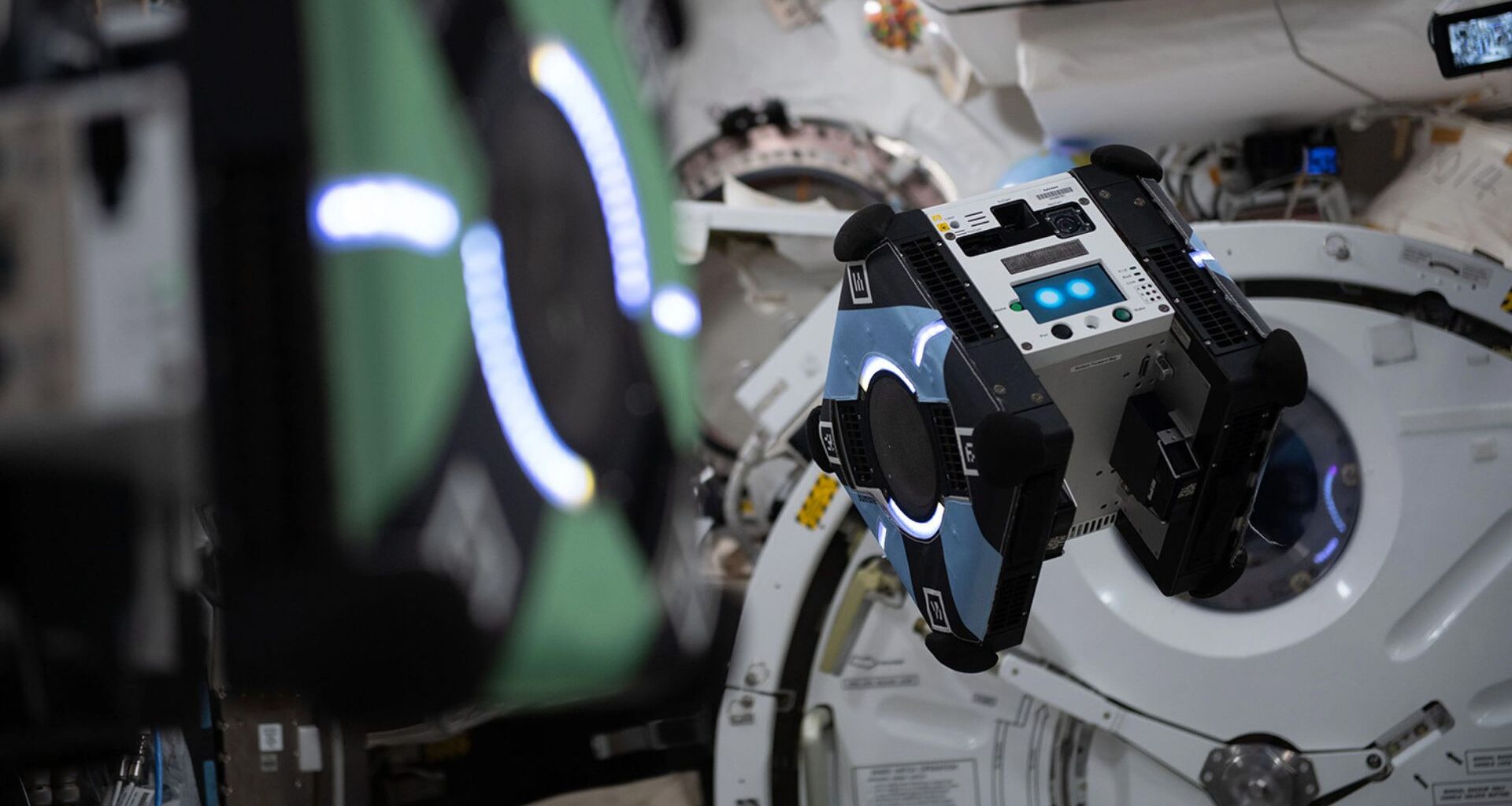
A toaster-sized robot just took a major step toward autonomous space navigation.
Stanford researchers have successfully demonstrated a machine-learning-based control system aboard the International Space Station (ISS) for the first time.
The achievement marks a turning point for robotics in orbit and opens the door to missions where robots operate with minimal human oversight.
Astrobee, a cube-shaped free-flying robot already aboard the ISS, served as the test platform.
The new system helps it safely navigate the station’s narrow corridors and cluttered interiors without direct astronaut control.
The research was published and presented at the 2025 International Conference on Space Robotics (iSpaRo).
Smarter motion planning
The ISS environment is dense, interconnected, and filled with storage racks, computers, wires, and experimental hardware.
That complexity makes motion planning difficult, said lead researcher Somrita Banerjee, who completed the work as part of her Stanford PhD.
Traditional planning approaches used on Earth don’t translate well to space hardware.
“The flight computers to run these algorithms are often more resource-constrained than ones on terrestrial robots,” said senior author Marco Pavone.
He added that space introduces more uncertainty and stricter safety demands than ground robotics.
To address that challenge, the team built an optimization system that plans safe, feasible routes using sequential convex programming. But solving each step from scratch required significant computational time, slowing the process.
So the team trained a machine-learning model on thousands of previous solutions.
The model acts as a “warm start,” offering an informed first guess before the optimization refines the path.
The safety constraints remain intact, but the AI accelerates the process dramatically.
Banerjee compared it to choosing a route based on common travel paths rather than drawing a theoretical straight line between two cities.
“You start with something informed by experience and then optimize from there,” she said.
Before reaching the ISS, the system was tested at NASA Ames Research Center on a floating robot platform that mimics microgravity.
When testing began on the ISS, astronauts handled only setup and cleanup before stepping aside.
The ground team then issued commands through NASA’s Johnson Space Center.
The team tested 18 trajectories, running each twice — once with a standard cold start and once using the AI-powered warm start. The results were decisive.
“We showed that it’s 50 to 60% faster, especially in more challenging situations,” Banerjee said.
Those included tight spaces and complicated maneuvers requiring rotation.
Preparing for future missions
NASA has now designated the system at Technology Readiness Level 5, showing it works in a real operational setting. That lowers the risk for future proposals and experiments.
Looking ahead, Banerjee said autonomy will be essential as space missions expand.
“As robots travel farther from Earth and as missions become more frequent and lower cost, we won’t always be able to teleoperate them from the ground,” she said.
Pavone’s team plans to push the technology further using stronger AI models similar to those behind modern language tools and self-driving systems.