
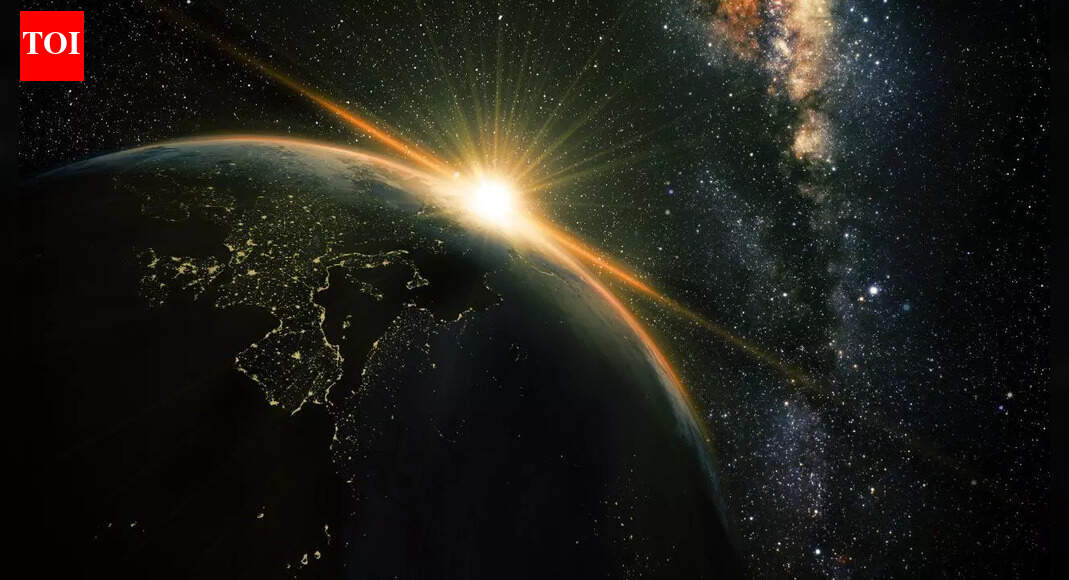
 Black holes capture the imagination of scientists and space enthusiasts because they represent the most extreme gravitational forces in the universe. NASA explains that anything approaching a black hole encounters enormous tidal forces that stretch and distort matter, and that time itself slows dramatically due to gravitational time dilation. According to NASA, if an object such as Earth moved too close, the intense gravity would tear apart the planet’s structure long before reaching the event horizon. These concepts are not science fiction but the real consequences predicted by Einstein’s theory of general relativity. A peer-reviewed scientific review on tidal disruption events in PubMed describes how matter approaching a massive black hole experiences extreme gravitational stretching that can rip stars or planets apart. The study documents how tidal forces shred objects into streams of debris, supporting NASA’s explanation of spaghettification.
Why black hole gravity becomes catastrophic
Black holes compress an enormous amount of mass into a tiny space, creating gravitational fields powerful enough to warp spacetime. As an object approaches, the difference in gravitational pull between its nearer and farther sides becomes immense. For Earth, the result would be violent stretching that destroys the crust, oceans and atmosphere. NASA explains that this process is so intense that matter can be pulled into thin strands, known as spaghettification.
What could happen if Earth moved too close
As Earth approached a black hole, gravitational disruption would first destabilise orbit. Increasing tidal forces could trigger massive earthquakes, volcanic activity and extreme ocean bulging. The atmosphere might strip away, and weather systems could collapse. Radiation surrounding an active black hole would destroy life long before physical destruction occurred. Near the event horizon, time would slow dramatically compared with observers far away, a phenomenon NASA describes as gravitational time dilation.
Could Earth survive near a supermassive black hole
A supermassive black hole has a larger event horizon, meaning tidal forces at the boundary may be less violent than those around smaller stellar black holes. In theory, Earth might temporarily remain intact if entering a stable orbit at a safe distance. However, radiation from the accretion disk, orbital instability, and cosmic debris still make survival nearly impossible.
How likely is this scenario in reality
NASA confirms that the probability of a rogue black hole migrating into the solar system is extremely low. Most black holes are located far away, and modern telescopes can detect gravitational disturbances long before any threat becomes dangerous. Even if a black hole passed through the outer solar system, its effects would be detected years to centuries in advance.If Earth ever drifted too close to a black hole, the results would be catastrophic. Tidal forces would tear apart land, ocean and atmosphere, and time would slow near the event horizon. The scenario is extremely unlikely, yet it reminds us of how delicate our existence is in a vast and unpredictable universe. For now, Earth remains safe in its stable orbit around the Sun, far removed from the destructive power of these cosmic giants.Also read| NASA explores how astronauts manage periods in space: Why it matters for future missions