
 Dr Lauren Smith

More of the seven-arm octopus has been found at Forvie
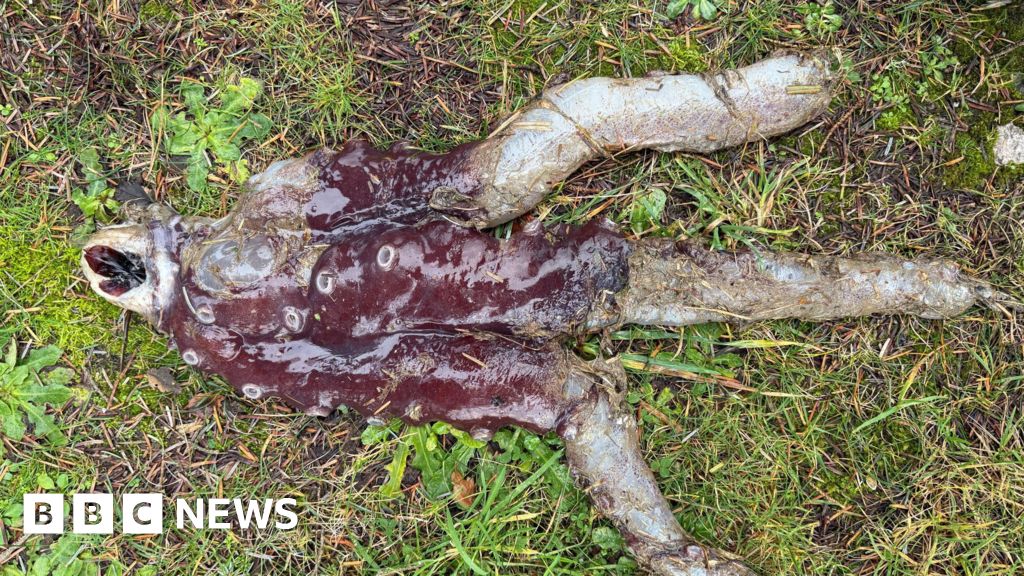
Further remains of an unusual deep-sea creature called a seven-arm octopus have been found on an Aberdeenshire beach.
Arms with rows of suckers were initially discovered by a member of the public at Forvie National Nature Reserve at Collieston, near Ellon, on 30 November.
Some detective work by conservationists led to the animal being identified as a septopus, a species with eight arms like other octopus – but in males one of the arms is also a reproductive organ that they attach to females when mating.
More of the creature has now been recovered at the reserve – including its beak which is a hard mouth part used for crushing prey.
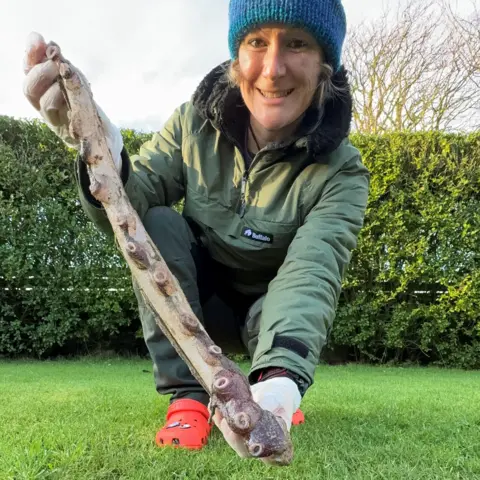 Dr Lauren Smith/East Grampian Coastal Partnership
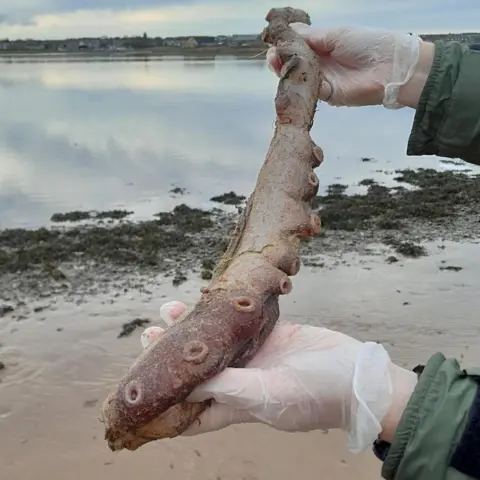 NatureScot
Dr Lauren Smith said the discovery at Forvie NNR was “incredibly rare” and samples have been taken for further study.
The discovery at Forvie in Aberdeenshire left wildlife enthusiasts mystified.
Marine biologist Dr Lauren Smith, of East Grampian Coastal Partnership, said the seven-arm octopus would be carefully preserved and studied.
Dr Smith said: “The level of interest has been truly incredible.
“Researchers and museums are interested in genome work, stable-isotope analysis and preservation of the specimens. Currently they are all in my freezer.”
Specimens are to be sent to the University of Aberdeen, Trace Wildlife Forensics Networks, National Museum Scotland and Natural History Museum London.
 Dr Lauren Smith
Octopus use their beaks to crush prey
The species live hundreds of metres below the surface of the sea and females, which are larger than males, can grow to 13ft (4m) long.
Dr Smith added: “There has been a lot of speculation as to how the remains ended up where they did.”
She said theories included it was captured accidentally by a trawler and then thrown overboard, or killed by a whale.
Another suggestion is that it became disorientated in shallower water and then was attacked by another animal.
Forvie NNR covers about 2,471 acres (1,000 ha) of sand dunes and heath between the North Sea and the estuary of the River Ythan.
The area is known for seals and also has the largest tern and black-headed gull colony in mainland Scotland.
Reserve staff described the arms as a rare find.