
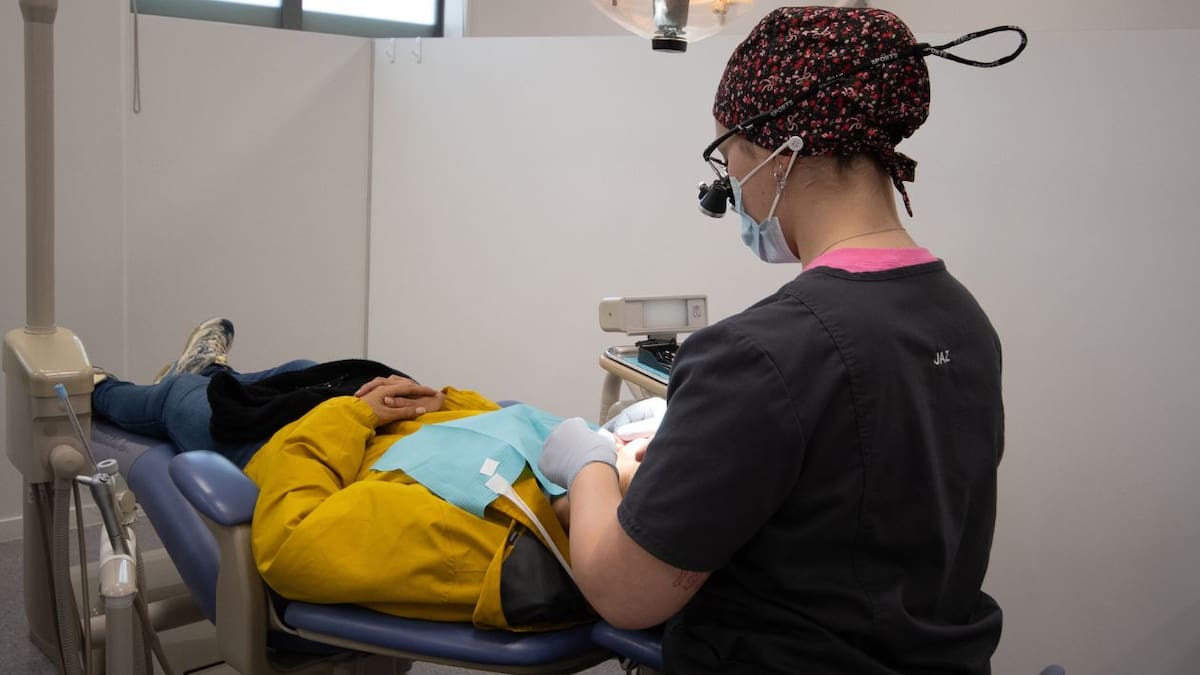
Max Harris, of Dental for All, joins a nationwide roadshow examining the consequences of an oral health system in decay.
It’s early morning on a chilly spring Sunday in Karitāne, a small coastal settlement 40 minutes north of Dunedin. Behind some old school buildings, about 15 people huddle in a
carpark and introduce themselves tentatively. Some cup their hands to their faces, finding warmth in the cold.
The group of volunteers are here to run a free dental day, co-ordinated by the University of Otago faculty of dentistry in partnership with rūnaka Kāti Huirapa Rūnaka ki Puketeraki and supported by the Dental for All campaign and Zaara Mobile Dental Services.
Lead organiser Samuel Carrington (Te Arawa, Ngāti Whakaue, Ngāti Hurungaterangi), an oral health therapist and academic, arrives and ushers the group into a disused school classroom. Volunteers set up a reception table and place dental chairs in each corner. In a small kitchenette, equipment is sterilised by two oral health professionals. The classroom morphs into an oral health centre.
Carrington gathers everyone for a karakia and explains how the day will proceed. One experienced dentist says he’s done this before: it will be hard work, but it will be fulfilling.
Patients have gathered outside and at 10am are shown into the classroom clinic. General oral health check-ups are being offered, as well as routine dental work such as filling cavities. Most people say they haven’t been to a dentist for some time because of cost.
The effects on health go well beyond the acute pain of tooth decay.
Some have travelled from Dunedin, others from Moeraki, 35 minutes north of Karitāne. There are parents with young children, university students, older people.
Today, their session and any treatment needed will be free. But for the rest of the year, adults in this country have to pay to have their teeth attended to unless it’s following an ACC-covered accident, treatment while in hospital, or they qualify for a Work and Income NZ grant of up to $1000 for “immediate and essential” treatment (including fillings, extractions and treatment for infection).
It has been this way since 1938, when New Zealand’s public healthcare system was set up by Michael Joseph Savage’s government. After successful lobbying by some dentists of the day, dental care was not included, and for over-18s has remained in the private sector ever since.
Almost half of New Zealand adults (44.9%) report unmet need for dental care due to cost, Tooth Be Told, a 2022 report commissioned by the Association of Salaried Medical Specialists, found.
And the 2021 New Zealand Health Survey found 40% of adults avoided going to the dentist in the previous 12 months because of cost. The percentage was higher for women, Māori and Pasifika people.
A quarter of a million New Zealanders every year have to have a tooth pulled out because the decay is so bad. Some survey respondents reported pulling their own teeth with a wrench when a tooth caused severe pain.
The 2024/25 New Zealand Health Survey showed high dental costs have a clear effect on our health, and it goes well beyond the acute pain of tooth decay, infections and abscesses. Research has shown tooth decay and gum disease have links with heart disease, respiratory illnesses such as pneumonia, dementia and other chronic conditions including cancer.
A New Zealand Dental Association survey in 2023 found the average cost of a composite filling had increased from $262 nationwide in 2020 to $308 in 2023. A University of Otago study published last year found that from 1978 to 2023, average fees for standard dental treatments increased by 75-236% while, adjusted for inflation, average earnings rose 46%. Anecdotally, prices have risen further in the past two years.
However, prices vary widely by postcode. In 2023, a check-up, X-ray, 15-minute clean and two composite fillings averaged $561 north of Auckland compared with $663 in Auckland, which is generally the most expensive place to get treatment. The cheapest places were provincial areas such as Taranaki, Hawke’s Bay, Central Districts and Gisborne ($529), and Marlborough, Nelson, South Canterbury and North Otago ($525).
Why the holes?
How did we get here? What brought a group of committed oral health workers out to a disused school on a chilly Sunday morning? Isn’t there a better way of approaching oral care in our healthcare system?
I attended the Karitāne free dental day as a member of the Dental for All team. I’m not an oral health worker so I spent most of the day making teas and coffees for the workers and chatting to people who were waiting for care.
My day job is mainly in law but I’m a part of the Dental for All campaign because I feel the pain of my friends when they can’t afford to go to the dentist. I’ve had a flatmate who couldn’t afford to have their braces removed, causing embarrassment and discomfort. And I’ve had life-saving surgery in our public healthcare system, so I know public health can turn lives around when it works right. It makes no sense to me that our teeth are excluded from it.
Dental for All was formed in 2022, a coalition of oral health workers (dentists and oral health therapists), unions, and frontline social service providers Auckland City Mission and Auckland Action Against Poverty and other advocates.
The 2022 Tooth Be Told report makes the case for universal dental care. It reported New Zealand adults had the highest unmet need among 11 comparable countries including Australia, the UK, the US, Canada and Germany. Hospital admissions relating to dental decay rose 31% from 2008 to 2019, to nearly 15,000 a year.
Tooth Be Told cited dental association research showing every dollar spent on dental care gets a return of $1.60, with the economic benefits estimated at $4.50 for every dollar spent.
Research compiled in November 2024 for Dental for All confirmed the current system is costing us all, not just in human but also in dollar terms. Using Treasury’s cost-benefit analysis tool CBAx, consultants Frank Group found the current dental system is costing (at a conservative estimate) $2.5 billion a year in lost productivity – that’s money spent on things like missed job interviews, or pain impairing people’s work. It is also costing, again conservatively, $3.1b in lost quality of life, including the mental health impacts of poor oral health, and the impact of poor dental health on participation in society.
When you compare these numbers to the cost of universal free dentistry – which in 2020 was estimated at $650m-$1.5b a year – it is clear the financial burden of the current system is higher than the cost of providing free dental care for all.
From top left: Auckland Action Against Poverty’s Agnes Magele, front, during a panel discussion at the Napier free dental day; The AUT University free dental day; Dental for All’s Kayli Taylor, left, and Hana Pilkinton-Ching serve kai at AUT; Max Harris, Taylor and Pilkinton-Ching during the roadshow. Photos / Luke Pilkinton-Ching
A political issue
A 2023 Talbot Mills poll for the Association of Salaried Medical Specialists found 74% of Kiwis support making dental care free, with 73% of National and Act voters backing the policy. Dental care was an issue at that year’s election, and Dental for All coalition member Hugh Trengrove was asked to put a question at one of the leaders’ debates. The Greens announced a costed policy for universal, public dental care. Labour unveiled a commitment to universal dental for under-30s, as a step towards fully universal dental. New Zealand First and Te Pāti Māori also had policies on expanding access to dental care.
The Dental for All coalition came to the conclusion that extending means-tested access to oral healthcare is not effective or fair. For example, the $1000 Winz grant is accessible only if a person’s income and savings fall below a relatively low threshold, and in commissioned research into experience of the current system, one respondent said applying for the grant for essential treatment was one of the most degrading experiences of their life.
Dental for All believes dental care should be universal and free, consistent with other essential healthcare such as hospital care, just as dental care is free for under-18s. Universal coverage across the system would build buy-in across the population: when everyone benefits, everyone is more willing to defend the system.
We believe a new delivery model must be consistent with Te Tiriti o Waitangi. A one size fits all approach to healthcare has consistently failed Māori, and Māori leadership is an effective way to get care to communities through iwi, hapū, marae and urban Māori authorities.
Dental for All believes dental care should be universal and free, consistent with other essential healthcare such as hospital care, just as dental care is free for under-18s.
Rinse and repeat
Dental for All is funded by the Clare Foundation, a progressive philanthropic foundation launched by former dentist Anna Stuck. Research done and goals agreed, we decided to hit the road, both to hear how dental issues are experienced across the country and to connect people with others who want to see change. We planned community town hall discussions, sought to support free dental days, and in other cases wanted to go to where communities were already meeting. That roadshow is what took us to Karitāne.
We made three trips between August and October. On our first trip, we started in Porirua, went through Wellington and made our way north, ending in Hamilton and Rotorua. The second trip went through the Far North, Whangārei and Auckland, moving across the Bay of Plenty to the East Coast and Hawke’s Bay. The third trip took in most of Te Wai Pounamu, through Invercargill, Dunedin, Christchurch and surrounding towns, then the West Coast and Nelson.
All too often, people turn to home remedies: pliers and fish wire were preferred home treatment.
As well as free dental days in Kāpiti, Auckland, Flaxmere, Karitāne and Invercargill, there were community panel discussions and conversations in an amazing range of venues: an RSA hall in Opononi, marae and iwi health trusts, a high school, a St John training building in Greymouth, youth and community centres, a university, a wānanga, a church, the Auckland City Mission base Homeground, the old Blackball Hilton pub in Blackball, the historical heart of the labour movement.
Across these diverse locations attendees had strikingly similar stories. The cost of treatment was turning people away from dental care, leaving them living with pain. All too often, they had to turn to “home remedies” – and the same were mentioned from Auckland to Whanganui to Wānaka: clove oil, salt water or paracetamol to keep the pain at bay. Pliers and fish wire were preferred home equipment.
We heard that the free dental service for under-18s – split now into a children’s dental service up to year 8 and an adolescent service from year 9 via contracted dental practices – has been run down. In two centres on the East Cape, we heard mobile dental clinics hadn’t visited since the pandemic.
With dental care largely out of the public system, there is no accountability for this run-down service. What we heard reflected what we learnt from the Tooth Be Told report.
No one tried to defend the approach our country takes to oral healthcare. Oral health therapist Lateisha Chant (Rangitāne o Wairau, Ngāti Kuia, Ngāti Apa ki te Rā Tō) spoke in Porirua about how the cut-off for care at 18 was splitting up families. She said adults regularly visited her service to ask if their teeth could be checked alongside their children’s.
A dentist in the south reported that older people in aged-care homes couldn’t access the Winz grant because they had money set aside for their funerals, which meant they had too much in savings to access the grant.
Dr Gary Payinda referred to harrowing cases of serious oral health problems in intensive care in Whangārei, which could be avoided if people were able to access care earlier.
Auckland City Missioner Helen Robinson said hundreds of thousands of people, perhaps more, go without genuine access to oral healthcare, “and it hurts us”.
Te Ao Mārama Aotearoa Māori Dental Association co-tumuaki Leeann Waaka said: “When systems are shaped without Māori, they fail Māori. Te Tiriti o Waitangi must guide how we rebuild a better future together, because our people deserve this.”
High school student Jamin Fountain said, pithily, “Gaps in our system create gaps in our teeth.”
Auckland City Missioner Helen Robinson.
Locals act
We saw, however, that people are committed to change. We set out on the roadshow to float the idea of local organising groups. In all 25 locations we went to, people wanted to sign up to a local group to fight for change, sometimes in large numbers.
In Opononi, population 264, 40 people attended a community discussion and about 15 signed up to be part of a group.
These groups will now reconvene, advocate locally and ramp up pressure for universal, free, te tiriti-consistent dental care in the lead-up to the 2026 election.
Sometimes, people queried whether dental care was a matter of personal responsibility. Agnes Magele, co-ordinator of Auckland Action Against Poverty, who attended about half the roadshow, rejected this. What gets seen as neglect, says Magele, is really individuals making impossible choices and sacrifices to provide for their family with limited income.
And we heard it is difficult for families to develop habits and good oral health practices when the adults can’t build a relationship with a dentist because of the cost barrier.
The number of places for dentistry at Otago University has not expanded for decades.
Others questioned whether there was sufficient workforce to expand oral healthcare provision. At the University of Otago faculty of dentistry, we heard the number of places for domestically funded dentistry has not expanded above 60 for decades despite population growth. According to the World Health Organisation, New Zealand in 2022 had 5.1 dentists per 10,000 people, compared with 6.4 per 10,000 in Australia, 4.9 per 10,000 in the UK, 6.5 per 10,000 in Canada, and 9.7 per 10,000 in Finland.
We also heard oral health therapists are being underused and it would help if they could be supported to complete the “adult scope of practice” component of training, either through financial support to complete the postgraduate course, or integrating the course into undergraduate study, as happens in Australia. Oral health therapists do work previously done by dental therapists and dental hygienists; dental therapists (previously called dental nurses) and dental hygienists also still operate in their own right.
Oral health therapists can do a lot of what dentists do, including extractions of primary teeth and fillings, but their scope of practice limits certain activities to under-18s. They can carry out some adult treatment, however, such as the treatment of periodontal (gum) disease for all ages.
Dentists align
We were also asked what the views are of the Dental Association, which represents the profession. We’ve met with the association, and members of its leadership team attended events on the roadshow. Its recently published plan “Roadmap towards better oral health” addresses a range of issues, including access to care.
Parts of the plan align with Dental for All’s commitments: universal health coverage, equal access to oral health services for all and considering adult dental care as a human right. It notes, “There is no sensible reason for oral health issues not being considered as part of general health.”
However, the association says although it supports universal health coverage, this “does not suggest free coverage for all health interventions, regardless of cost, as this is not sustainable”.
Its policy director, Robin Whyman, said in a recent interview the association supports free dental care being extended to 18-24-year-olds, but has not yet supported going further.
Māori-led care
On our road trip, we saw across the country that Māori health providers, in particular, are already moving to deliver oral healthcare – often for free – for community members. In an event we held at the Ngāti Hine Health Trust in Whangārei, the trust’s chief executive announced it was reopening its dental service. Other services in the Far North and on the East Coast are scoping oral health provision options.
Emeritus Professor John Broughton, co-founder of Te Ao Mārama /the Māori Dental Association, spoke of the need for a network of community clinics and mobile dental services across the motu.
Broughton was also instrumental in the funding of a pilot Māori oral health service under a National-led government in the late 1990s. As a member of the then-Māori Health Commission, Broughton (Ngāti Kahungunu Ki Heretaunga, Ngāi Tahu) presented then-Māori affairs minister Tau Henare with an action plan, Oranga Niho. It was simple: a dentist and dental therapist working together as part of an existing Māori provider.
Henare supported the proposal, funding was provided in the 1999 Budget, and a contract for the new service was awarded to Te Taiwhenua o Heretaunga in Hastings. But successive governments have not built on these foundations.
Accessible care is provided in the oral health clinic at Auckland University of Technology, and in clinics at Otago’s dentistry faculty in Dunedin, which does more than 60,000 patient treatments a year, as well as in some community oral health centres, such as the Canterbury Charity Hospital.
These services fall short of nationwide care, even if momentum does appear to be building in Māori-led and community oral healthcare.
When the UK’s National Health Service was set up in 1948, free basic dental care was included in the scheme. The NHS was built following the example set by Welsh local health services. Could the New Zealand oral health service follow a similar path, building on local, often Māori-led, momentum?
One way of thinking about Dental for All is as a fix to a glitch programmed into our public healthcare system from the start.
Ring of confidence
Back in Karitāne, it’s late afternoon and the volunteers begin to wrap up their work. Patients leave the makeshift clinic with relief written on their faces, sometimes even smiles. It’s a vivid reminder of how closely connected oral health is to a person’s confidence. Children who’ve been playing on the lawn outside make their way, reluctantly, back to cars to head home. Inside the clinic, the oral health workers are tired but buoyed by the day – 21 adults have been seen and treated.
The day closes with karakia, and the dental chairs and equipment are packed up. The whole day – with ease of access, all members of a family treated together, committed oral health workers in a safe and welcoming venue – is a glimpse of a world to come, which could yet be within our grasp.
One way of thinking about Dental for All is as a fix to a glitch programmed into our public healthcare system from the start. It’s repair work: filling a gap in the system that should never have been left there. But maybe a better way of thinking about it is more positive: it’s a realisation of the promise of public healthcare in 1938 that was never completely implemented. It continues the work of the founders of our welfare state – work that was never quite finished.
Max Harris is a barrister who works part-time at ActionStation on the Dental for All campaign. Additional reporting by Dental for All’s Hana Pilkinton-Ching and Kayli Taylor.
SaveShare this article
Reminder, this is a Premium article and requires a subscription to read.
Copy LinkEmailFacebookTwitter/XLinkedInReddit