
For Cambodia, this represents the loss of over $3 billion USD in annual worker remittances, a critical source of income for household economies.
Tourism along the Trat, Chanthaburi, Sa Kaeo, and Ubon Ratchathani borders has been designated a “Conflict Zone,” leading foreign insurers to revoke travel coverage.
This has resulted in a decisive slump for the final quarter, with cancellation rates during the peak high season approaching 100 per cent.
Geopolitical Friction and the Lost Gas Prize
The crisis has been significantly intensified by the involvement of global powers. The United States, under President Donald Trump, deployed “Tariff Diplomacy,” threatening an initial 36 per cent tariff on Thai and Cambodian exports unless a ceasefire was implemented.
China, meanwhile, has been actively manoeuvring to preserve and extend its regional influence, framing the conflict as a flashpoint for geopolitical competition.
The greatest, yet least-discussed, casualty is the Overlapping Claims Area (OCA) in the Gulf of Thailand, which both nations had planned to develop jointly.
The indefinite suspension of the 2001 Memorandum of Understanding (MOU) has postponed any hope of tapping the immense natural gas resources, conservatively valued at over 10 trillion baht.
This project’s stagnation, alongside the uncertainty, risks a mass outflow of Foreign Direct Investment (FDI) from newer industrial sectors, such as Electric Vehicles (EVs) and digital technology, where Thailand is already competing fiercely with Vietnam.
Future Scenarios
Analysts have outlined two dominant future scenarios:
Protracted Conflict: Regardless of any short-term ceasefires, border crossings are likely to remain shut for a sustained period. This would permanently damage trade, downgrade bilateral relations, and risk the conflict becoming a chronic, low-level military confrontation.
Renewed US Pressure: A fresh wave of intervention by the US may see them use the indefinite suspension of trade negotiations and the application of new trade tariffs to compel both nations back to the negotiating table, leading to a new, yet inherently fragile, ceasefire agreement.
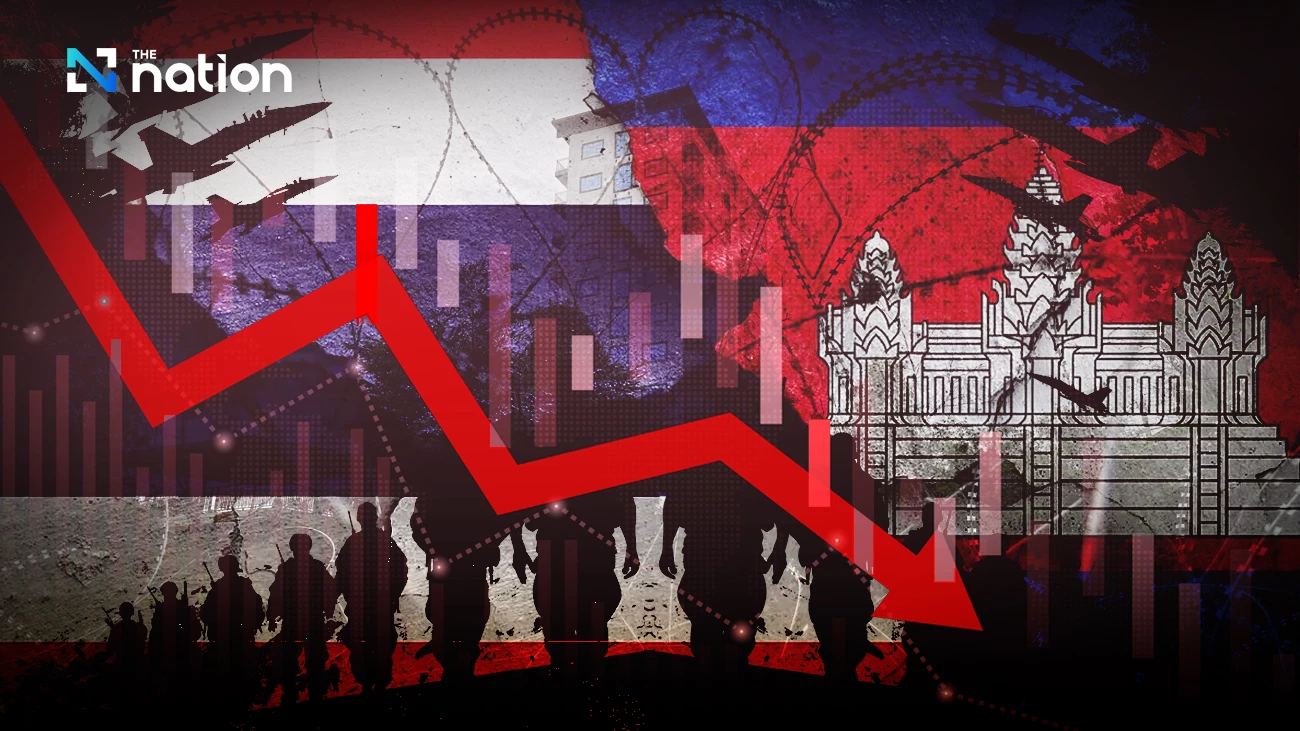
The war has unequivocally demonstrated that the economic fates of Thailand and Cambodia are more profoundly linked than previously acknowledged.
The border problem no longer stops at the frontier; it is fundamentally shaking the economic stability and security of both nations. The restoration of peace is therefore not a political option but an urgent economic necessity.