
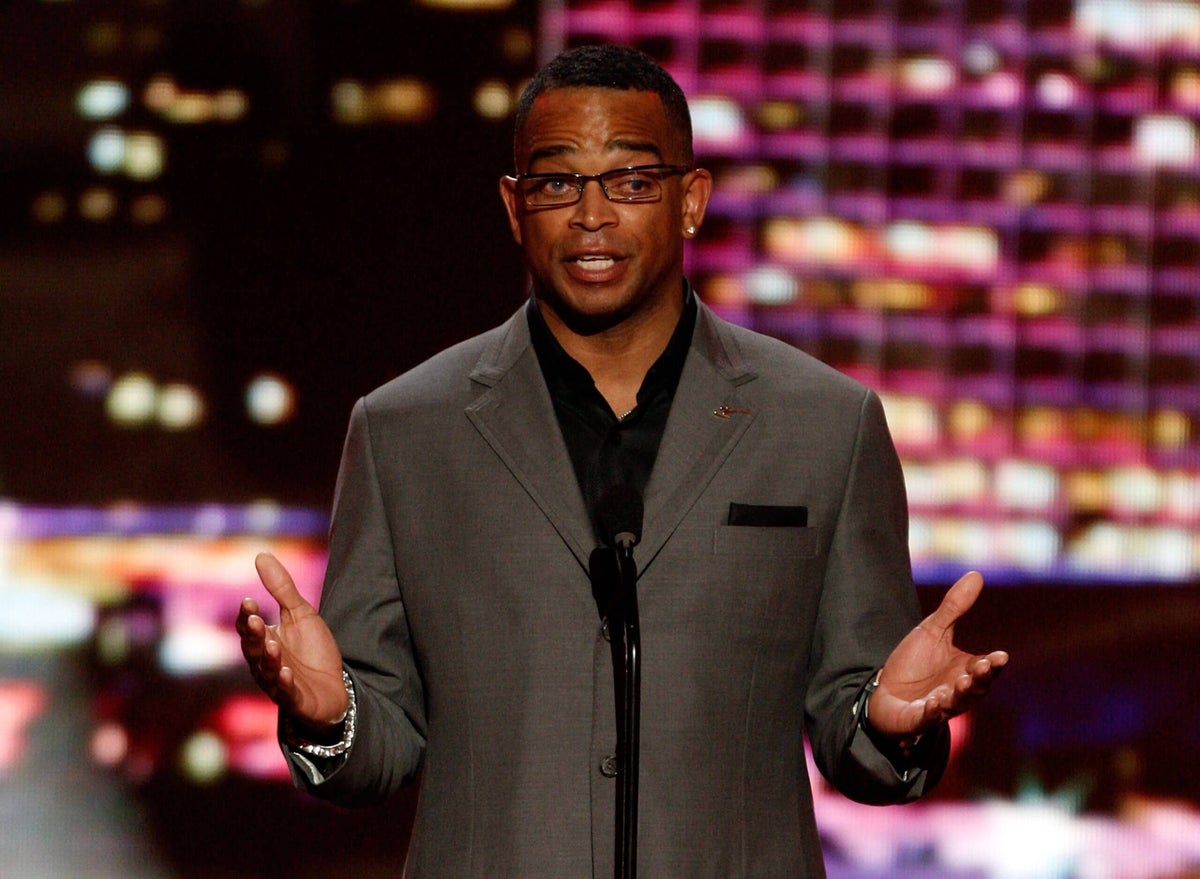
Stuart Scott was a pioneering sportscaster who changed the broadcasting business with his personality. Scott, who died Jan. 4, 2015, at 49 after a seven-year battle with cancer, is often remembered for his hip-hop style and catchphrases such as “Boo-Yah,” “Hallah” and “Just call Michael (Jordan) butta’, ’cause he’s on a roll,” to name a few.
Nevertheless, his story goes deeper than a few catchphrases. ESPN announced Nov. 20 that the network would produce a “30 for 30” documentary, “Boo-Yah: A portrait of Stuart Scott,” on Scott’s life, which airs Wednesday at 9 p.m. (ET).
Andre Gaines, who has produced biographical documentaries about Dick Gregory, Jackie Robinson and Jesse Owens, directed and produced the film. Like most directors, Gaines likes to make longer films, but understood the limitations of his assignment well thanks to a large amount of video and photo files.
Gaines and his crew had 300-400 hours of Scott’s personal archive, over 1,000 ESPN broadcast archives and 6,000-8,000 photos from Scott’s ex-wife, friends, family and colleagues who offered to be part of the film. That challenge made the documentary rewarding to work on and to see as a finished product.
“I want folks to laugh. I want folks to cry. I want folks to really understand the power of perseverance,” Gaines told The Athletic. “Cancer was the last battle of Stuart’s life, but he had many battles leading up to it.
“There’s a lot of different challenges that once you see the totality of those experiences from start to finish, the audience would really understand him a lot better and sympathize and in many cases empathize with what he went through.”
Scott burst onto the broadcasting scene with an authentic voice and style in the late 1980s after graduating from North Carolina. His unique voice is central to the film. He paved the way for many sports broadcasting personalities, such as Jemele Hill, Chris Broussard and Stephen A. Smith, who also brought their cultural identities in front of the camera.
“We kind of take for granted that authenticity and being yourself and speaking your truth are the types of things that we expect from our television personalities,” Gaines said. “But that really wasn’t the case when Stuart was first starting out, and it was something that he ushered into existence.
“What we see now that we take for granted just didn’t exist when he came onto the scene, and that’s what I hope that the audience takes away, a thankfulness for his sacrifices.”
Here are three takeaways from the film:
Bringing culture to sport
The documentary reveals Scott’s rise through the sportscasting industry and the impact of mixing Black culture and sports with personality. The background of Scott’s verbiage is on display. His wording isn’t always proper, but that’s his intent. It was something that resonated with athletes and viewers who shared his skin color.
The film reveals Scott’s struggle to accelerate at ESPN, which used his personality and culture on the network’s “second service,” ESPN@2, to target “younger audiences.” When the show “SportsNight” only lasted a few years, his segment “SportsSmash” was nixed. The film reveals Scott’s struggles to reach ESPN’s “SportsCenter” as an anchor, as executives struggled with his personality and outfits.
After Scott covered the 1996 Olympic bombing at Centennial Park in Atlanta, he eventually earned his opportunity to co-host “SportsCenter” — but he had to follow the news structure ESPN executives wanted.
Barriers drove Scott toward success
Scott moved from suburban Chicago to Winston-Salem, N.C., when he turned 7 and faced racial barriers from when he was a kid. He felt an “array of emotions” as he prepared for college graduation, and he was told by a news director that he “sucks and would never make it in this business.” The comment motivated him.
Scott’s freshman year at North Carolina was in 1984, Michael Jordan’s last season with the Tar Heels. Kenny Smith — who is among over 30 interviewees in the film, ranging from family to coworkers and players — mentions how Scott always felt he could fit in with Jordan and the basketball guys.
Scott’s first job out of college came in 1987. In the film, he references that he was “po” — not “poor” — and how he didn’t have air conditioning in his apartment. He flipped his pillow over, and it was cool, which later led him to using the phrase “as cool as the other side of the pillow” on television.
ESPN2 launched in 1993, targeting younger audiences, and producers brought in Scott because “he was different.”
A persevering finish
The film concludes by highlighting two critical details of the adversity Scott faced, beginning with an eye injury he suffered at New York Jets camp in April 2002. Later, the film jumps to Scott’s battle with appendix cancer. Between a voiceover of his day-to-day treatments and his mindset behind them, and from the initial diagnosis phone call to his ex-wife and kids, the film portrays Scott’s perseverance.
It also reveals footage of the various ways Scott fought cancer — including shooting hoops with former President Barack Obama and even anchoring “SportsCenter” in between treatments.
Scott was presented with the Jimmy V Award at the 2014 ESPYs, and the documentary closes with his fight with cancer, a tear-jerking wrap-up to an inspiring film.