
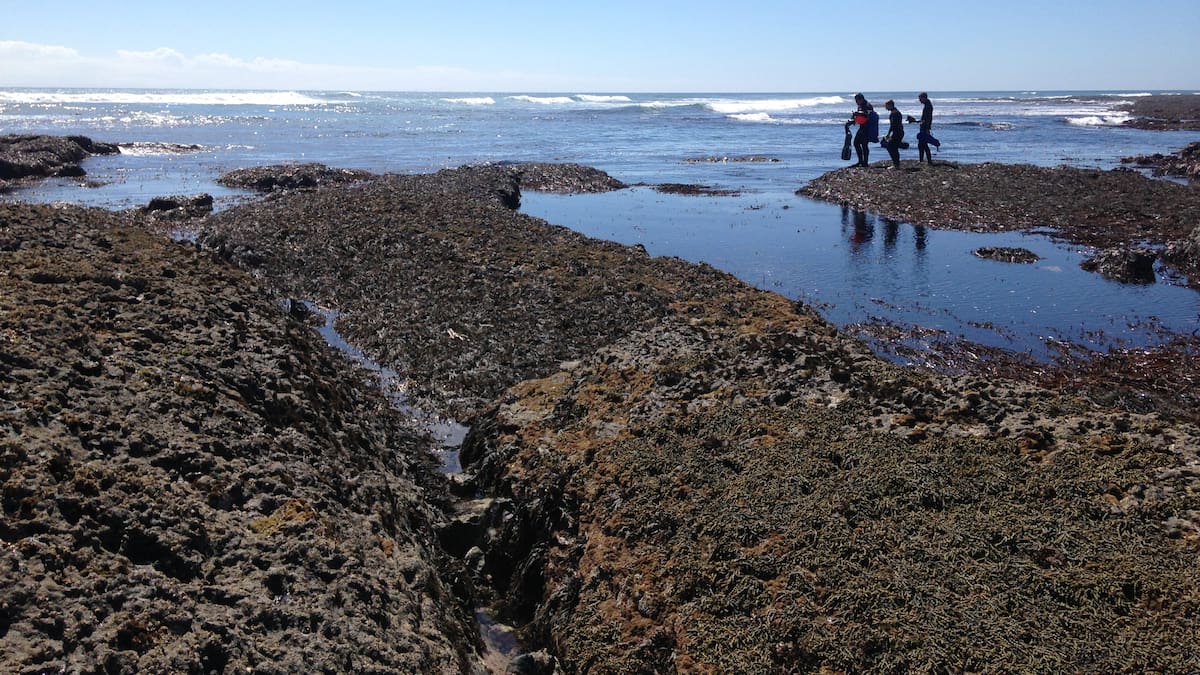
Local kaitiaki Reuben Taipari said there had been cases of customary permits being issued for up to 400 pāua, which was far too many from an area that covers only about 3km of coastline around Tauroa Point.
Kaumātua Haami Piripi leads a karakia at Patito, Ahipara, to mark a rāhui on gathering pāua from the area.
Taipari said concerns about the huge number of pāua being taken had been ongoing for years, but it was now time for all parties ‘to get together to work on a solution’.
The rāhui confirms the community’s earlier proposal to implement a temporary closure under section 186A of the Fisheries Act 1996, aimed at restoring pāua stocks and safeguarding customary rights for future generations.
The Minister of Fisheries, Shane Jones has endorsed the rāhui, recognising the strength of partnership between government agencies, hapū, and iwi, and the importance of innovative, community-led approaches to marine sustainability.
There was unanimous support at the Wainui Marae hui to implement the rāhui immediately.
A ritual ceremony was conducted at Patito by local kaumātua Haami Piripi, who delivered a karakia in the presence of more than 30 attendees.
A hui at Wainui Marae on November 30 implemented a rāhui on gathering pāua around Tauroa, in the Far North.
Speaking on behalf of the collective, local kaumātua John Paitai emphasised the urgency of preventing the local extinction of pāua and reaffirmed the significance of Māori customary practices that enable whānau to gather kaimoana responsibly.
While kaumātua led the kaupapa, the strong participation of knowledgeable rangatahi brought a renewed sense of optimism for the long-term future of the fishery and the wider coastal environment.
Taipari closed the proceedings by confirming increased monitoring efforts, improved collaboration between partners, and enhanced data sharing, which will help deepen understanding of pressures on the pāua fishery and support the development of a broader suite of management solutions.
The hui was marked by unity, positivity, and collective determination. With widespread support from stakeholders, the rāhui signals a meaningful step toward “pāua to the people” – ensuring the species can thrive once again for current and future generations, spokeswoman Lisa McNab said.
An MPI spokesperson said traditionally, tangata whenua protected their fisheries resources when they were under pressure.
Far North leaders Haami Piripi, John Paitai and Patau Tepania.
‘‘Under tikanga Māori, rāhui are respected. Adherence to a rāhui is voluntary and generally well supported.
“To provide statutory support for their rāhui, tangata whenua may request a temporary closure under section 186A of the Fisheries Act, which can be for up to two years.
“Fishery officers will enforce a temporary closure (under section 186A of the Fisheries Act 1996) once approved.”